
When you’re wrestling with the persistent ache, stiffness, or radiating pain of degenerative disc disease (DDD), you know just how much it can steal from your life. Simple things like sitting at your desk, playing with your kids, or even just enjoying a walk can suddenly feel like monumental tasks. For many in Cedar Park and the surrounding areas, it feels like the only options are to either mask the pain with medication or start considering invasive procedures like injections and surgery.

But there’s another path—one we specialize in at Bell District Spine and Rehab. As a trusted local chiropractor serving patients in Cedar Park, TX, our clinic is built around non-surgical solutions that get to the real source of your discomfort. Led by Dr. John Tuggle, we believe that truly effective care shouldn’t just quiet the symptoms; it should restore function and give you the power to live a full, active life again.
We created this guide to cut through the noise and give you a clear, honest comparison of all your treatment options. We’ll walk through everything from conservative care to surgery, helping you understand the real-world pros and cons of each. Our mission is to arm you with the confidence to make the best decision for your health right here in our community.
Your Treatment Options at a Glance
Navigating the world of DDD treatments can feel overwhelming. To make it simpler, we’ve organized the primary approaches into three distinct categories. Each one has a different goal, level of invasiveness, and is suited for a different type of patient. Getting a handle on these differences is the first step toward finding the right path for your recovery.
| Treatment Approach | Primary Goal | Invasiveness Level | Best For Patients Who… |
|---|---|---|---|
| Conservative Care | Restore function, relieve nerve pressure, reduce inflammation, and promote natural healing. | Non-Invasive | Want to address the root cause of pain and avoid drugs or surgery. |
| Interventional Pain Management | Provide temporary relief from severe inflammation and pain to allow for physical therapy. | Minimally Invasive | Are experiencing acute pain flare-ups that prevent them from participating in rehabilitative care. |
| Surgical Intervention | Permanently alter the spine to create stability or replace a damaged disc. | Highly Invasive | Have severe nerve compression or instability that has not responded to any conservative treatments. |
At Bell District Spine and Rehab, our philosophy is simple: start with the safest, most effective, and least invasive options first. This patient-first approach ensures you receive the right care at the right time, minimizing risks and maximizing your potential for a full recovery.
So, What Exactly Is Degenerative Disc Disease?
Let’s clear the air on this one first. The term “degenerative disc disease” (DDD) sounds pretty scary, right? It brings up images of a condition that just gets worse and worse. But here’s the reality: it isn’t a “disease” in the way you might think. It’s a term we use to describe the natural, age-related wear and tear on your spinal discs. It’s the result of a lifetime of moving, lifting, and living.
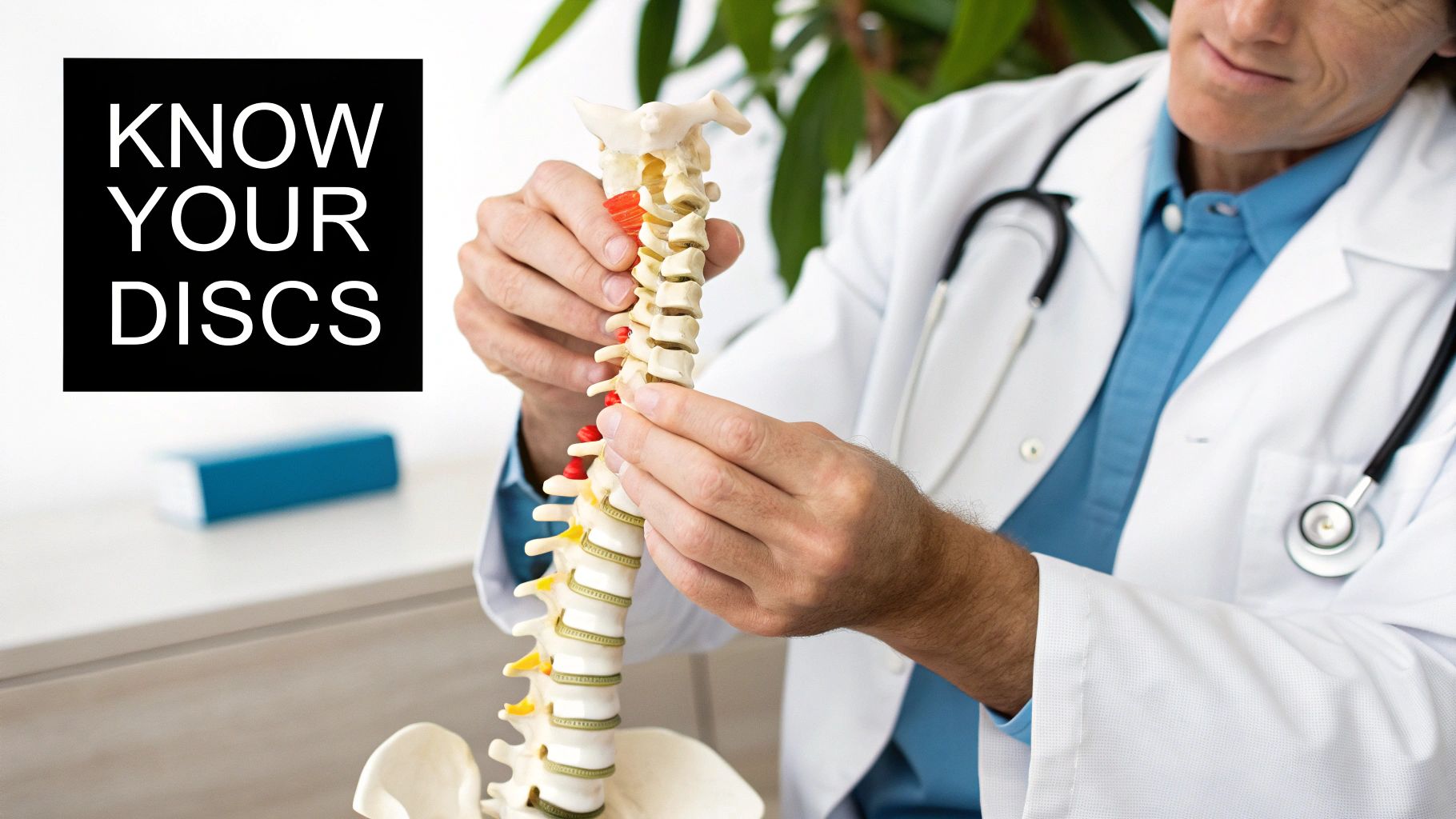
Think of your spinal discs as the gel-filled shock absorbers sandwiched between your vertebrae. They’re built to handle immense pressure. But over time, they can start to lose water content, thin out, and become less flexible—kind of like a tire slowly losing air.
What’s Happening Inside Your Spine?
When a disc starts to degenerate and lose height, the space between your vertebrae shrinks. This is where the trouble really begins. It’s not just about the disc itself; this change sets off a chain reaction that puts a ton of stress on the surrounding joints, nerves, and muscles.
For many of our patients here in Cedar Park, this process triggers some very familiar symptoms:
- A Stubborn Ache in Your Back or Neck: This isn’t just temporary soreness. It’s that nagging, persistent pain that can be a dull throb or a sharp, debilitating ache, often getting worse when you bend or sit for too long.
- Pain That Shoots Down Your Arms or Legs: Ever feel a sharp, electric jolt travel from your back down your leg? That’s often a sign that a thinning disc is crowding a nerve root. When it involves the sciatic nerve, we call it sciatica—a classic sign of trouble in the lower back that we see frequently at our Cedar Park clinic.
- Certain Positions Make It Worse: Many people find that sitting for long periods is excruciating. In fact, sitting can increase the load on your lumbar discs by up to 40%! The pain might ease up a bit when you’re walking or lying down, only to flare up again when you twist or lift something.
- Muscle Spasms and a Feeling of “Giving Out”: When the spine loses its natural cushion, the muscles around it have to work overtime to provide stability. This can lead to painful spasms and a frightening feeling of instability, as if your back could just give way.
How These Symptoms Hijack Your Life
For folks in Cedar Park and the surrounding communities, especially those with desk jobs or who love an active lifestyle, these symptoms can completely sideline you. Suddenly, you’re thinking twice before picking up your kids, skipping your weekend hike, or struggling to get a decent night’s sleep. The wear and tear might be a natural process, but the pain it causes is absolutely not something you have to just grit your teeth and endure.
The pain from degenerative disc disease is more than just a symptom; it’s a warning light. It’s your body telling you that the fundamental mechanics of your spine are compromised. Our goal isn’t just to turn off the light, but to fix the engine causing it.
Recognizing these signs for what they are is the most important first step you can take. When you understand what’s going on inside your body, you can start looking for treatments that do more than just mask the pain. Finding the best treatment for degenerative disc disease starts with digging deep to find the root cause—and that’s exactly where we begin at Bell District Spine and Rehab.
Comparing Your Degenerative Disc Disease Treatment Options
Living with degenerative disc disease can feel like standing at a crossroads with confusing, conflicting signs. You know you have options, but figuring out which path is right for you requires a clear-eyed look at their goals, methods, and what they demand in terms of recovery. For our patients here in Cedar Park, the choice usually boils down to three main avenues: conservative care, interventional pain management, and surgery.
Each of these approaches has a fundamentally different philosophy. At Bell District Spine and Rehab, we will always champion a conservative, non-surgical path first because it’s designed to correct the underlying mechanical problems driving your pain. In contrast, interventional methods focus on managing severe symptoms to provide temporary relief, while surgery is reserved for permanently altering the structure of your spine. Let’s break these down to see how they really stack up.

Path 1: The Conservative, Function-First Approach
This is the cornerstone of effective, long-term DDD management. Conservative care includes treatments like chiropractic adjustments, physical therapy, and advanced modalities like non-surgical spinal decompression. The entire approach is built on one simple principle: helping the body heal itself by addressing the root cause of the pain.
The goal here is to restore proper spinal mechanics, reduce inflammation naturally, and relieve pressure on the compromised discs and nerves. Instead of just silencing the alarm bells (your symptoms), this approach works to improve how your spine actually moves and functions, building a foundation for lasting relief.
Key Insight: Conservative care isn’t a passive treatment. It’s an active partnership between you and your provider focused on restoring function and building resilience, making it the ideal starting point for the vast majority of DDD cases.
As a chiropractor in Cedar Park, TX, Dr. Tuggle uses this exact approach to help patients avoid dependency on medication and more invasive procedures. The recovery is gradual and cumulative, with improvements building over time without the risks and downtime that come with surgery. This is hands-down the best place to start when symptoms are manageable and there are no signs of severe neurological deficits.
Path 2: The Interventional Pain Management Bridge
When you hear about interventional pain management, it typically means injections like epidural steroid injections or nerve blocks. It’s critical to understand that these treatments are not designed to “fix” the degenerated disc itself. Their job is to deliver a powerful, targeted dose of anti-inflammatory medication directly to the problem area.
Think of this path as a temporary bridge. When pain is so severe that you can’t even think about participating in rehabilitative care like physical therapy or chiropractic, an injection can calm things down enough to make that work possible. The relief can last anywhere from a few weeks to several months.
However, injections are purely a symptom-management tool. They don’t address the underlying spinal instability or mechanical issues causing the disc to break down in the first place. While minimally invasive, they do carry risks, and their effects are always temporary.
Path 3: The Surgical Last Resort
Surgical intervention is the most invasive option on the table and should only be considered a last resort. It’s typically reserved for cases where conservative treatments have failed to provide meaningful relief or when there are clear signs of progressive neurological damage, like worsening muscle weakness.
The main surgical options are spinal fusion, which permanently joins two or more vertebrae together, and artificial disc replacement. The goal is to stabilize the spine or permanently remove the source of nerve compression.
While surgery can be highly effective for the right candidate, it’s a major decision that comes with significant risks—infection, long recovery periods, and the potential for “adjacent segment disease,” where the vertebrae above and below the fused level wear out faster. It’s a procedure that fundamentally and irreversibly alters your body’s mechanics.
Head-to-Head: Comparing Treatments for Degenerative Disc Disease
To help you see the differences side-by-side, we’ve put together a table comparing these approaches based on the factors that matter most when you’re making a decision.
This table provides a high-level overview of how each approach fits into a comprehensive care plan.
| Treatment Approach | Primary Goal | Invasiveness Level | Ideal Candidate Profile | Typical Recovery Period | Long-Term Outlook |
|---|---|---|---|---|---|
| Conservative Care (Chiropractic, Decompression) | Restore function, relieve nerve pressure, promote healing. | Non-Invasive | Patients with mild to moderate pain seeking to address the root cause and avoid drugs or surgery. | Gradual improvement over weeks; no downtime. | Excellent, focuses on sustainable health and preventing recurrence. |
| Interventional Pain Management (Injections) | Provide powerful, temporary relief from severe inflammation and pain. | Minimally Invasive | Patients with acute pain flare-ups that prevent participation in rehabilitative care. | A few days of soreness; relief may take days to set in. | A temporary solution; does not address the underlying problem. |
| Surgical Intervention (Fusion, Disc Replacement) | Permanently stabilize the spine or replace a damaged disc. | Highly Invasive | Patients with severe nerve compression or instability that has not responded to all other treatments. | 3-12 months or more; significant rehabilitation required. | Can be very effective for the right candidate, but carries risks and alters spinal mechanics permanently. |
Seeing the options laid out like this makes it clear why starting with the least invasive, most function-focused approach is almost always the right first step.
At Bell District Spine and Rehab, our focus is squarely on that first column. We use state-of-the-art therapies like non-surgical spinal decompression, which gently creates negative pressure inside the disc to help it rehydrate and heal. You can discover spinal decompression therapy benefits in Cedar Park in our detailed guide on the topic. By combining this method with precise chiropractic adjustments and targeted rehabilitative exercises, we help guide patients toward recovery without ever needing to consider more aggressive interventions.
Why a Conservative Approach Should Come First
When you get a diagnosis like degenerative disc disease, it’s easy to think a big problem needs a big, dramatic solution. But for the vast majority of people, the most effective—and sustainable—path to relief starts with conservative, non-surgical care. The philosophy here is simple but powerful: we have to address the cause of the pain, not just slap a band-aid on the symptoms.
At Bell District Spine and Rehab, this is the core principle that guides every treatment plan we build for our Cedar Park patients. We focus on restoring function and empowering your body’s own incredible healing processes. This approach lets you sidestep the risks, downtime, and permanent changes that come with more invasive procedures.
The goal isn’t just to make you feel better for a week. It’s to fundamentally improve how your spine moves and handles load for the long haul. By fixing the mechanical issues that led to the disc breakdown in the first place, we can provide lasting relief and help you avoid future flare-ups.
Restoring Health to Damaged Discs
A degenerated disc is essentially a starved disc—it’s dehydrated, compressed, and deprived of the nutrients it needs to stay healthy. Our first job is to reverse that hostile environment. We do this by combining advanced, non-invasive therapies that work together to create the ideal conditions for healing.
Non-Surgical Spinal Decompression: This is a cornerstone of our treatment for DDD. Think of it as creating a gentle vacuum inside the disc. This computer-controlled therapy creates a negative pressure that helps suck water, oxygen, and nutrients back into the disc, kickstarting the rehydration and repair process. It’s a precise way to give the disc room to breathe and heal.
Class IV Laser Therapy: Deep tissue inflammation is a huge source of pain in DDD. We use Class IV laser therapy to send specific wavelengths of light deep into the affected tissues. This light stimulates cellular activity, which speeds up healing, dials down inflammation, and provides significant pain relief without any medication.
By combining these powerful tools, we directly target both the compromised disc and the inflamed tissues around it. This integrated strategy ensures we aren’t just chasing pain, but actively making your spine healthier. And on a related note, sometimes simple changes make a big difference; optimizing your sleep by finding the best mattress for back pain can also dramatically help with daily comfort.
The Role of Chiropractic Adjustments
While high-tech therapies work on the disc itself, we also have to correct the faulty spinal mechanics that caused the problem to begin with. This is where chiropractic adjustments are absolutely critical. Dr. Tuggle, a trusted back pain chiropractor in Cedar Park, uses precise adjustments to get stiff or misaligned spinal joints moving properly again.
Getting those joints moving right is crucial for a few key reasons:
- It takes abnormal stress off the discs.
- It relieves pressure on nearby nerves.
- It helps calm down muscle tension and spasms.
Think of it this way: if your car’s alignment is off, the tires will wear out unevenly. Similarly, if your spinal alignment is compromised, your discs bear an uneven load, accelerating their degeneration. Chiropractic adjustments correct that alignment, protecting your discs from further damage.
This comprehensive strategy hits the problem from every angle—the disc, the inflammation, and the spinal mechanics.
A Real-World Example in Cedar Park
Let’s look at a common scenario we see all the time at our clinic: a professional from a nearby community who spends hours commuting and sitting at a desk. They come to us with chronic low back pain and sciatica that’s starting to mess with their work and family time. They’re worried they’re on a fast track to injections or even surgery.
Instead of jumping to those invasive options, we start with a smart, conservative plan. We use spinal decompression to take the pressure off their lumbar discs, followed by laser therapy to calm the deep inflammation irritating their sciatic nerve. Dr. Tuggle then performs gentle chiropractic adjustments to restore healthy motion to their lower back and pelvis.
Within just a few weeks, the radiating leg pain starts to disappear, and the constant backache begins to fade. From there, we introduce specific exercises to strengthen their core and fix their posture. This patient not only gets relief but also learns how to keep the problem from coming back—all without a single needle or incision. That’s the power of a conservative, function-first approach.
When to Consider Injections or Surgery for DDD
While the vast majority of our patients at Bell District Spine and Rehab find lasting relief through conservative care, we know there are situations where degenerative disc disease demands a more aggressive approach. For our Cedar Park neighbors dealing with this condition, it’s critical to understand when injections or surgery shift from a distant possibility to a necessary conversation.
Interventional therapies, like epidural steroid injections, are not a long-term fix for DDD. Think of them as a temporary bridge. When inflammation is so severe that it’s impossible to even start the necessary rehab, an injection can be a game-changer. It delivers powerful anti-inflammatory medication directly to the source of the pain, calming a major flare-up and opening a crucial window of opportunity.
That window is when we can effectively use treatments like chiropractic adjustments and spinal decompression to address the underlying mechanical problems. But make no mistake: injections only mask the symptoms; they don’t heal the disc. They’re best used strategically to get over a significant pain barrier, not as a recurring treatment.
Identifying the Red Flags for Surgical Consultation
The decision to see a surgeon is a serious one, and it should only happen after all conservative options have been given a fair shot. As a dedicated back pain chiropractor in Cedar Park, a huge part of Dr. Tuggle’s job is helping patients recognize the “red flags” that mean it’s time for a surgical evaluation.
These warning signs almost always involve a progressive loss of nerve function. Here’s what to watch for:
- Worsening Muscle Weakness: If you notice your leg or arm strength is steadily declining—making it hard to walk or grip things—that’s a clear sign of significant nerve compression.
- Loss of Sensation: Growing numbness in your limbs or, more urgently, a loss of feeling in the “saddle” area (inner thighs and groin) requires immediate medical attention.
- Loss of Bowel or Bladder Control: This is a medical emergency. It points to severe compression of the spinal cord (a condition called cauda equina syndrome) and requires urgent surgical intervention.
- Intractable Pain: Sometimes, the pain is simply unbearable. If it doesn’t respond to any conservative or interventional treatments and is destroying your quality of life, surgery may be a valid option.
This decision tree helps visualize how we approach treatment, emphasizing that invasive options are reserved for when conservative care just isn’t enough to get the job done.
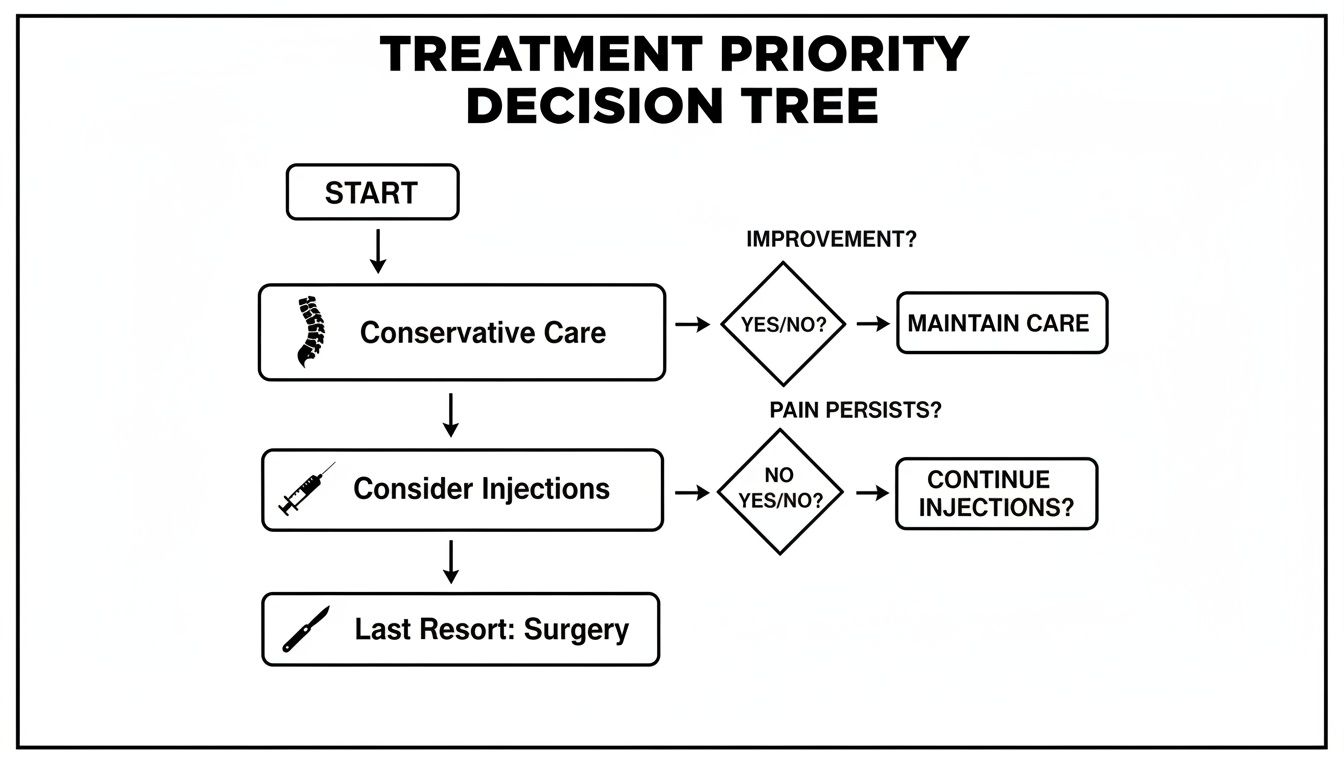
As you can see, the standard of care is to start with the safest, least invasive options first. We only move down the line when absolutely necessary.
An Honest Look at Surgical Options
When surgery becomes the right choice, the two main procedures are spinal fusion and artificial disc replacement.
Spinal fusion is exactly what it sounds like: the surgeon permanently joins two or more vertebrae to stop painful motion. In contrast, disc replacement involves removing the damaged disc and putting a prosthetic device in its place that preserves movement.
Both are major operations with significant risks, including infection, hardware failure, and long, grueling recovery periods. Fusion, in particular, has a known long-term side effect called adjacent segment disease, where the vertebrae above and below the fused area wear out faster because they’re taking on extra stress.
Recent advancements in artificial disc replacement have shown really promising results. For the right candidate, minimally invasive disc replacement surgery often has better success rates than traditional fusion. In fact, clinical trial data showed success rates of over 87% for disc replacement compared to 81% for fusion. A huge advantage is the much shorter recovery—disc replacement patients are often home from the hospital in just 2-4 days. You can dig into more of the data on disc replacement surgery success rates on minimallyinvasiveneurosurgerytexas.com.
Surgery should always be the absolute last resort after every other avenue has been exhausted. Our commitment at Bell District Spine and Rehab is to provide Cedar Park patients with the most effective non-surgical care possible, helping them avoid the operating room and reclaim their lives through a safer, function-first approach.
Ready to Take Control of Your Recovery in Cedar Park?
Your journey away from degenerative disc disease starts with a single, informed step. As this guide has shown, a personalized and conservative treatment plan isn’t just an option—it’s often the safest and most effective starting point for managing your pain and getting your life back.
For those of us in Cedar Park and the surrounding areas, Bell District Spine and Rehab provides that expert, non-surgical care. As a trusted chiropractor in Cedar Park, TX, Dr. Tuggle is focused on getting to the root cause of your pain, not just chasing the symptoms.
What to Expect When You Visit Our Cedar Park Clinic
We believe recovery is a partnership. Your treatment plan is built around your specific condition, your body, and your lifestyle goals. This ensures the care you get is not only effective but sustainable for the long haul. Our non-invasive methods are all designed to help you regain mobility and live without that constant, nagging discomfort.
The goal isn’t just to feel better temporarily—it’s to build a foundation for long-term spinal health. By addressing the underlying mechanics, we help you prevent future flare-ups and reclaim the active life you deserve.
We invite you to schedule a consultation with Dr. Tuggle to see how therapies like spinal decompression and chiropractic adjustments can help you find lasting relief without resorting to drugs or surgery. Our team is here to help you understand all your options so you can make the best choice for your health.
You can learn more about how we address the underlying causes of disc pain in our detailed guide on disc injury pain relief in Cedar Park.
Contact our clinic today. It’s time to start your journey toward a healthier, more active future and stop letting pain dictate the terms of your life.
Common Questions About DDD Treatment
When you’re dealing with the pain of degenerative disc disease, you’re bound to have questions. It’s completely normal. To help you feel more confident about your path forward, we’ve put together answers to some of the most common questions we hear from our patients right here in Cedar Park.
Can Chiropractic Care Actually Fix a Degenerated Disc?
This is a great question, and the honest answer is that we can’t make a worn disc new again. No one can. However, chiropractic care is exceptionally effective at managing the condition and its symptoms.
Our goal is to restore proper spinal motion, take the immense pressure off that damaged disc and the surrounding nerves, and naturally decrease inflammation. This comprehensive approach is why so many of our patients find significant pain relief and improved function, allowing them to get back to their lives and often avoid more invasive procedures down the road.
How Soon Will I Feel Results from Your Treatments?
Every person’s body and recovery timeline is unique, depending on factors like the severity of the disc degeneration and your overall health. That said, most of our patients at Bell District Spine and Rehab start to feel a noticeable difference within the first few treatment sessions.
During your initial consultation, Dr. Tuggle will lay out a personalized plan that gives you a clear and realistic idea of what your recovery journey will look like.
Is Spinal Decompression Therapy a Painful Procedure?
Not at all. In fact, most people find it incredibly relaxing. Spinal decompression is a very gentle and controlled therapy. You’ll be comfortably secured to a specialized table that applies a precise, light stretching force to your spine.
The process is so comfortable that it’s not uncommon for patients to drift off to sleep during their session. It’s widely considered one of the safest and most pleasant non-surgical treatments for disc-related pain.
Patient Experience Insight: The feeling during spinal decompression is often described as a mild, relieving stretch in the back or neck. There is no pain involved; the technology is designed for comfort and safety, ensuring a positive therapeutic experience.
Will My Insurance Cover Treatment for Degenerative Disc Disease?
Most insurance plans do provide coverage for chiropractic care and related therapies for conditions like degenerative disc disease. Our dedicated team in Cedar Park will gladly verify your benefits and explain your coverage to you in simple terms before you begin treatment.
We are committed to making care affordable and accessible for everyone in our community. No surprises, no hidden fees.
At Bell District Spine and Rehab, we believe you deserve a clear path to recovery. If you’re ready to find lasting relief from degenerative disc disease without drugs or surgery, contact us today to schedule your consultation.