

Living with the sharp, radiating pain of a herniated disc is an exhausting experience, and if you’re in Cedar Park, TX, finding the right treatment is your top priority. The truth is, the best place to start is almost always with non-surgical chiropractic care. Our goal at Bell District Spine and Rehab is to relieve that intense nerve pressure using conservative methods like chiropractic adjustments and spinal decompression without jumping straight to invasive procedures. Surgery absolutely has its place, but it’s typically reserved for severe cases where other options haven’t brought relief.
Your Guide To Herniated Disc Relief In Cedar Park
Whether it’s sciatica shooting down your leg from a back injury or a relentless ache in your neck and arm, a herniated disc can bring your life to a screeching halt. Simple things like sitting at your desk, taking a walk, or getting a good night’s sleep suddenly become monumental challenges. It’s no wonder so many people in our Cedar Park community start to worry that their only way out is through surgery. But for the vast majority, that simply isn’t the case.
At Bell District Spine and Rehab, we regularly see patients from Cedar Park, Leander, and across North Austin who are searching for lasting relief—without the risks and lengthy recovery of an operation. As your local chiropractor, our philosophy is straightforward: let’s start with the most effective, least invasive options first.

Comparing Your Treatment Options
Trying to figure out your next steps can be confusing. To help you see the landscape clearly, this guide breaks down the primary pathways for treating a herniated disc. We’ll walk through everything from advanced non-surgical therapies to traditional medical and surgical routes, giving you the information you need to make the best choice for your health.
| Treatment Pathway | Primary Focus | Ideal For |
|---|---|---|
| Non-Surgical Care (Chiropractic, Decompression) | Addressing the root mechanical cause of nerve pressure. | Most cases of herniated disc pain, including sciatica and radiculopathy. |
| Medical Management (Medication, Injections) | Managing symptoms like pain and inflammation. | Providing temporary relief to allow for participation in rehabilitative care. |
| Surgical Intervention (Microdiscectomy, Fusion) | Directly removing the disc material compressing a nerve. | Severe cases with significant neurological symptoms or pain unresponsive to conservative care. |
A Patient-First Philosophy in Cedar Park
Led by Dr. John Tuggle, who brings over 24 years of experience to the table, our clinic is focused on one thing: finding and fixing the root cause of your pain, not just masking the symptoms. As a trusted chiropractor in Cedar Park, our goal is to restore your body’s natural ability to heal itself.
We believe in empowering our patients with knowledge. Understanding your condition and the available treatments is the first step toward reclaiming your life from pain. Our commitment is to provide a clear path forward, reassuring you that a life with less pain is not only possible but within reach.
Think of this guide as your resource—a tool to give you clarity and confidence as you figure out the best treatment for your herniated disc.
So, Why Does a Herniated Disc Hurt So Much?
To figure out the best way to treat a herniated disc, it’s helpful to know what’s actually going on inside your spine. A spinal disc isn’t just a simple cushion; it’s a pretty sophisticated piece of natural engineering designed to absorb shock and let you move.
Think of it like a jelly donut. It has a tough, fibrous outer ring called the annulus fibrosus and a soft, gel-like center known as the nucleus pulposus. A herniation happens when a tear in that tough outer layer allows some of that soft inner gel to squeeze out.
This displaced material is the real troublemaker. It pushes past its normal boundaries and often presses directly on the highly sensitive spinal cord or the nerve roots branching out from the spine.
The Nerve Compression Problem
When that herniated disc material bumps into a nerve, it kicks off a painful chain reaction. The direct physical pressure, or impingement, is the most obvious source of pain. This compression messes with the nerve’s ability to send and receive signals correctly.
This is exactly why herniated disc symptoms are rarely just a simple backache. Instead, you feel symptoms all along the path of that irritated nerve. For example, a herniated disc in your lower back (lumbar spine) can press on the sciatic nerve, causing that classic sharp, shooting sciatica pain that travels down your leg. If you are looking for a sciatica chiropractor in Cedar Park, you’ve come to the right place.
Likewise, a disc issue in your neck (cervical spine) can trigger pain, numbness, or tingling that radiates into your shoulder, arm, and even down to your fingers, a common complaint our neck pain chiropractor helps with daily.
Inflammation: The Hidden Pain Amplifier
On top of the mechanical pressure, that escaped nucleus pulposus is also highly inflammatory. When this gel-like substance leaks out and touches a nerve root, it releases chemical irritants that cause serious swelling and inflammation.
This chemical irritation can be just as painful—if not more so—than the physical compression. It makes the nerve hypersensitive and overactive, causing it to fire off intense pain signals to your brain. This is a key reason why the pain can feel so severe and relentless.
Understanding this dual cause—mechanical pressure and chemical inflammation—is absolutely critical. Effective treatment has to address both. Just masking the pain with medication often fails because it does nothing to fix the underlying mechanical problem that’s causing the irritation in the first place.
When you’re dealing with back discomfort, it’s important to distinguish between muscle soreness and actual pain, as the latter can signal a more serious issue like a herniated disc.
Why Your Symptoms Keep Changing
The location and type of symptoms you feel depend entirely on which nerve is being compressed and how badly it’s being affected. This explains why the experience can vary so much from one person to the next.
- Pain: Can feel like anything from a dull ache to a sharp, burning, or electric shock sensation.
- Numbness or Tingling: Often described as “pins and needles” in the area the nerve supplies.
- Muscle Weakness: If the nerve controlling a muscle is compressed, you might notice weakness, like trouble lifting your foot (a condition called foot drop) or a weakened grip.
This is the foundational science behind why non-surgical treatments offered at our Cedar Park clinic, like spinal decompression and chiropractic adjustments, are so effective. They are specifically designed to take that mechanical pressure off the nerve, which in turn reduces inflammation and restores proper spinal function, allowing your body to finally heal.
Chiropractic Care vs. Surgery for Herniated Discs
When you’re staring down the intense, radiating pain of a herniated disc, figuring out the next step can feel completely overwhelming. The two main roads—conservative, non-surgical chiropractic care and surgical intervention—are worlds apart in their approach, risks, and what recovery looks like. Making the right choice for you starts with a clear-eyed look at what each path actually involves.
For the vast majority of patients we see here in Cedar Park, starting with a non-surgical approach isn’t just a preference; it’s the clinically recommended first step. This strategy is all about fixing the underlying mechanical problem—the pressure on your nerve—without invasive procedures, giving your body the space and support it needs to do what it does best: heal.
Surgery, on the other hand, is a direct intervention. Its goal is to physically remove the piece of the disc that’s compressing the nerve root. While it can be incredibly effective in the right situation, it’s typically held in reserve for cases where conservative care hasn’t brought enough relief or when severe neurological symptoms are present.
The Chiropractic Approach: A Focus on Healing
The entire goal of chiropractic care is to create the perfect environment for your body to heal itself. Therapies like the ones we offer at Bell District Spine and Rehab are designed to methodically and gently reduce nerve pressure, calm inflammation, and bring proper function back to your spine.
This isn’t just about chasing symptoms; it’s about correcting the root cause. By decompressing the spine and improving its alignment, we help the bulging disc material retract, giving that irritated nerve the room it needs to finally calm down and repair.
This visual guide shows the typical journey, from the initial injury to the decision points for treatment.
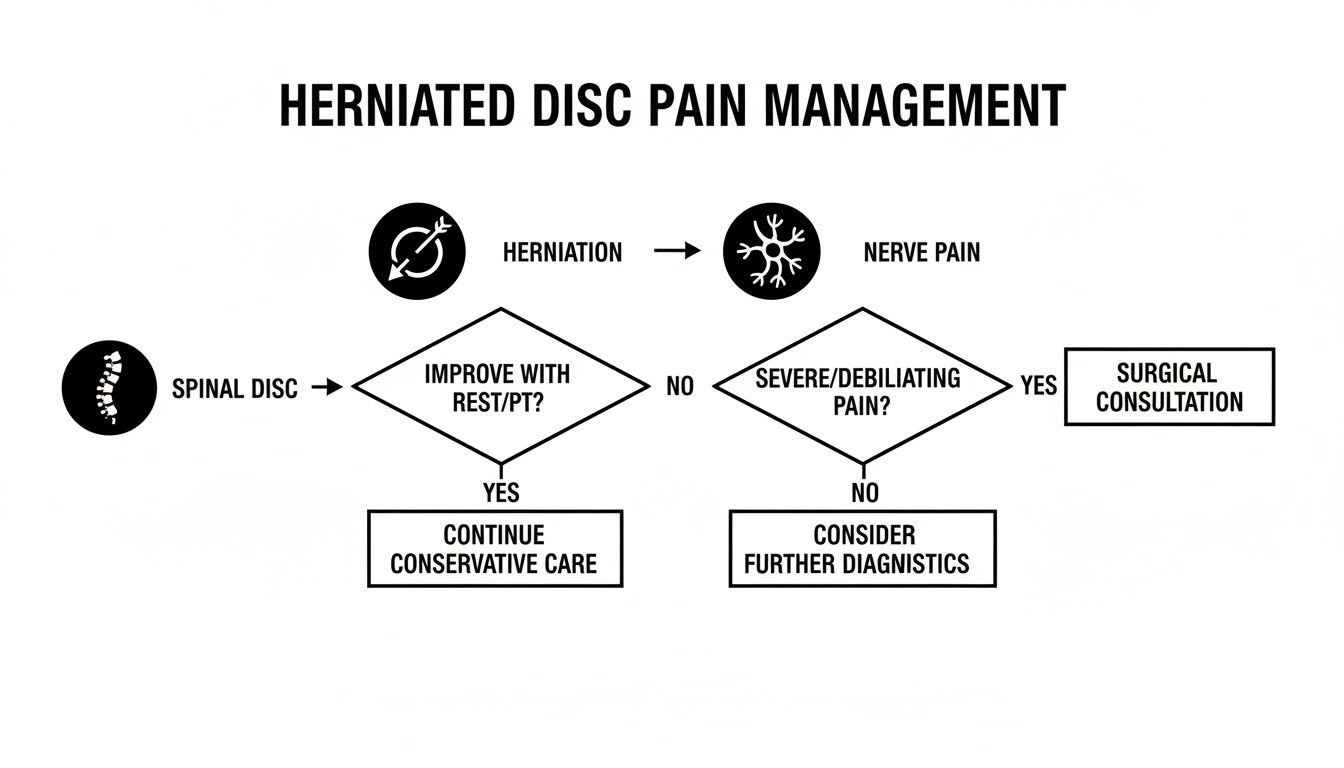
As you can see, the path often begins with a herniated disc causing nerve pain, which brings you to a crossroads where you have to decide between conservative care and more invasive options.
The Surgical Approach: A Direct Intervention
Surgery for a herniated disc, like a microdiscectomy, involves an orthopedic surgeon or neurosurgeon making an incision to get to the spine and physically remove the disc fragment that’s pushing on the nerve. It’s an incredibly precise procedure and is considered the gold standard for providing rapid relief when nerve compression is severe.
The main advantage of surgery is how immediate the decompression is. By removing the offending material directly, the pressure on the nerve is relieved almost instantly. But that comes with the inherent risks of any surgery, including infection, complications from anesthesia, and a much longer recovery period.
The decision to have surgery should never be taken lightly. It’s a powerful tool, but it’s best used when the benefits clearly outweigh the risks—and only after less invasive options have been given a fair shot.
Herniated Disc Treatment Comparison Guide
To help you really weigh your options, let’s put these two paths side-by-side, focusing on the factors that matter most to our patients here in Cedar Park and Leander. This table breaks down the key differences to guide your thinking.
| Treatment Approach | Primary Goal | Typical Success Rate | Risks & Considerations | Ideal Candidate |
|---|---|---|---|---|
| Non-Surgical Chiropractic Care | Reduce nerve pressure & inflammation to let the body heal itself. | High; 70%+ avoid surgery. | Very low risk; temporary soreness is the most common side effect. | Most people with herniated disc pain, including sciatica. |
| Surgery | Physically remove disc material that is compressing the nerve. | 80-95% for rapid pain relief in ideal candidates. | Standard surgical risks (infection, nerve damage, anesthesia) & potential for failed back surgery syndrome. | Those with severe, progressive neurological symptoms or intractable pain that hasn’t responded to 6+ weeks of conservative care. |
| Injections (ESI) | Deliver powerful anti-inflammatory medication directly to the nerve root. | 50-70% for temporary pain relief (weeks to months). | Risks include infection, nerve injury, and temporary increases in blood sugar or blood pressure. | Patients needing short-term, potent pain relief to tolerate physical therapy or bridge to another treatment. |
| Medication | Manage pain and reduce inflammation to improve function. | Variable; provides symptom relief but doesn’t fix the mechanical issue. | Side effects from NSAIDs (stomach issues) and nerve pain meds (drowsiness); risk of dependency with opioids. | Used in the early, acute phase to manage symptoms and allow engagement in other therapies. |
Ultimately, a multi-faceted conservative approach often yields the best long-term results by addressing the root cause without the risks of more invasive procedures.
Effectiveness And Patient Outcomes
The million-dollar question is: which approach actually works better? The answer really depends on the individual case, but the evidence overwhelmingly supports starting with conservative care.
Did you know that non-surgical treatments are often so effective they can help you sidestep surgery entirely? A major European clinical trial published in the Spine Journal found that a minimally invasive injection therapy, similar in its drug-free philosophy to the treatments we use, was just as good as microdiscectomy for pain relief. The results were stunning: an impressive 71% of patients completely avoided surgery.
Furthermore, large-scale analyses show that similar interventional therapies have pain relief success rates ranging from 62.5% to 88%, with adverse event rates under 1%.
Making The Right Choice For You
Choosing the best treatment for a herniated disc is a personal decision, one you should make in partnership with a healthcare provider you trust. At Bell District Spine and Rehab, Dr. Tuggle uses his extensive experience to help patients in Cedar Park understand their specific condition and all the options on the table.
For most people, the path forward begins with a consistent course of non-surgical chiropractic care. Therapies like spinal decompression are specifically designed to create negative pressure inside the disc, helping to gently draw the herniated material back where it belongs. To see how this powerful, non-invasive treatment works, you can learn more about spinal decompression therapy in our detailed guide.
This conservative-first approach just makes sense—it’s low-risk, it addresses the root of the problem, and it has a high rate of success. Surgery will always be a valuable option, but it’s a tool best saved for when your body truly needs that level of intervention.
Why Chiropractic Care Is The Preferred First Step
When you’re hit with the intense, debilitating pain of a herniated disc, the idea of a “quick fix” surgery can sound incredibly appealing. But here’s something years of clinical practice and patient outcomes have taught us: starting with a conservative, non-surgical approach is almost always the right move. For most of our patients here in Cedar Park, this is the best treatment for a herniated disc because it’s not only highly effective but also carries minimal risk, giving your body the chance to heal naturally without invasive procedures.
This isn’t about just waiting it out and hoping the pain fades. It’s an active, hands-on strategy designed to correct the mechanical problem that’s causing your symptoms in the first place. The goal is simple: create the perfect internal environment for your body to heal by taking pressure off the nerve, dialing down inflammation, and getting your spine moving correctly again.
How Our Chiropractor in Cedar Park Addresses The Root Cause
At Bell District Spine and Rehab, our non-surgical game plan is built on a foundation of proven, evidence-based therapies that work in concert to deliver lasting relief. Instead of just throwing medication at the problem to mask the pain, we focus on treatments that physically change what’s happening inside your spine.
Two of our cornerstone therapies for disc injuries are spinal decompression and chiropractic adjustments.
-
Spinal Decompression: This gentle, non-invasive therapy is an absolute game-changer for herniated discs. It works by creating a subtle negative pressure inside the disc—think of it as a vacuum effect. This helps gently pull the bulging or herniated material back into place and away from that pinched nerve. Just as important, this process floods the disc with healing nutrients, oxygen, and water to kickstart regeneration.
-
Chiropractic Adjustments: Precise adjustments are crucial for restoring proper movement and spinal alignment. When a disc herniates, the vertebrae around it can get stiff and dysfunctional, making everything worse. By correcting these misalignments, we reduce the mechanical stress on the injured disc and give the affected nerve even more breathing room.
This integrated approach is all about sustainable, long-term relief. We’re not just trying to calm down an irritated nerve; we’re fixing the reason it got irritated to begin with. You can learn more about how disc issues are often tied to overall spinal health in our guide to the best treatment for degenerative disc disease.
The Science Behind A Conservative-First Approach
The recommendation to start with non-surgical care isn’t just a hunch—it’s backed by a mountain of clinical evidence. Study after study shows that the vast majority of patients can achieve fantastic results and avoid the operating room entirely.
The data speaks for itself. Research on minimally invasive intradiscal procedures shows success rates hovering between 70-80%, while endoscopic methods achieve good or excellent outcomes in a staggering 81.8-91% of cases. A major review of multiple studies involving thousands of patients reported a 76% clinical success rate for one type of injection therapy. These numbers are right up there with the 70-90% success range often quoted for surgery, but they come with far fewer risks. You can read the full research on these non-surgical outcomes to see the data for yourself.
This is precisely why our approach at Bell District Spine and Rehab is so effective. By using advanced, non-invasive tools like spinal decompression, shockwave, and laser therapy, we can achieve outcomes that help our Cedar Park patients get back to their lives without resorting to surgery.
By focusing on treatments that amplify your body’s own healing powers, we help you reduce your reliance on pain medication and build a foundation for a healthier, more resilient spine. It’s a patient-first strategy that ensures you get the right care at the right time.
When Surgery Becomes A Necessary Consideration
The vast majority of herniated discs get better without surgery. But it’s just as important to know when surgery isn’t just an option, but the right option.
At Bell District Spine and Rehab, our philosophy is simple: we put you first. That means giving you the complete, unvarnished truth about all your treatment paths. We want every Cedar Park resident to know exactly when a surgical consultation is necessary, because your health and safety are the ultimate priority.
For most people, surgery only enters the conversation after a solid course of conservative treatment—usually at least six to eight weeks—fails to bring meaningful relief. However, some symptoms are so serious they completely change the timeline. These are the “red flags” that signal severe nerve compression requiring immediate medical evaluation.
Identifying Red Flag Symptoms
Recognizing these critical warning signs is non-negotiable for anyone dealing with a disc injury. These symptoms suggest a level of neurological trouble that conservative care simply can’t fix on its own.
Key red flags that demand an urgent discussion with a medical specialist include:
- Cauda Equina Syndrome: This is a rare but true medical emergency. Symptoms include loss of bladder or bowel control, numbness in the groin or “saddle” area, and severe weakness in both legs. If you experience these, go to an emergency room immediately.
- Progressive and Significant Muscle Weakness: This isn’t just feeling a little tired; it’s a noticeable and worsening weakness in a limb. A classic sign is foot drop, where you can’t lift the front of your foot, causing it to drag when you walk.
- Severe, Unrelenting Pain: We’re talking about excruciating pain that laughs at conservative treatments and makes it impossible to function in your daily life.
Understanding Surgical Outcomes
When surgery is the right call, it can be incredibly effective. Surgical procedures have been the standard for severe cases for a long time, and a massive analysis of over 39,000 patients gives us a clear picture of the results.
The study found that about 79% of patients achieve good or excellent long-term outcomes. A common minimally invasive procedure, microdiscectomy, boasts an even higher 84.3% success rate. For many of our patients in Cedar Park and North Austin, these numbers actually reinforce why starting with non-surgical care is the smartest first step. You can read the full analysis of surgical outcomes to dig into the data yourself.
Our commitment is to your best interest. We believe in empowering patients with all the facts, ensuring you understand that while non-surgical care is the preferred first choice for most, surgery plays a critical role for a specific subset of cases.
Ultimately, this is about finding the safest, most effective route back to your life. Our job as your trusted Cedar Park chiropractor is to provide an accurate diagnosis, deliver powerful non-surgical treatments, and give you honest guidance on when a referral to a surgical specialist is the best move for you.
Your Path To Recovery At Bell District Spine And Rehab
Dealing with a herniated disc is frustrating. The pain can feel unpredictable, and figuring out the right steps to take is often overwhelming. At Bell District Spine and Rehab, we cut through the confusion and walk with you every step of the way on a clear, patient-focused path back to health. Our goal is to give you confidence and control, starting from the moment you step into our clinic right here in Cedar Park.
Your recovery journey begins with a comprehensive one-on-one consultation and examination with Dr. Tuggle. This initial visit is where we truly listen. We want to understand your story—how the pain is affecting your work, your family, your life—and then perform detailed diagnostics to pinpoint exactly what’s going on.
A Treatment Plan Designed Just For You
Once we have a clear diagnosis, we throw cookie-cutter plans out the window. Dr. Tuggle designs a personalized treatment strategy built specifically around your condition, your body, and your health goals. This isn’t just one therapy; it’s often a powerful combination of our advanced, non-invasive treatments working in synergy to get you better, faster.
Your customized plan may include:
- Spinal Decompression Therapy to gently create space and relieve pressure on the angry disc and nerve root.
- Precise Chiropractic Adjustments to restore proper movement and mechanics to your spine.
- Advanced Laser or Shockwave Therapy to target inflammation deep at the cellular level and kickstart your body’s natural healing process.
What To Expect During Your Visits to Our Cedar Park Clinic
We know that coming in for treatment can be intimidating, so we make our therapy sessions as comfortable and reassuring as possible. We’ll explain what we’re doing and why every step of the way. For instance, a spinal decompression session is actually quite relaxing; you’ll just feel a gentle, controlled pull as the table works its magic on your spine.
Our goal is to create a supportive and educational environment. We empower you with knowledge about your condition and the healing process, making you an active partner in your own recovery.
We also recognize that healing doesn’t stop when you leave our office. Factors outside the clinic matter, especially when it comes to sleep. For anyone struggling with persistent pain, getting the right support at night is crucial. To help your body heal around the clock, you can learn more about choosing the best mattress for back pain.
Your search for a “chiropractor near me” in Cedar Park, TX, ends here. We are committed to helping you find real, lasting relief so you can get back to the life you love. Don’t let herniated disc pain control you for another day. Schedule your consultation with Bell District Spine and Rehab and take the first confident step toward a pain-free future.
Your Questions About Herniated Disc Treatment, Answered
When you’re dealing with the pain of a herniated disc, you’re bound to have questions. To help our Cedar Park neighbors feel more confident about their treatment path, we’ve put together some clear, straightforward answers to the most common concerns we hear at Bell District Spine and Rehab.
How Long Does a Herniated Disc Take to Heal Without Surgery?
While every person’s recovery journey is unique and depends on the injury’s severity, most of our patients see significant improvement within 6 to 12 weeks of consistent, non-surgical chiropractic care. The key is steady progress. Many people start feeling noticeable relief after just a few sessions of spinal decompression or chiropractic adjustments as we begin to take pressure off that pinched nerve.
Is Spinal Decompression Therapy Painful?
Absolutely not. In fact, most people find the sessions to be incredibly gentle and relaxing. You’ll feel a light, controlled stretching sensation in your back or neck as the computerized table gently creates negative pressure inside the disc. The entire system is built for comfort and safety—it’s not uncommon for patients to doze off during treatment.
How Do I Know if My Back Pain Is Actually a Herniated Disc?
While only a hands-on examination from a professional chiropractor can give you a definite diagnosis, a few key symptoms strongly point toward a herniated disc. The biggest clue is radiculopathy—that’s pain that shoots or radiates away from your spine and into an arm or leg.
It often feels like:
- Sharp, electric pain traveling down the back of your leg (classic sciatica).
- Numbness, tingling, or a “pins and needles” sensation in your arm, hand, leg, or foot.
- Noticeable weakness in certain muscles, like finding it difficult to lift your foot (a condition called foot drop).
If you’re experiencing any of these radiating symptoms, it’s a big red flag that a nerve is involved. A dull, localized ache in your back without these “traveling” symptoms is less likely to be from a disc herniation.
The only way to know for sure is to get a proper examination. A thorough diagnosis from an experienced chiropractor in Cedar Park, TX, like Dr. Tuggle, is the most important first step. It ensures you get on the right treatment path and don’t waste time on therapies that won’t work.
Don’t let pain and uncertainty run your life for another day. The team at Bell District Spine and Rehab is here to give you an accurate diagnosis and create a personalized, non-surgical treatment plan that gets to the root of the problem.
Take the first step toward real, lasting relief. Schedule your consultation today and find the best treatment for your herniated disc.