

Preventing sports injuries is a proactive, three-part strategy: understand your body’s unique mechanics, build a solid foundation of strength and mobility, and unlock your full potential by training smarter, not just harder.
It’s a blueprint that moves beyond a few simple stretches and into a comprehensive approach for building true athletic resilience. For athletes in Cedar Park, TX, this means staying in the game and performing at your best without the setbacks of pain and injury.
Your Blueprint for Peak Performance and Injury Prevention
Every athlete in Cedar Park, from weekend runners hitting the Brushy Creek trail to competitive high school players, shares a common goal: to perform at their best. But staying in the game means staying off the sidelines. If you’re dealing with back pain, neck pain, or a recurring sports injury, you know how frustrating it can be. As your local chiropractor in Cedar Park, we’re here to help.
This guide is your blueprint for smart injury prevention, offering real strategies that go far beyond generic advice. We’ll explore the core principles of proactive care and show you how understanding your body’s mechanics is the first, most crucial step toward building resilience. At Bell District Spine and Rehab, we see firsthand how easily preventable injuries can derail athletic goals, and our mission is to provide the care you need to stay active.
This simple framework illustrates the core idea: prevention moves from understanding your body to building resilience and, finally, unlocking peak performance.
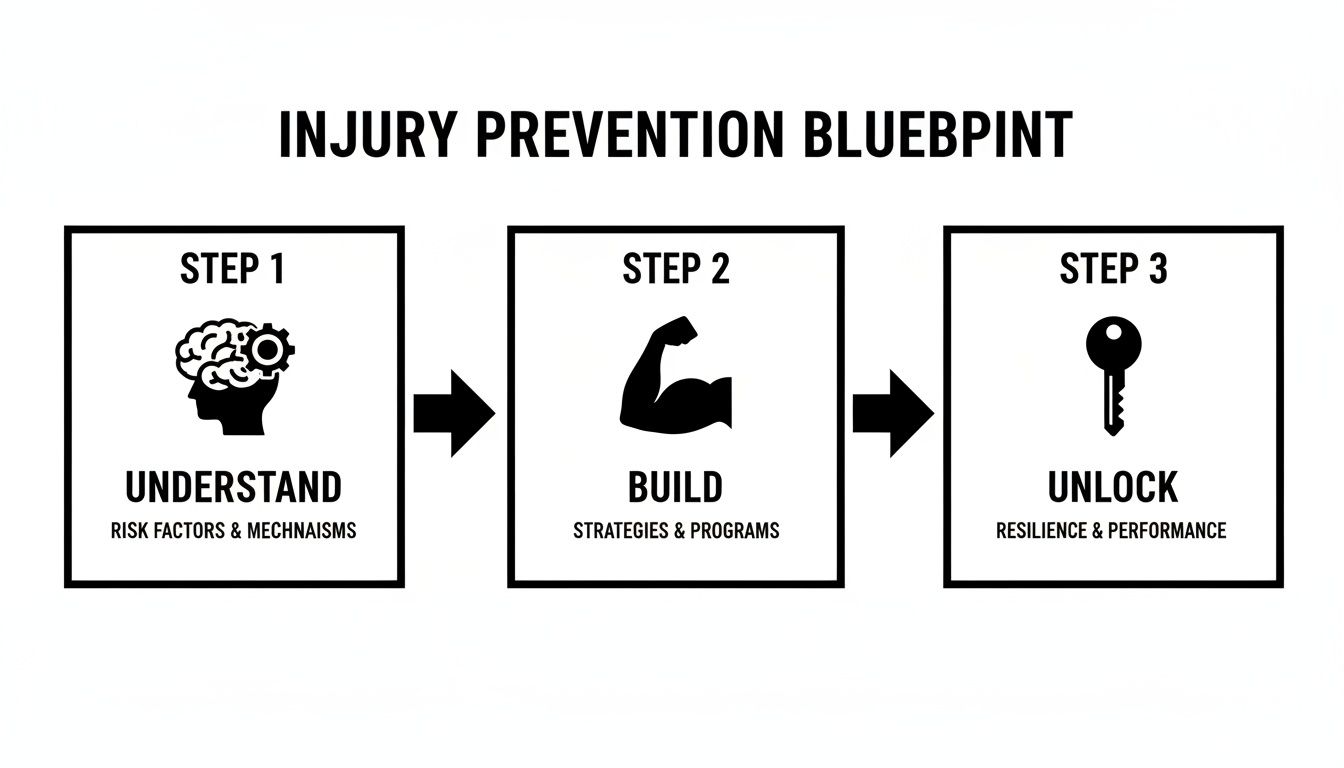
The key insight here is that prevention isn’t a one-and-done action. It’s a continuous cycle of learning, strengthening, and applying smart training principles. We’ll address the common concerns of local athletes in Cedar Park, Leander, and Austin, showing you how a smart prevention strategy doesn’t limit you—it unlocks your true potential, safely.
The Growing Focus on Proactive Care
The emphasis on staying healthy has never been greater. The global sports medicine market has seen remarkable growth, valued at approximately USD 7.30 billion and projected to hit USD 15.25 billion by 2033. This surge reflects a fundamental shift in how athletes and healthcare providers approach sports-related injuries—moving from reactive treatment to proactive prevention.
At Bell District Spine and Rehab, our philosophy mirrors this proactive shift. As your trusted chiropractor in Cedar Park, we believe the best way to treat an injury is to prevent it from ever happening. Our goal is to empower local athletes with the knowledge and tools to build a durable, high-performing body.
A Framework for Staying in the Game
This guide is built on a foundation of practical, actionable advice that any athlete can start using immediately. We will cover the essential pillars you need to construct a robust defense against common injuries. To lay out a solid foundation for avoiding injuries and maximizing your time on the field, our essential guide provides extensive football injury prevention tips that are applicable across many sports.
Here’s a quick look at the core strategic pillars we’ll be covering to help you build out your own robust injury prevention plan.
Core Pillars of Sports Injury Prevention
| Pillar | Focus Area | Why It Matters for Cedar Park Athletes |
|---|---|---|
| Resilient Foundation | Functional Strength & Core Stability | Protects joints from the high-impact demands of running on trails or playing on turf. |
| Unlocked Mobility | Dynamic Warm-ups & Mobility Routines | Prepares your muscles for the specific movements required in sports like soccer, tennis, or golf. |
| Smart Training | Load Management & Active Recovery | Prevents burnout and overuse injuries by balancing intensity with crucial rest periods. |
| Recognizing Red Flags | Injury Awareness & Seeking Help | Knowing when to push through soreness versus when to see a professional can be the difference-maker. |
By breaking down each of these areas, we’ll give you a clear, step-by-step approach to building a body that’s ready for anything you throw at it.
Building a Resilient Foundation with Strength and Stability
True injury prevention begins long before you step onto the field, court, or trail. The secret is building a resilient musculoskeletal system—one that can absorb unexpected impacts, generate explosive force, and maintain stability through even the most awkward movements.

This foundation is built through a smart, well-rounded strength and conditioning program. This is about functional strength, which acts as your body’s own internal armor, protecting you from common sports injuries.
The Core Is More Than Abs
When most athletes hear “core,” they immediately think of sit-ups. But a truly functional core is a complex web of muscles deep in your abdomen, lower back, pelvis, and hips. They must work together to stabilize your spine, creating a solid platform for every move you make.
A strong, stable core is your body’s central power station. It allows you to efficiently transfer force from your legs to your arms. When that connection is weak, other body parts—like your knees or shoulders—are forced to compensate, which is a fast track to strain and injury.
Take a runner in Cedar Park hitting the pavement on the Brushy Creek trail. They need a powerful core to keep their hips from dropping with every stride. Without that stability, the force travels down the leg incorrectly, often causing IT band syndrome or patellofemoral pain, better known as runner’s knee.
A stable core is the anchor for all athletic movement. It protects your spine, improves balance, and unleashes more powerful, efficient performance, dramatically cutting your injury risk.
Neuromuscular Control: The Brain-Body Connection
Being strong isn’t enough; your brain has to know how to use that strength in a split second. This is where neuromuscular control comes in. It’s your nervous system’s ability to coordinate muscle actions to produce smooth, efficient, and stable movements. It’s that instant communication telling your muscles how to fire to land a jump safely or pivot without twisting a knee.
Poor neuromuscular control is a hidden cause of many non-contact injuries. Think of a basketball player who lands awkwardly and sprains an ankle. Their muscles around the joint simply didn’t activate fast enough to protect it.
The good news is you can train this vital connection. It just takes the right drills:
- Balance Drills: Start with simple single-leg stands and work your way up to unstable surfaces like a foam pad or balance disc.
- Plyometrics: Think controlled jumping and landing drills. These teach your body to absorb and produce force explosively and safely.
- Agility Exercises: Ladder drills and cone drills are perfect for challenging your body to change direction quickly and efficiently.
Weaving these drills into your routine helps upgrade your body’s operating system. You’re training your nervous system to react faster, creating a more responsive and injury-proof body.
Personalized Plans for Cedar Park Athletes
A generic workout plan from the internet cannot account for your body’s unique history, movement patterns, and hidden imbalances. Following a cookie-cutter program can sometimes reinforce the very weaknesses that lead to injury.
This is where a professional evaluation changes the game. At Bell District Spine and Rehab, we use detailed movement analysis to pinpoint specific weaknesses and asymmetries in our Cedar Park patients. We watch how you squat, lunge, and move to identify areas of instability or poor mechanics that could become a problem.
From there, we build personalized exercise plans to correct these specific imbalances. For a runner, that might mean strengthening a weak gluteus medius to protect their knee. For a baseball player, it could be activating the small rotator cuff muscles to prevent a throwing injury. Understanding the many chiropractic adjustment benefits helps patients see how proper spinal alignment is a key piece of this strength puzzle.
Our approach ensures your body isn’t just strong, but functionally sound and ready for the unique demands of your sport. This personalized strategy is a cornerstone of any effective plan for how to prevent sports injuries and stay in the game for the long haul.
2. Unlocking Your Mobility with Dynamic Warm-Ups
Remember the old gym class routine of holding a few hamstring stretches for 30 seconds before a full sprint? Modern athletics demands a much smarter approach. How you prepare your body before you train or compete is one of the most critical factors in staying injury-free.
It all starts with a proper dynamic warm-up.

Unlike static stretching—where you hold a position for a long time—a dynamic warm-up uses continuous, controlled movements that get your body ready for action. Think leg swings, torso twists, and walking lunges. These motions are designed to wake up your nervous system, increase blood flow, and lubricate your joints for what’s coming next.
A key part of this preparation involves knowing how to warm up before lifting, which can dramatically reduce your risk of injury under the bar.
Mobility vs. Flexibility: What Cedar Park Athletes Need to Know
It’s easy to use the terms mobility and flexibility interchangeably, but they represent two different—and equally important—concepts. Understanding this distinction is key to a smart injury prevention plan.
- Flexibility is the passive ability of your muscles to lengthen. Think of a partner pushing your leg into a deep hamstring stretch.
- Mobility, on the other hand, is your ability to actively move a joint through its full, intended range of motion with control.
Here’s a real-world example: an athlete might be flexible enough to easily touch their toes but struggle to perform a deep, stable squat without their back rounding. That’s a classic case of good flexibility but poor mobility—a major red flag for potential injury.
At Bell District Spine and Rehab in Cedar Park, we focus on building functional mobility. We want to ensure your joints can move freely and that you have the strength to control that movement. This prevents the dangerous compensation patterns that lead to chronic issues like tendonitis and joint pain.
Why Dynamic Warm-Ups Are a Game-Changer
The evidence is clear: starting with dynamic movements offers huge advantages over static stretching, which is much better suited for your cool-down.
Key Benefits of a Dynamic Warm-Up:
- Wakes Up Your Nervous System: It improves the mind-muscle connection, enhancing coordination and reaction time.
- Increases Core Body Temperature: Warm muscles are more pliable and far less susceptible to strains and tears.
- Boosts Blood Flow: It delivers crucial oxygen and nutrients to working muscles, improving performance.
- Improves Active Range of Motion: Actively moving your joints through their full ranges prepares them for the specific demands of your sport.
By mimicking the movements you’re about to perform, a dynamic warm-up rehearses the activity for your body in a way that static stretching simply cannot. It’s like giving your body a blueprint for the work ahead.
Sport-Specific Warm-Up Sequences
A golfer’s warm-up should look completely different from a soccer player’s. The goal is always to prime the specific muscles and movement patterns you’ll be using. Here are a few examples relevant for athletes in the Cedar Park and Leander area.
For the Golfer (Focus on Rotation):
- Torso Twists: Stand with feet shoulder-width apart and gently rotate your upper body side to side.
- Arm Circles: Make large circles forward and backward to mobilize the shoulder joints.
- Side-to-Side Leg Swings: Hold onto a cart or wall and swing one leg across your body to open up the hips.
- Practice Swings: Start with slow, half-swings and gradually build up to full, powerful swings.
For the Soccer or Football Player (Focus on Lower Body Power):
- High Knees & Butt Kicks: These classic drills wake up the hip flexors, quads, and hamstrings.
- Walking Lunges with a Twist: A great compound movement that activates the legs, glutes, and core while adding a rotational component.
- Frankenstein Walks: Walk forward, kicking one leg straight out at a time to dynamically stretch the hamstrings.
- Lateral Shuffles: Prepare the adductors and abductors for the crucial side-to-side movements of the game.
Building the right 5-10 minute dynamic routine into every session is one of the simplest yet most powerful ways to stay injury-free. It’s a non-negotiable step to ensure your body is truly ready to perform.
Training Smarter with Strategic Load Management and Recovery
One of the most common paths to injury we see in Cedar Park athletes is doing too much, too soon.
It’s the runner who doubles their mileage in a single week or the weightlifter who adds 50 pounds to their squat overnight. While enthusiasm is commendable, this approach often leads to overuse injuries that were entirely preventable with a smarter game plan.
The governing principle here is load management. This means carefully balancing the physical stress on your body with your body’s ability to adapt and recover. When you push too hard without giving yourself a chance to heal, tissues break down faster than they can repair. This is a direct line to issues like tendonitis, stress fractures, and muscle strains.
The 10% Rule for Safe Progression
A practical and widely trusted strategy for managing your training is the 10% rule. The guideline is simple: avoid increasing your training volume, intensity, or duration by more than 10% per week.
For example, if you ran 10 miles this week, you’d aim for no more than 11 miles next week. This slow, steady increase gives your muscles, tendons, and bones the time they need to adapt and grow stronger. This patient approach prioritizes long-term progress over risky short-term gains, helping you stay in the game for the long haul.
Recovery: The Secret Weapon of High Performance
The other side of the training coin is recovery. Many athletes view rest as unproductive, but it is where the real adaptation happens—it’s when your body repairs tissue and builds strength. Skipping recovery is like trying to build a house without letting the foundation set.
For athletes in Cedar Park, Leander, and the surrounding areas, a solid recovery plan is built on three core pillars:
- Sleep: This is your body’s prime time for repair. During deep sleep, your body releases growth hormone, which is essential for muscle growth and tissue regeneration. Aiming for 7-9 hours of quality sleep is one of the most powerful recovery tools available.
- Nutrition: Food is the fuel that powers both your performance and your recovery. A balanced diet rich in protein helps rebuild damaged muscle fibers, while quality carbohydrates replenish energy stores. Proper nutrition gives your body the raw materials it needs to come back stronger.
- Hydration: Water is vital for nearly every bodily function, including moving nutrients and flushing out waste. Even slight dehydration can hinder performance, slow recovery, and significantly increase your risk of muscle cramps and injury.
Think of recovery not as a break from your training, but as an essential and active part of it. The work you do in the gym or on the field only pays off if you give your body the resources it needs to adapt afterward.
Advanced Recovery for Cedar Park Athletes
Here at Bell District Spine and Rehab, we help local athletes take their recovery to the next level with advanced, targeted therapies. While the fundamentals are always most important, sometimes your body needs extra support to heal efficiently—especially when dealing with nagging pain or chronic inflammation.
We use state-of-the-art modalities to accelerate the healing process:
- Shockwave Therapy: This non-invasive treatment uses acoustic waves to stimulate blood flow and metabolic activity at the site of an injury. It’s effective for breaking down scar tissue and kickstarting the body’s natural healing response, making it highly effective for chronic issues like plantar fasciitis and tendinopathies.
- Laser Therapy: By delivering specific wavelengths of light to damaged cells, laser therapy can reduce inflammation, relieve pain, and speed up tissue repair at a cellular level. It’s a painless way to help your body heal faster and more completely.
The focus on proactive care is growing rapidly. In fact, the sports injury prediction market is a clear sign of this shift, with projections showing it will grow to USD 2.74 billion by 2029. This investment highlights a broader understanding that preventing injuries and optimizing recovery is the future of athletics. You can discover more insights about this growing market on ResearchAndMarkets.com. Our advanced therapies at Bell District Spine and Rehab align perfectly with this forward-thinking approach, giving Cedar Park athletes access to the tools they need for a safer, faster recovery.
Knowing When to Get Professional Help
Every athlete knows the deep, satisfying ache after a tough workout. But there’s another kind of pain—a sharp signal that something is wrong. It can be tempting to ignore that signal and push through.
Learning to tell the difference is one of the most important skills for long-term athletic success.

Ignoring a minor issue is the fastest way to turn it into a major setback that can sideline you for weeks or even months. The old “play through the pain” mentality can do far more harm than good, turning a manageable strain into a chronic problem.
Recognizing the Red Flags
Post-workout soreness, also known as Delayed Onset Muscle Soreness (DOMS), typically feels like a dull, generalized ache in the muscles you worked. It usually peaks 24-48 hours after your session and then starts to fade.
Injury pain, on the other hand, is your body’s alarm system. You have to listen to it.
Here are the warning signs it’s time for an assessment:
- Sharp, Localized Pain: If you can point to a specific spot that hurts, especially if the pain is stabbing or shooting, it’s not just soreness.
- Pain That Gets Worse with Activity: Normal muscle ache often eases up as you warm up. Injury pain usually gets worse the more you try to use the affected area.
- Swelling or Bruising: Any visible swelling or discoloration around a joint or muscle is a clear indicator of tissue damage.
- Joint Instability: If a joint feels like it might “give out,” or if you notice clicking or locking, that’s a major red flag for potential ligament or structural damage.
Here’s a good rule of thumb: if the pain forces you to change how you move—causing a limp, altering your throwing motion, or making you favor one side—it’s time to get a professional evaluation from a chiropractor near you in Cedar Park.
The need for smart prevention and early intervention has never been more critical. Recent data shows that sports and recreational injuries saw a 17% increase, continuing an upward trend. This sharp rise, detailed in injury facts on the National Safety Council’s website, underscores just how important it is to catch these red flags early.
The Bell District Spine and Rehab Evaluation Process
When an athlete from Cedar Park, Leander, or Round Rock walks into our clinic, our first job is to understand the whole story. We know that the site of the pain isn’t always the source of the problem. That’s why our evaluation process is designed to uncover the root cause, not just treat the symptoms.
Here’s what patients can expect when visiting our chiropractic clinic:
- A Detailed History: We’ll discuss your sport, training schedule, past injuries, and the specifics of your current pain. This conversation gives us crucial clues.
- Movement Analysis: We’ll observe your body in action, guiding you through functional movements—like squats, lunges, and sport-specific motions—to pinpoint biomechanical flaws, muscle imbalances, or mobility restrictions.
- Targeted Physical Exam: Dr. Tuggle will then perform a hands-on assessment of the injured area, checking for tenderness, range of motion, and joint stability to make an accurate diagnosis.
This thorough approach allows us to build a treatment plan designed for lasting results. If you’re an athlete struggling with recurring issues, you can learn more about how we provide lasting sports injury pain relief in our detailed guide. Our philosophy is simple: fix the underlying cause so the problem doesn’t come back, helping you return to your sport stronger and more resilient than before.
Your Partner in Athletic Longevity in Cedar Park
Staying in the game isn’t about one secret trick. It’s about building a smart, consistent system around your preparation, training, and recovery. When you weave functional strength, dynamic mobility, and intelligent recovery into your weekly routine, you’re not just training for tomorrow—you’re building a resilient foundation for long-term athletic success.
For athletes here in Cedar Park, having a trusted partner can make all the difference. At Bell District Spine and Rehab, Dr. Tuggle and our team are dedicated to more than just treating injuries after they happen. We’re passionate about stopping them from occurring in the first place. Think of us as your local chiropractor, committed to keeping you on the field, court, or trail.
We believe proactive chiropractic care is the key to unlocking your full athletic potential. Our entire philosophy is built around finding and fixing the root cause of dysfunction before it becomes a sidelining injury, ensuring you can perform at your best for years to come.
If you are ready to shift from a reactive mindset to a proactive one and build a personalized strategy for durability, we’re here to help. Taking that first step is all it takes to stay active and competitive for the long haul. Your journey to peak performance and lasting health starts with a solid plan.
Questions Cedar Park Athletes Ask Us
When you’re committed to your sport, you’re always looking for an edge. Here are some of the most common questions we hear from athletes in our Cedar Park clinic about staying healthy, resilient, and at the top of their game.
How Often Should an Athlete See a Chiropractor?
There’s no one-size-fits-all answer, as every athlete’s body and training load is different. For general maintenance and keeping your body tuned up, many athletes find a check-in every 2-4 weeks is ideal. This allows us to catch and correct minor biomechanical issues before they develop into larger problems.
If you’re in a heavy training cycle for a marathon or in the middle of a competitive season, you might benefit from more frequent visits. We’re not just treating pain; we’re optimizing function. Think of us as a key part of your performance and injury prevention team.
What Is the Most Common Cause of Sports Injuries?
The single biggest cause we see is overuse. It’s the classic “too much, too soon” story. We see it all the time—the runner who suddenly doubles their weekly mileage or the lifter who gets too ambitious with the weight on the bar without giving their tissues time to adapt.
These repetitive stress injuries, like shin splints or a rotator cuff ache, are exactly why smart load management is non-negotiable. Your recovery and rest days are just as crucial as your toughest workouts.
Many athletes think they only need a chiropractor when something hurts. The reality is, proactive chiropractic care is one of the most powerful tools for how to prevent sports injuries. Keeping your body in proper alignment ensures your nervous system is firing on all cylinders, which helps you stay ahead of issues before they start.
Can Chiropractic Care Help with More Than Just Back Pain?
Absolutely. While we are a trusted back pain chiropractor in Cedar Park, our expertise covers the entire musculoskeletal system from head to toe. Your body is an interconnected machine, and we treat it that way.
We work with athletes all the time on issues like:
- Shoulder Pain: We help swimmers, lifters, and quarterbacks by addressing rotator cuff imbalances and improving overhead mobility.
- Neck Pain and Headaches: We help patients find headache relief from tension that often stems from neck strain and poor posture during sports.
- Knee Pain: We can correct tracking issues and muscular imbalances that lead to common problems like runner’s knee and IT band syndrome.
- Sciatica: That shooting pain down the leg can be debilitating. We work to relieve the nerve compression causing sciatica for our patients.
How Can I Tell the Difference Between Soreness and an Injury?
Learning to listen to your body is a critical skill for any athlete.
Delayed Onset Muscle Soreness (DOMS) is that familiar, generalized ache in the muscles you trained. It typically peaks 24-48 hours after your workout and then gradually gets better. It’s a sign that you created enough stimulus for your muscles to adapt and get stronger.
An injury, on the other hand, sends up “red flags.” Look out for:
- Pain that is sharp, stabbing, or shooting.
- Pain that gets worse, not better, as you try to move.
- Any visible swelling, bruising, or a feeling of instability in a joint.
If the pain forces you to change your form or if it lingers for more than a couple of days, your body is telling you something is wrong. Pushing through that kind of pain can turn a minor issue into a major setback. When in doubt, it’s always best to get it checked out by a professional you trust.
At Bell District Spine and Rehab, we’re passionate about helping Cedar Park athletes not only recover from injuries but avoid them in the first place. If you’re ready to build a more resilient body and stay in the game for the long haul, we invite you to schedule a consultation.
Contact us today to take a proactive step toward peak performance and find out how chiropractic care can help you achieve your goals. Learn more and book your appointment at https://belldistrictspineandrehab.com.