
When the sharp, debilitating pain of a herniated disc or sciatica takes over, it can shrink your entire world. Simple things like sitting at your desk in Cedar Park, playing with your kids, or even just getting out of a chair can feel like monumental tasks. For many, it seems the only options are pain medications that just mask the problem or the daunting prospect of spinal surgery.
But there’s a better way forward. Laser disc decompression is a sophisticated, non-surgical treatment offering real hope for lasting relief by targeting the source of your pain. Here at Bell District Spine and Rehab, we specialize in this precise procedure, helping patients throughout Cedar Park, TX, and the surrounding areas get their lives back from chronic back and neck pain. If you’re looking for a chiropractor in Cedar Park to address your disc injury, you’ve come to the right place.
Your Path to Relief from Disc Pain in Cedar Park

Living with the constant throb of a bulging disc or the electric shock of sciatica isn’t just a physical burden—it’s mentally and emotionally exhausting. It drains your energy, steals your focus, and puts a damper on your quality of life. Many people in our Cedar Park and Leander communities assume their choices are limited to temporary fixes or invasive surgery, but that’s not the full picture.
This guide is here to introduce you to a different path: Laser Disc Decompression. We’ll break down this state-of-the-art procedure in plain, simple language, cutting through the confusing medical jargon. Our goal as your local Cedar Park chiropractor is to provide the clear, straightforward information you need to feel confident and informed about your health.
What You Will Learn
We want this to be your go-to resource for understanding how this treatment works and whether it’s right for you. We’ll walk you through the entire process, from the science behind it to what you can expect in our Cedar Park clinic.
- The Root Cause of Your Pain: First, we’ll get back to basics. We’ll explain the simple mechanics of how a herniated or bulging disc puts pressure on your spinal nerves, leading to that all-too-familiar pain.
- How Laser Decompression Works: Next, you’ll learn how this incredibly precise technology works to safely relieve pressure inside the disc, gently coaxing the bulge away from the irritated nerve.
- Your Treatment Options Compared: We’ll put laser disc decompression side-by-side with other common treatments, like open surgery and traditional non-surgical spinal decompression, to help you see the differences.
- The Patient Experience in Cedar Park: Finally, we’ll give you a behind-the-scenes look at what it’s like to come to Bell District Spine and Rehab for your care, from your first conversation with Dr. John Tuggle to your personalized recovery plan.
Think of this guide as your first step toward understanding how a targeted, modern approach can provide the profound relief you’ve been looking for. We believe that knowledge is empowering, and we’re here to make sure you have everything you need to feel good about the choices you make for your health.
Understanding Why Your Back and Legs Hurt
To truly understand why a treatment like laser disc decompression works so well, it helps to first picture what’s happening inside your spine. That nagging, persistent back pain you’re feeling isn’t random—it’s the direct result of a specific mechanical problem. Once you understand the ‘why’ behind the pain, the solution starts to make a lot more sense.
Think of the discs between your vertebrae as little shock absorbers, like tiny jelly donuts. Each one has a tough, fibrous outer layer (the donut) and a soft, gel-like center called the nucleus pulposus (the jelly). These discs cushion your spine, allow it to move, and create the necessary space for nerves to exit the spinal cord without getting pinched.
When this system is healthy, it works beautifully. The discs are plump and hydrated, keeping the vertebrae perfectly spaced and ensuring there’s no interference with the sensitive nerves nearby.
The Problem of Nerve Compression
The trouble starts when a disc begins to break down, which can happen from age, repetitive strain, or an auto injury. The tough outer wall weakens and can develop tiny tears. When that happens, the pressure from your own body weight can cause the soft, jelly-like center to push outward, creating a bulge. In more serious cases, the jelly can break through the outer wall, which is called a herniation.
This is when things can go from bad to worse.
That bulging or herniated material is like the jelly squeezing out of the donut. It pushes past its normal boundary and into the spinal canal, where it can press directly against a spinal nerve root. This unwanted pressure is called nerve compression or impingement, and it’s the real culprit behind your pain.
Your nervous system is the body’s electrical wiring, sending signals from your brain to every part of you. When a nerve gets compressed, it’s like a short in the circuit. The signals get disrupted, and your body launches an intense inflammatory response, leading to a cascade of painful symptoms.
From Pinched Nerve to Radiating Pain
This nerve pressure is what causes the symptoms that so many people in Cedar Park, TX, know all too well. The exact symptoms depend on which disc is the problem, but they usually follow a familiar pattern.
- Sciatica: If the herniated disc is in your lower back (lumbar spine), it often presses on the sciatic nerve. This is what triggers sciatica—that sharp, shooting, or burning pain that travels from your lower back, through your buttock, and all the way down the back of your leg. A sciatica chiropractor can help identify the source of this pain.
- Localized Back or Neck Pain: The inflammation around the damaged disc and compressed nerve can create an intense, localized pain right at the source, making your lower back or neck feel stiff, sore, and achy.
- Numbness and Tingling: Nerve compression can interfere with sensory signals, causing that annoying “pins and needles” sensation, tingling, or even complete numbness in your legs, feet, arms, or hands.
- Muscle Weakness: In some cases, the pressure is so severe it blocks signals to your muscles, leading to weakness in your leg or foot. This can make it hard to lift your foot, a condition sometimes called foot drop.
The pain you feel isn’t just a random symptom; it’s a clear signal from your body that a nerve is in trouble. The solution, then, isn’t just to mask the pain but to take the pressure off that nerve. This is the fundamental concept that explains why targeted treatments like laser disc decompression can be so effective.
How Laser Decompression Relieves Nerve Pressure
The science behind laser disc decompression is surprisingly simple, and it all comes down to reducing pressure. Think of a tire that’s overinflated, causing it to bulge out. You don’t need a whole new tire; you just need to let a little air out. Laser disc decompression works in a very similar, but much more precise, way.
The goal here isn’t to mask your symptoms. It’s to address the root of the problem: the physical pressure a bulging or herniated disc is putting on a nearby nerve. This is what’s causing that sharp pain, numbness, or tingling. We are directly fixing the mechanical issue.
The Science of Pressure Relief
The entire procedure is built around one word: precision. Using advanced imaging like fluoroscopy to see what’s happening in real-time, a very thin laser fiber—about the width of a needle—is carefully guided directly into the soft, jelly-like center of the troublesome disc. This is all done with local anesthesia, so you’ll be awake but the area will be completely numb. You won’t feel any pain.
Once that fiber is in the perfect spot, the laser sends a controlled burst of energy into the disc’s core. This energy is absorbed by the water molecules inside, causing a minuscule amount of the disc material to vaporize. This process is called ablation.
That’s the magic moment. By removing that tiny bit of material, we instantly lower the pressure inside the disc.
It’s a lot like deflating a small balloon that’s stuck inside a larger one. As the inner balloon shrinks, it releases the pressure on the outer wall, allowing it to pull back into its proper shape. This is exactly what happens inside your spine.
This drop in pressure creates a vacuum effect, gently pulling the herniated or bulging part of the disc back toward the center and, most importantly, away from that pinched nerve. With the pressure gone, the nerve can finally start to heal, and those pain signals it’s been sending down your arm or leg begin to fade away.
A Minimally Invasive Approach to Lasting Relief
Unlike traditional surgery that requires large incisions, cutting through muscle, and a lengthy recovery, laser disc decompression is done through an entry point the size of a needle. For our patients here in Cedar Park, this minimally invasive approach is one of its biggest benefits.
This chart shows exactly what we’re trying to reverse—the journey from a healthy disc to one that’s causing debilitating nerve pain.
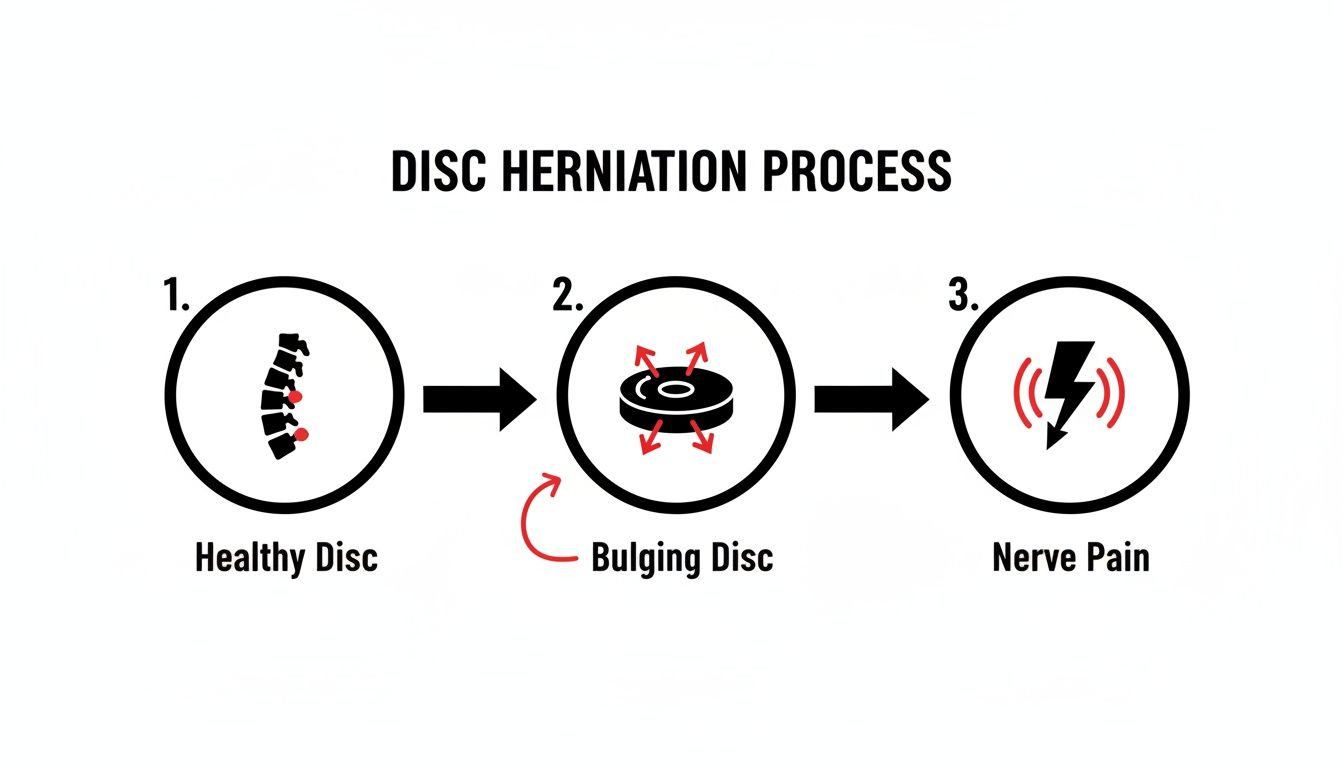
You can see how that bulging material directly presses on the spinal nerve, which is the trigger for all those symptoms that are disrupting your life.
Because the procedure is so gentle on the surrounding tissues, the advantages are significant:
- No General Anesthesia: We typically use local anesthetic and mild sedation, so you avoid the risks that come with being put completely under.
- Outpatient Procedure: You can go home the very same day. There’s no need for an overnight hospital stay.
- Rapid Recovery: Most people are up and walking around within hours and can get back to light activities and work in just a few days.
This approach has proven to be a highly effective path for many people who want relief without going through major surgery. In a landmark series by the procedure’s pioneer, Dr. Choy, the treatment was tracked for 1,275 patients over nearly two decades, showing an incredible 89% success rate based on pain relief and getting back to normal activities.
At Bell District Spine and Rehab, we’ve found that combining the laser’s precision with other therapies can create a powerful strategy for healing. To see how we integrate different advanced technologies, you might want to read our article on how laser therapy transforms chiropractic care in Cedar Park. Our focus is always on using the right combination of treatments to get you back to your life faster, with results that last.
Choosing The Right Treatment For Your Spine
When you’re dealing with back pain that just won’t quit, figuring out what to do next can be completely overwhelming. You have options ranging from conservative therapies to major surgery, so how do you know which path is the right one for you? Here at Bell District Spine and Rehab in Cedar Park, our entire philosophy is built around one thing: you. We take the time to help you understand every option so you can make a confident, informed decision about your health.
The goal isn’t to find a single magic bullet treatment. It’s about matching the right solution to your specific diagnosis, your symptoms, and your life. Let’s compare the three main ways we can tackle disc-related pain: laser disc decompression, traditional open surgery, and non-surgical spinal decompression.
Laser Disc Decompression: A Precise, Minimally Invasive Solution
As we’ve covered, laser disc decompression is an incredibly precise, minimally invasive procedure. It’s designed to relieve pressure from the inside of a bulging or herniated disc. We perform it through a tiny, needle-sized entry point using only local anesthesia. There’s no cutting through muscle and no removal of bone.
This makes it a fantastic choice for a very specific type of patient.
- Best For: People with contained disc herniations. This means the outer wall of the disc is still intact, but it’s bulging out and pressing on a nerve.
- Key Advantage: It gets right to the source of the problem—the internal pressure causing the bulge—offering quick relief with almost no disruption to surrounding tissues and a very fast recovery.
Traditional Open Spine Surgery: An Effective Tool For Complex Cases
Open spine surgery, which includes procedures like a discectomy or laminectomy, is a much more involved approach. The surgeon makes an incision, carefully moves muscle tissue aside, and sometimes removes small pieces of bone or the disc itself to physically free up a compressed nerve.
While it comes with a longer recovery and higher risks, open surgery is still the necessary and correct choice for certain complex spinal problems.
- Best For: Patients with severe conditions like spinal instability, significant spinal stenosis, or large disc herniations that have broken into fragments. These are issues that simply can’t be fixed with a less invasive method.
- Key Advantage: It gives the surgeon a direct line of sight to manually decompress the affected nerves, providing a definitive fix for major structural problems.
Non-Surgical Spinal Decompression: A Gentle, Restorative Therapy
This is the one that often gets confused with surgery, but it’s completely different and totally non-invasive. Non-surgical spinal decompression uses a sophisticated, motorized traction table to gently and rhythmically stretch the spine. This creates a negative pressure inside the discs, which helps pull bulging material back into place and boosts circulation to promote healing over time.
This approach is one of our go-to conservative care options. We break it down in much more detail in our guide to non-surgical spinal decompression therapy.
- Best For: Patients with more generalized lower back pain, degenerative disc disease, or mild to moderate disc bulges who want a therapy-based solution without any needles or incisions.
- Key Advantage: It’s completely non-invasive, painless, and can be incredibly effective over a series of sessions without any of the risks that come with surgery.
Each of these treatments has its place, and the key is an accurate diagnosis. A patient with a contained herniation might get phenomenal results with laser disc decompression, while someone with severe spinal instability would absolutely need the structural fix that only surgery can provide.
To help you see the differences more clearly, here’s a quick comparison of the three main approaches.
Comparing Spine Treatment Options
| Feature | Laser Disc Decompression | Open Spine Surgery | Non-Surgical Spinal Decompression |
|---|---|---|---|
| Invasiveness | Minimally invasive (needle entry) | Highly invasive (incision, muscle retraction) | Completely non-invasive (external) |
| Anesthesia | Local | General | None |
| Recovery Time | Very fast (days to a week) | Long (weeks to months) | None (can resume activities immediately) |
| Best For | Contained disc herniations | Severe stenosis, instability, fragments | Mild/moderate bulges, degenerative discs |
| Mechanism | Reduces internal disc pressure | Physically removes bone/disc material | Creates negative pressure via traction |
| Risk Profile | Low | High | Extremely low |
Choosing the right path forward all comes down to a thorough and expert evaluation. For instance, when you compare laser disc decompression to more invasive techniques, the details really matter. One study of 84 patients showed the laser procedure led to a 70.0% improvement in quality of life. But it also had a re-operation rate of about 31%. Interestingly, this wasn’t statistically different from the re-operation rate for open surgery, which suggests that for the right person, it’s just as durable in the long run. You can read the full research about these nuanced outcomes here.
Here at our Cedar Park clinic, Dr. Tuggle will personally review your MRI and perform a comprehensive physical exam to pinpoint the exact cause of your pain. This is how we can confidently recommend the most effective and least invasive treatment path for your unique situation.
So, is laser disc decompression the right move for you? This is, without a doubt, the most important question to answer. While this procedure can be life-changing for many, it’s not a catch-all fix for every type of back pain.
At Bell District Spine and Rehab, our first job is to get the diagnosis right. We’re committed to recommending the treatment that gives you the best shot at real, lasting relief. This honest, direct approach is how we build trust and empower you to make the best decision for your health.
Who Is This For? Identifying the Ideal Candidate
Laser disc decompression is incredibly precise, but its benefits are greatest when we’re targeting the right kind of disc problem. The procedure is designed to relieve pressure from inside the disc. This is perfect for some situations but less helpful for others.
An ideal candidate usually checks a few specific boxes.
You might be a perfect fit if you have:
- A Contained Disc Herniation: This is the big one. It means the soft, jelly-like center of your disc is bulging, but the tough outer wall is still intact—it hasn’t ruptured. An MRI is the only way to confirm this with certainty.
- Classic Radiating Nerve Pain: You’re likely dealing with sciatica (that sharp, shooting pain down your leg) or radiculopathy (pain, numbness, or tingling radiating into your arm).
- Tried Other Things Without Success: You’ve already given conservative treatments a fair shot for at least six weeks—things like physical therapy, chiropractic adjustments, or medications—but the pain is still winning.
When Is This Procedure Not the Best Fit?
Knowing who isn’t a good candidate is just as crucial. We believe transparency is the cornerstone of good healthcare, and we will always guide you to the best option for your specific condition, even if it means ruling this procedure out.
Laser disc decompression might not be the right path in cases involving:
- Severe Spinal Stenosis: If the spinal canal itself has narrowed significantly because of things like bone spurs or thickened ligaments, a different approach is often needed to create more space.
- Spinal Instability: Conditions like spondylolisthesis, where one vertebra slips forward on another, require stabilization. This procedure doesn’t address that kind of mechanical instability.
- Sequestered or Fragmented Discs: If a piece of the disc has completely broken off and is now floating in the spinal canal, it needs to be physically removed, which usually requires a surgical procedure.
- Spinal Tumors or Infections: These are serious medical issues that demand immediate and entirely different types of specialized care.
It’s no surprise that with the global rise in spinal problems, laser disc decompression has become a key player for people seeking non-surgical solutions. The market for these systems was valued at over USD 745 million and is expected to nearly double by 2032, largely due to aging populations and our increasingly sedentary lifestyles. You can explore more about these market trends on futuremarketreport.com.
Ultimately, the only way to know for sure if this is right for you is with a thorough evaluation. Here at our Cedar Park clinic, Dr. Tuggle will sit down with you, personally review your MRI, listen to your story, and map out a plan designed for you and you alone.
What to Expect on Your Recovery Journey

Deciding to move forward with any procedure is a big deal, even a minimally invasive one like laser disc decompression. Here at Bell District Spine and Rehab, we know that your care doesn’t just happen in the treatment room. It starts the moment you walk through our doors and continues long after you’ve recovered. We’re committed to supporting you every step of the way, making sure you feel confident and cared for from your first consultation to your final follow-up.
Your journey with us kicks off with a detailed, one-on-one consultation with Dr. John Tuggle. This isn’t a rushed, five-minute chat. It’s a deep dive into your health. Dr. Tuggle will sit down with you, personally go over your MRI, and explain exactly what the images mean and how they connect to the pain you’re feeling. He’ll listen to your story, understand what you want to get back to doing, and perform a thorough physical exam to build a complete picture.
This comprehensive approach is how we make sure the treatment plan we design is precisely what you need.
Your Initial Recovery Period
One of the biggest wins with laser disc decompression is the incredibly short downtime. Because the procedure is so gentle, most of our patients are up and walking around the very same day. There’s no need for a lengthy hospital stay.
Here’s what you can generally expect when visiting our Cedar Park clinic:
- Go Home Quickly: The procedure is done on an outpatient basis, which means you get to recover in the comfort of your own home.
- Resume Light Activities: Most people are back to light activities and desk work within just a few days.
- Experience Minimal Discomfort: Any soreness after the procedure is usually mild and resolves quickly on its own.
We’ll give you a clear, personalized timeline for your recovery, so you know exactly what to expect as you get back to your life here in Cedar Park.
Our Integrated Approach to Long-Term Wellness
Real healing isn’t just about stopping the immediate pain; it’s about building a stronger, more resilient spine to keep problems from coming back. This is where our integrated chiropractic care model really makes a difference. Your recovery journey includes follow-up care and rehabilitation designed to make your results last.
We focus on restoring function and stability through a smart combination of expert chiropractic care and personalized rehab exercises. This might involve gentle chiropractic adjustments to ensure your spinal alignment is correct as it heals. It also means following a carefully planned exercise program to strengthen your core muscles.
Think of a strong core as a natural brace for your spine—it provides stability and takes the strain off your discs. As you get stronger, your therapist might introduce tools like resistance tube bands to help you rebuild stability and improve your muscle endurance safely.
Our goal is to do more than just fix the immediate problem. We aim to empower you with the tools and strength needed to protect your spine for years to come, ensuring you can enjoy a healthy, active life without fear of reinjury.
Common Questions About Laser Disc Decompression
It’s completely normal to have a lot of questions when you’re thinking about any kind of medical procedure. At Bell District Spine and Rehab, we believe clear, honest answers are the foundation of good healthcare. They help you feel confident and comfortable with your choices.
Here are some of the most common questions our Cedar Park patients ask us about laser disc decompression.
Is Laser Disc Decompression Painful?
This is usually the first question on everyone’s mind, and the answer is no. The procedure itself is done under local anesthesia, which means the entire area we’re working on will be completely numb.
You might feel a mild sense of pressure during the treatment, but you shouldn’t feel any pain. Afterwards, any soreness is usually very minimal and fades on its own within a day or two. Our team is focused on your comfort every step of the way.
How Long Does the Recovery Take?
One of the biggest reasons people choose laser disc decompression is the incredibly fast recovery time. It’s a game-changer compared to more invasive surgeries.
Most of our patients are up and walking around the very same day. You can typically get back to light activities and office work within just a few days. This is a world away from the weeks, or even months, of downtime required after traditional open back surgery. We’ll give you a personalized recovery plan to get you back to your life safely and quickly.
The swift return to daily activities is a hallmark of this minimally invasive procedure. It allows you to focus on healing and getting back to your life in Cedar Park without the prolonged downtime associated with surgery.
What Is the Success Rate of the Procedure?
When patients are good candidates for this treatment, the results are excellent. Clinical studies have shown very high success rates for providing significant, lasting pain relief. Some of the landmark research points to an 89% success rate for the right type of patient.
The key to that success is making sure you have the right kind of disc issue, which is typically a contained herniation. Dr. Tuggle will perform a comprehensive evaluation, including a detailed review of your MRI, to determine if this is the ideal path for you and discuss what kind of outcome you can realistically expect.
Is This Treatment Covered by Insurance?
Insurance coverage can vary quite a bit depending on your specific plan and their determination of medical necessity. We understand that navigating insurance can be frustrating, and at Bell District Spine and Rehab, we’re committed to making our care as accessible as possible.
We accept most major insurance plans, including Medicare. Our Cedar Park team will work directly with you to verify your benefits and give you a completely transparent overview of any potential costs before you make a decision. We want you to focus on your health, not on financial surprises.
Ready to find out if laser disc decompression is the right solution for your back pain or neck pain? The team at Bell District Spine and Rehab is here to provide the answers and expert care you deserve. Schedule your consultation with Dr. Tuggle today and take the first step toward lasting relief.