
If you’re dealing with a muscle strain in Cedar Park, you want relief, and you want it fast. The quickest way to recover isn’t just about resting and waiting. It’s a smart combination of immediate protection followed by gentle, early movement. While older advice preached total rest, modern sports medicine shows that starting a careful, guided rehabilitation process just two days after an injury can significantly reduce your recovery time and get you back to your life sooner.
What to Do Immediately After a Muscle Strain
That sudden, sharp pain is your body’s alarm bell. What you do in the first 48 hours is critical, setting the stage for your entire recovery. How quickly you heal depends on these initial steps. For anyone in Cedar Park or our neighboring communities like Leander and Round Rock, knowing what to do right away is the key to a fast comeback from back pain, neck pain, or any other muscle injury.
For years, everyone followed the RICE method (Rest, Ice, Compression, Elevation). But the science has moved on. Today, we know a more active approach called PEACE & LOVE works better with your body’s natural healing process. This modern protocol helps you manage the initial symptoms without shutting down the essential inflammation your tissues need to repair themselves.
Shifting from RICE to PEACE & LOVE
The first phase, PEACE, is your guide for the first 1-3 days. The goal here is simple: calm the area down and create the best possible environment for healing to begin.
- Protection: For a day or two, avoid activities and movements that stir up the pain. If you’re a desk worker in Round Rock who strained your back lifting a box, this might mean avoiding deep bending for a bit.
- Elevation: Whenever possible, keep the injured limb propped up higher than your heart. This simple trick helps reduce swelling naturally.
- Avoid Anti-Inflammatories: This is a major shift from old advice. Initial inflammation is your body’s cleanup crew rushing to the scene. Using NSAIDs like ibuprofen can interfere with this vital first stage of tissue repair.
- Compression: A gentle wrap with a bandage can provide light support and help manage swelling.
- Education: Listen to your body. As your local Cedar Park chiropractor, we believe in empowering our patients. Understanding what helps and what hurts is crucial. Getting professional guidance from a chiropractor can make all the difference in navigating your recovery safely.
The second phase, LOVE (Load, Optimism, Vascularisation, Exercise), starts after the acute period. It’s all about active recovery, emphasizing that smart movement—not prolonged rest—is the true key to a strong and lasting recovery from issues like back pain, neck pain, or sciatica.
The Critical Timing of Rehabilitation
Starting your recovery early doesn’t just feel better; it makes a measurable difference. A groundbreaking study showed that starting rehab just two days after an acute muscle strain can slash recovery time by a remarkable three weeks compared to waiting nine days.
In the study, the early rehab group was back to their sport, pain-free, in about 62 days. The group that waited took 83 days to get there. That’s a 25% faster recovery rate, with no increased risk of re-injury. You can dig into the full research on this important muscle strain study to see the data for yourself.
This timeline powerfully illustrates how early, guided movement makes a huge impact on your recovery.
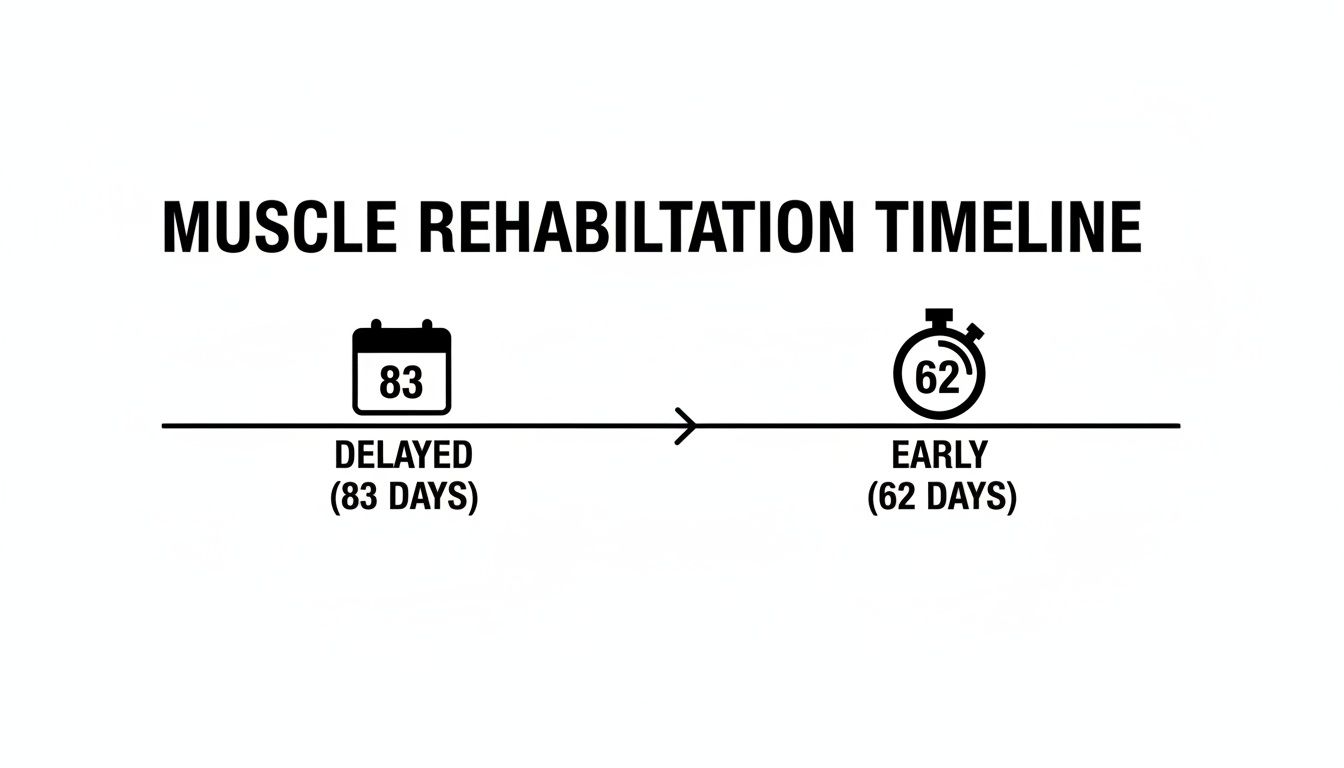
The takeaway is clear: delaying the start of your rehabilitation only extends the time you spend on the sidelines.
Here’s a practical look at what to expect based on your muscle strain’s severity. This table breaks down recovery timelines, helping you set realistic goals for getting back to your life.
Understanding Your Muscle Strain Recovery Timeline
| Strain Grade | What It Feels Like | Typical Recovery Time | Your Next Step in Cedar Park |
|---|---|---|---|
| Grade 1 (Mild) | A slight pull or tenderness. You can still use the muscle, but it’s uncomfortable. | 2-4 weeks | Focus on gentle mobility and gradual strengthening. At our clinic, we can guide you. |
| Grade 2 (Moderate) | A sharp pain, noticeable loss of strength, and some swelling/bruising. Movement is painful. | 4-8 weeks | Requires a structured chiropractic care plan to rebuild strength and prevent re-injury. |
| Grade 3 (Severe) | A “pop” sensation followed by intense pain and inability to use the muscle. Significant swelling is common. | 3-6 months | This is a full tear. Immediate professional evaluation is essential for proper healing. |
Knowing where you stand helps you and your chiropractor build the right plan from day one, avoiding setbacks and frustration.
When to See a Chiropractor in Cedar Park, TX
While mild strains can be managed with initial care, some signs are red flags that you need a professional evaluation from a trusted chiropractor near you. If you heard a “pop” when the injury happened, have significant swelling or bruising, or can’t put any weight on the limb, it’s time to seek help.
At Bell District Spine and Rehab, we can accurately diagnose the severity of your strain and build a plan tailored to you. An expert assessment means you aren’t guessing; you’re taking the most effective steps toward the fastest possible recovery.
How Chiropractic Care Helps Your Muscle Heal Faster

After the first 48-72 hours of protecting the injury, it’s time to introduce smart, controlled, and gentle movement. This concept, known as active recovery, is a cornerstone of modern chiropractic care and one of the most important factors in healing a muscle strain as quickly as possible.
Staying completely still can cause stiff, weak scar tissue to form. But when you move with intention, you encourage new muscle fibers to align correctly, creating tissue that is both strong and flexible. This approach sends a constant supply of oxygen and nutrients to the area and gives your healing cells a clear blueprint for how to rebuild.
This is a crucial step for anyone trying to recover, whether you’re a Cedar Park resident nursing a groin pull from a weekend soccer game or an Austinite trying to fix a back strain from an auto injury.
The Logic Behind Smart Movement
As soon as you start moving the injured muscle within a pain-free range, several powerful healing processes kick into high gear. This isn’t just about “loosening it up”; it’s a precise biological signal that tells your body how to repair itself for the long haul.
This approach stops the muscle from shortening and tightening—a common side effect of keeping it immobilized. Keeping that tissue pliable is absolutely essential for regaining full, pain-free mobility.
Key Takeaway: Gentle movement isn’t about pushing through pain. It’s about finding a comfortable range of motion that stimulates blood flow, guides healthy scar tissue formation, and prevents the secondary stiffness that can prolong your recovery.
Safe Exercises to Get You Started
The right movement depends entirely on your specific injury. What works for a pulled hamstring might be a terrible idea for a lower back strain. At Bell District Spine and Rehab, we build custom rehab plans, but here are a few examples of safe, initial movements we often recommend for common conditions we treat.
For a Mild Lower Back Strain (Common in Back Pain Sufferers):
- Cat-Cow Stretches: On your hands and knees, gently arch your back toward the ceiling, then slowly let it sink down. This mobilizes the spine without putting a heavy load on the strained muscles.
- Pelvic Tilts: Lie on your back with your knees bent. Gently flatten your lower back against the floor by tightening your core. This wakes up the deep core muscles that support your lumbar spine and provide back pain relief.
For a Calf or Hamstring Strain (Often related to Sciatica):
- Ankle Pumps: While sitting or lying down, slowly point your toes away from you, then pull them back toward you. This simple move gets blood flowing through your lower leg.
- Isometric Hamstring Contractions: Sit in a chair with your knee bent at 90 degrees. Gently press your heel into the floor without moving your leg, holding for 5-10 seconds. This activates the muscle without stressing injured fibers.
Remember, these exercises should never cause sharp pain. The goal is gentle activation.
What to Expect at Our Cedar Park Chiropractic Clinic
Guesswork has no place in a solid recovery plan. At our Cedar Park clinic, we use a structured approach to guide you from these initial gentle motions all the way back to full strength.
Dr. John Tuggle will assess your specific injury to map out the exact movements that will help, not harm, your healing. We ensure you’re performing every exercise with the right form and at the right intensity. This expert guidance removes the fear and uncertainty of re-injury, empowering you to take an active role in getting better. Our goal is to progress you safely, ensuring your muscle heals stronger and more resilient than before.
Advanced Therapies for Faster Muscle Repair
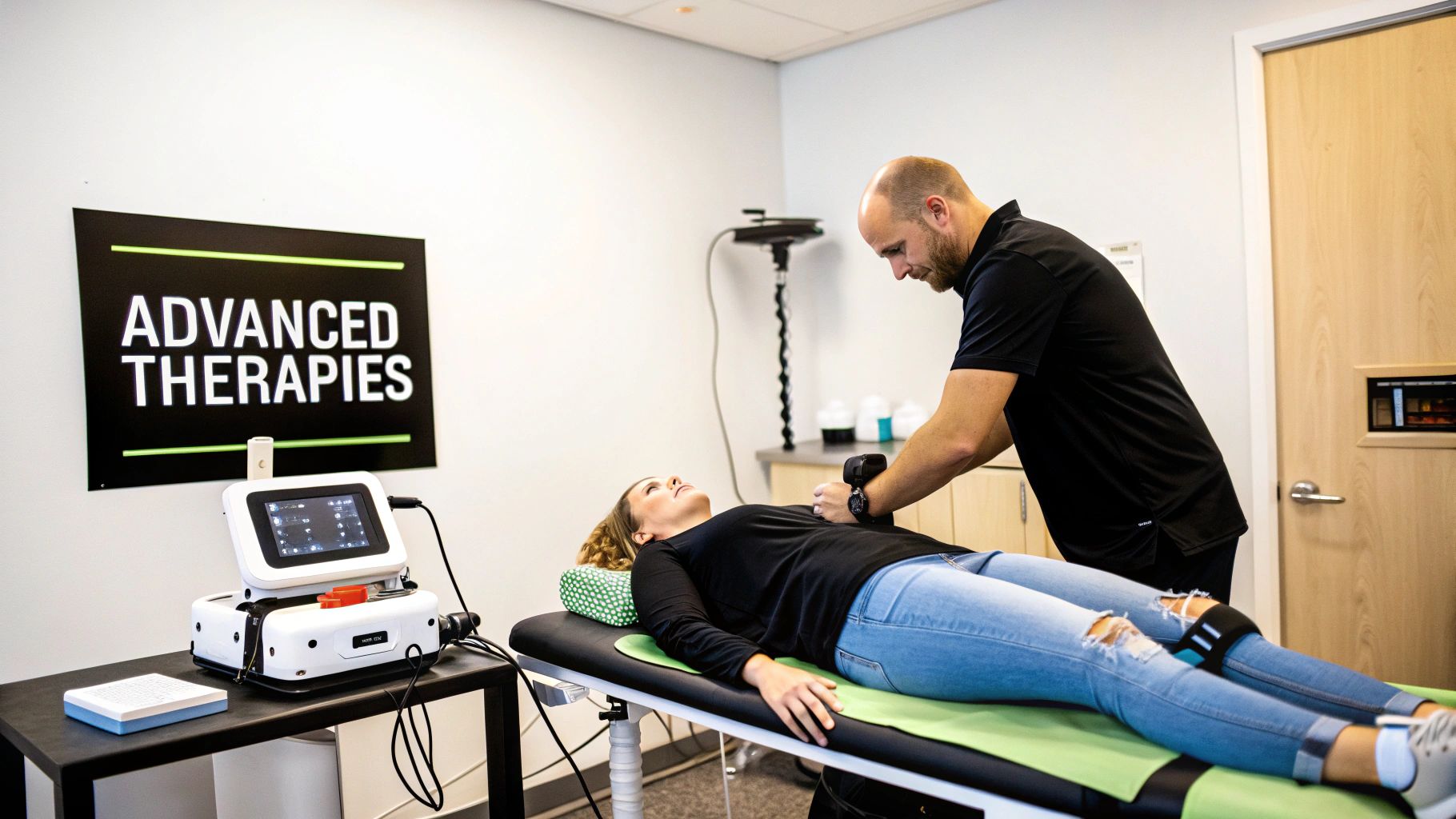
While the initial steps of protection and gentle movement lay the groundwork, sometimes your body needs a professional nudge to heal faster. This is especially true for moderate to severe strains or stubborn pain that limits your life.
For our patients here in Cedar Park and Leander, the fastest path to healing often involves layering in advanced, non-invasive therapies. These treatments work with your body’s own repair mechanisms to accelerate the process.
At Bell District Spine and Rehab, Dr. John Tuggle relies on state-of-the-art treatments that target injured tissue on a deeper level. These aren’t just quick fixes; they are designed to break up dysfunctional tissue, calm inflammation, and kickstart cellular repair, which can significantly shorten your recovery timeline.
Targeted Soft Tissue Techniques
Manual therapy is much more than a relaxing massage; it’s a precise clinical tool. We use targeted soft tissue techniques to release adhesions, boost circulation, and restore flexibility right at the site of the injury, which is essential for treating conditions from whiplash to common sports injuries.
Methods like Active Release Technique (ART) or Graston Technique involve applying specific pressure while guiding the muscle through its range of motion. This breaks up the sticky scar tissue that can restrict your movement and keep you in pain.
Research from Harvard proved that mechanical loading—the kind of force used in clinical massage—physically squeezes inflammatory cells out of injured muscle tissue. This process was shown to speed up repair, reduce scarring, and lead to stronger, healthier muscle fibers.
Breaking Down Barriers with Shockwave Therapy
For nagging, chronic strains or areas with dense scar tissue, Extracorporeal Shockwave Therapy (ESWT) can be a game-changer. This non-invasive treatment uses acoustic pressure waves to create a controlled micro-trauma in the affected tissue.
This process re-awakens your body’s dormant healing response. It stimulates the formation of new blood vessels, boosts collagen production, and helps dissolve calcified deposits. It’s incredibly effective for stubborn issues like plantar fasciitis, tennis elbow, and hamstring tendinopathy.
Many of our Cedar Park patients who felt “stuck” in their recovery see a significant breakthrough after just a few shockwave sessions. To get a deeper understanding, you can learn more about the benefits of Shockwave Therapy in our detailed guide.
Releasing Knots with Functional Dry Needling
Often, a muscle strain leaves behind tight, painful knots known as trigger points. These hyper-irritable spots can cause referred pain and restrict movement, common causes of headaches and migraines.
Functional Dry Needling is a highly effective technique for switching these trigger points off. A very thin, sterile needle is inserted directly into the knot, causing the muscle to twitch and then release. This release provides immediate pain relief, improves your range of motion, and restores normal muscle function.
Accelerating Healing at the Cellular Level
Beyond these hands-on approaches, we can’t forget about fuel. Supporting your body’s internal repair systems is vital. The right foods provide the essential building blocks for muscle regeneration.
Understanding what foods help muscle recovery is a cornerstone of effective healing. Think high-quality protein, complex carbs, and nutrients that fight inflammation.
These advanced therapies deliver the best results when integrated into a complete rehabilitation plan that includes chiropractic care to fix underlying biomechanical issues and a progressive exercise program. By combining these powerful tools, we create a roadmap that offers the fastest path back to the activities you love.
The Untapped Potential of Chiropractic Care
When you strain a muscle, it’s easy to focus only on the site of the pain. But a muscle strain is rarely just a muscle problem—it’s often a warning sign of a deeper biomechanical imbalance. This is where chiropractic care becomes a game-changer for a true, lasting recovery.
An underlying issue, like a misaligned pelvis or a stiff joint in your spine, can put constant, uneven stress on your muscles. This forces certain muscle groups to work overtime, leaving them vulnerable to injury. For our patients here in Cedar Park, this is a story we hear all the time. A nagging back strain might stem from a pelvis that’s out of alignment, forcing the lower back muscles to compensate until they finally give out.
Restoring Spinal Alignment for Better Function
The philosophy of chiropractic care is built on restoring proper movement and alignment to the joints, especially in the spine. When your joints move correctly, the muscles that attach to them can finally function as they should.
A chiropractic adjustment is a precise, gentle force applied to a joint that’s “stuck.” It’s about restoring motion, which delivers several benefits for a strained muscle:
- It takes pressure off the nerves. Misaligned vertebrae can pinch or irritate nerves, messing up signals to your muscles. An adjustment helps calm that irritation, letting the muscle function more efficiently.
- It improves your movement patterns. Correcting a stiff joint immediately takes abnormal stress off surrounding muscles, allowing the injured muscle to heal without being constantly re-aggravated.
- It boosts blood flow. Getting joints moving again helps improve circulation, delivering the oxygen and nutrients your strained muscle needs to repair itself.
By focusing on the structural source of the problem, chiropractic care doesn’t just help you feel better—it helps your body heal correctly and become more resilient.
Beyond the Adjustment: A Whole-Body Approach
At Bell District Spine and Rehab, a chiropractic adjustment is often the starting point. Dr. John Tuggle combines adjustments with other targeted therapies like spinal decompression or soft tissue techniques to build a complete recovery plan.
For example, after an adjustment restores proper mechanics in your lower back, we might follow it up with targeted soft tissue therapy to release tight knots in the strained muscles. This one-two punch ensures that both the joint and the muscle are working together. You can explore the wide-ranging chiropractic adjustment benefits in our other guide.
This integrated approach is what sets our Cedar Park chiropractic clinic apart. We see you as a whole person, not just an injury. By fixing underlying structural issues, we create an environment where your strained muscle can heal faster, helping you return to your life in Leander, Austin, or Round Rock with confidence. We also offer specialized services such as prenatal chiropractic and pediatric chiropractic care to serve the entire community.
Returning to Your Life and Preventing Re-Injury
Healing the initial strain is a huge win, but the real finish line is getting back to your life with confidence—free from the fear of it happening again. A patient, strategic return to activity is always the fastest way back.
Are You Ready to Return to Activity?
Before you jump back into your old routine, you need to be able to answer “yes” to these questions. Think of it as your personal readiness checklist.
- Is Your Range of Motion Back to Normal? You should be able to move the injured muscle and joint through its full range without pain. It needs to feel just as flexible as the uninjured side.
- Is Your Strength Balanced? Your injured muscle needs to be at least 90% as strong as its uninjured counterpart. We can run specific tests in our Cedar Park clinic to get an exact measurement.
- Can You Move Without Pain? You have to be able to perform daily tasks and sport-specific movements without any sharp pain or feeling of instability.
If you can’t confidently check all those boxes, your body is sending a clear signal: it still needs more time and targeted work.
Practical Prevention Tips for Our Community
Preventing another muscle strain is about figuring out why it happened. Here’s some real-world advice tailored for our neighbors.
For the Cedar Park Desk Worker:
Your biggest enemy is sitting still. Hours in a chair can lead to weak glutes and tight hip flexors—a classic recipe for lower back pain and hamstring strains.
- Ergonomics Matter: Adjust your chair so your hips are a little higher than your knees. Get your screen to eye level to stop neck strain.
- Move Every 30 Minutes: Set a timer. Get up, stretch, or do a few gentle squats. It keeps your muscles from getting stiff.
For the Leander Athlete:
Your focus has to be on smarter prep and recovery. A rushed warm-up is one of the top causes of muscle pulls we see.
- Dynamic Warm-ups are Key: Ditch old-school static stretching before you start. Focus on dynamic movements like leg swings and walking lunges to prime your muscles for work.
- Prioritize a Cool-Down: Just 10 minutes of gentle stretching after your workout can make a world of difference in improving long-term flexibility.
A critical part of long-term health is understanding your body’s nutritional needs. Fueling your muscles with adequate protein and staying hydrated are non-negotiable.
The Role of Maintenance Care
Think of your body like your car. You don’t wait for it to break down before you get an oil change. The same principle applies to your health.
Ongoing maintenance care at Bell District Spine and Rehab is about proactively finding and fixing small imbalances before they become major injuries. Regular chiropractic check-ups can identify joint restrictions and muscle imbalances you might not even feel yet. This preventative approach keeps your body functioning at its best, making you far more resilient.
Common Questions About Healing Muscle Strains
When you’re sidelined with a muscle strain, you want clear, straightforward answers. Here in our Cedar Park clinic, we understand. Let’s tackle the most common questions our patients ask.
Should I Use Heat or Ice on My Muscle Strain?
For the first 48 hours, ice can help numb the initial sharp pain and manage swelling. A good rule of thumb is 15-20 minutes on, then take a long break. However, the modern PEACE & LOVE protocol we follow de-emphasizes ice, suggesting we let the body’s natural inflammatory process work. After that initial phase, heat often becomes your best friend. It boosts blood flow and relaxes tight muscles. The best approach depends on your specific injury, which is why a personalized recommendation from your local chiropractor makes all the difference.
How Do I Know if My Muscle Strain Is Serious?
Your body is good at telling you when something is wrong. Did you hear a “pop”? Can you not put any weight on it? Is there significant swelling, discoloration, or a visible dent in the muscle? These are red flags. If you’re experiencing any of them, or if the pain isn’t getting better after a couple of days, it’s time to get it checked out. Dr. Tuggle can perform a thorough assessment to grade the strain and build the right game plan.
Expert Insight: Getting a professional diagnosis from a chiropractor near you is the single fastest way to heal. It eliminates guesswork and ensures you’re doing the right things from day one.
Why See a Chiropractor for a Strain in My Arm or Leg?
Most people hear “chiropractor” and think “back pain chiropractor.” But your body is one connected system. An injury in your leg or arm is often the result of, or can create, imbalances elsewhere—usually in your spine, pelvis, or shoulders. As your Cedar Park chiropractor, Dr. Tuggle looks at your whole body’s mechanics to uncover these root causes. By ensuring your joints are aligned and moving properly, we take abnormal stress off the injured muscle.
Can My Diet Help Speed Up Recovery?
Absolutely. You can’t rebuild a house without materials, and the same goes for your body. Focus on getting enough lean protein, which provides the amino acids for new muscle fibers. Staying hydrated is also non-negotiable. Certain nutrients like Vitamin C and Zinc are key players in tissue repair. For severe injuries, regenerative treatments are also showing promise. One study on Platelet-Rich Plasma (PRP) injections cut return-to-sport time for athletes by 55%. You can read the full research about these powerful findings on hamstring injuries right here.
Don’t let a muscle strain dictate your life. At Bell District Spine and Rehab, we combine expert chiropractic care with advanced therapies to address the root cause of your pain and accelerate your recovery. If you’re ready to get back to your life in Cedar Park, TX, schedule your appointment with Dr. Tuggle today.