
Correcting forward head posture is a process that hinges on three key elements: being consistently aware of your posture, committing to daily corrective exercises, and seeking professional care to fix the underlying spinal misalignments at their source. When you combine these daily habits with targeted therapies from a trusted local chiropractor, you can finally ease the chronic strain on your neck and shoulders for good.
Your Local Guide to Overcoming Neck Pain and Headaches in Cedar Park, TX
If you’re struggling with that nagging ache in your neck, headaches that just won’t quit, or a constant stiffness between your shoulder blades, you're not alone. So many of our neighbors here in Cedar Park and Leander are dealing with these exact symptoms. More often than not, they all point back to a common, and thankfully correctable, issue: forward head posture.
It’s often called “text neck,” and for a good reason. Our modern lives—filled with hours spent hunched over desks, laptops, and smartphones—are literally training our bodies to adopt this stressful, unnatural position.
This is more than a cosmetic issue; it's a major health concern. For every single inch your head juts forward from its natural alignment, it adds about 10 extra pounds of pressure on your cervical spine. That constant load is what leads to the pain and discomfort that disrupt your daily life, and why finding a neck pain chiropractor in Cedar Park is so critical.
Our Commitment to Patients in Cedar Park
Here at Bell District Spine and Rehab, we see the real-world impact of this condition every single day. Our experienced chiropractor, Dr. John Tuggle, believes in getting to the root cause of your pain—not just covering up the symptoms. Our entire approach is patient-focused, giving you the tools and treatments needed to restore proper alignment and get you back to feeling your best.
We’re proud to be your trusted local partner in health, serving our community with non-invasive, drug-free solutions that deliver lasting results for conditions ranging from sciatica to auto injury pain.
This guide is your roadmap to fixing forward head posture, built on a foundation of:
- Awareness: Finally understanding what’s causing your posture problems in the first place.
- Action: Using simple, effective exercises you can do right at home or at the office.
- Professional Care: Leveraging expert chiropractic treatment to correct spinal alignment where it really counts.
This simple flowchart breaks down the three pillars of a successful posture correction plan.
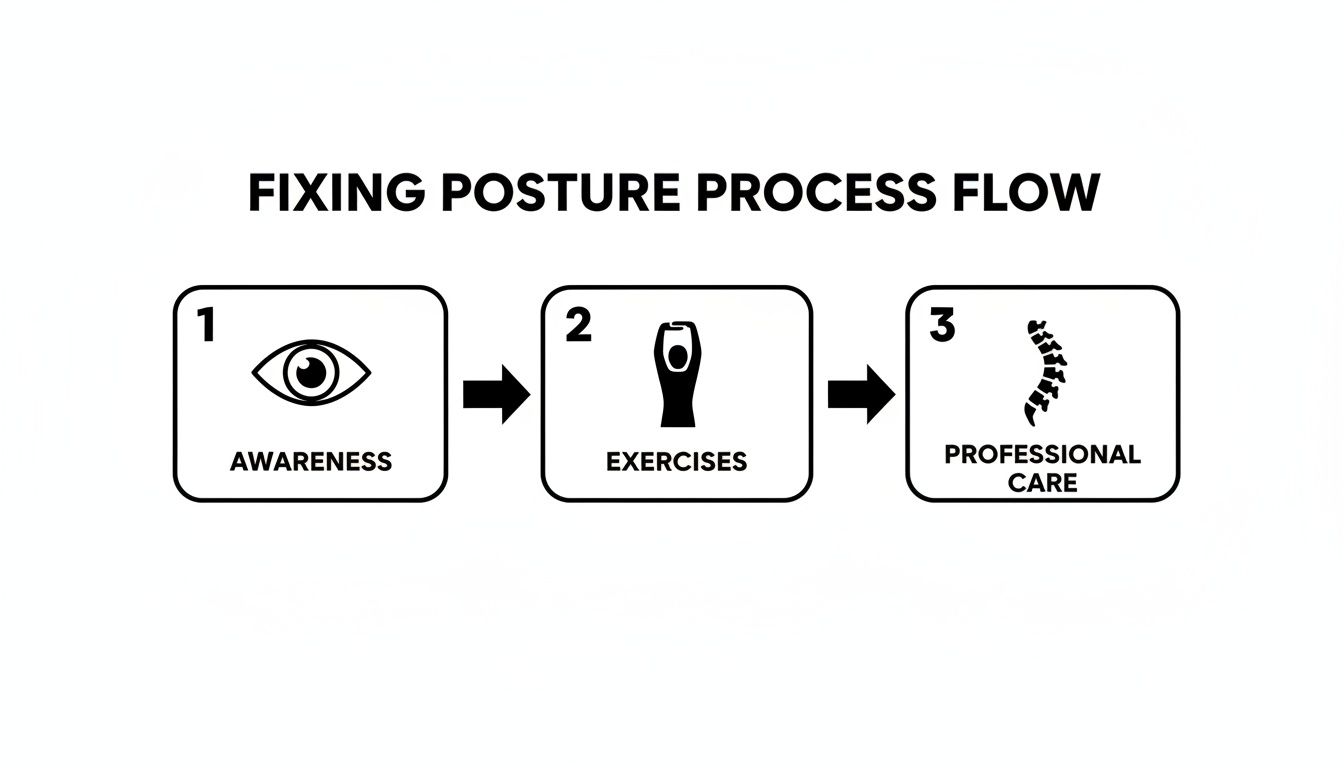
As you can see, lasting improvement isn't about some single magic fix. It’s a combined strategy that empowers you with self-care while using professional expertise for the most critical adjustments. The good news is, you can start taking meaningful steps toward a pain-free life today.
Your Quick-Start Plan for Better Posture
To make this simple, here's a table that breaks down the immediate actions you can start taking. Think of this as your day-one game plan.
| Strategy Pillar | Daily Action | The Impact |
|---|---|---|
| Postural Awareness | Set a timer to check your head position every 30 minutes. Tuck your chin slightly. | Builds the habit of self-correction, preventing you from slipping back into poor posture unconsciously. |
| Mobility & Strength | Perform chin tucks and shoulder blade squeezes twice a day (10-15 reps). | Strengthens the weak muscles in your upper back and stretches the tight muscles in your chest and neck. |
| Ergonomic Adjustments | Raise your monitor so the top third is at eye level. Hold your phone up. | Reduces the physical trigger that forces your head forward, making good posture the default position. |
This quick-start plan isn't the whole solution, but it’s a powerful first step. By focusing on these three areas right away, you begin retraining your body and alleviating the immediate strain on your spine.
The Real Causes and Risks of Your Neck Pain
That nagging ache in your neck isn’t random. It’s the slow, creeping result of daily habits that feel harmless but place a tremendous amount of stress on your spine over time. Understanding why it's happening is the first real step toward finding lasting relief from a trusted chiropractor near you.
More often than not, the primary culprit is our modern lifestyle. Hours spent hunched over a laptop, endless scrolling on a smartphone, or even just reading in bed can slowly train your body to adopt this damaging alignment. It’s such a gradual shift that most people don’t even notice it until the symptoms—stiffness, headaches, and pain—become impossible to ignore.
This posture is more than just a cosmetic issue; it’s a mechanical problem with serious consequences. Your head is surprisingly heavy, weighing roughly 10-12 pounds. When it’s properly balanced over your shoulders, your spine handles that weight just fine. But the physics change dramatically as your head drifts forward.
For every single inch your head moves forward from its ideal alignment, it effectively adds another 10 pounds of force for the muscles in your neck and upper back to support. A two-inch forward posture forces those muscles to carry the equivalent of a 30-pound head.
This constant strain is what leads to muscle fatigue, deep aches, and chronic pain. The muscles at the front of your neck and chest become tight and short, while the muscles in your upper back get overstretched and weak. This dangerous imbalance pulls your spine further out of alignment, creating a vicious cycle of dysfunction and discomfort.
From Poor Habits to Chronic Health Issues
What begins as a simple postural habit can spiral into a range of frustrating and painful conditions. Many of our patients in the Cedar Park and Leander communities come to our clinic with complaints that are directly linked to the cumulative stress of forward head posture.
You might be experiencing one or more of these common signs:
- Chronic Neck and Shoulder Pain: This is the most obvious symptom, caused by overworked muscles that are constantly losing the battle against gravity.
- Tension Headaches: The relentless strain on the small muscles at the base of your skull (the suboccipitals) is a major trigger for persistent headaches. If this sounds familiar, our guide on natural remedies for tension headaches offers some helpful insights.
- Reduced Range of Motion: Over time, the joints in your cervical spine can become stiff and "locked up," making it difficult to turn your head fully without pain.
- Tingling or Numbness: In more advanced cases, the misalignment can start to compress the nerves exiting your spine, leading to radiating symptoms like tingling or numbness in your arms and hands.
Ignoring these warning signs allows the underlying problem to get worse. Sustained pressure on your cervical discs can accelerate wear and tear, potentially leading to long-term issues like disc degeneration or osteoarthritis. This isn’t just about feeling better today; it’s about protecting the long-term health and function of your spine.
The Problem Isn't Just "Text Neck"
While technology gets a lot of the blame, it's not the only cause. Other common contributors are woven into our daily routines:
| Cause | Example Scenario |
|---|---|
| Poor Ergonomics | Working at a desk where your monitor is too low, forcing your head to dip down all day. |
| Driving Posture | Slouching behind the wheel during your daily commute around the Austin area. |
| Sleeping Position | Using a stack of pillows that props your head forward for hours every single night. |
| Previous Injuries | Unresolved issues from an old whiplash injury or sports accident that created muscle imbalances. |
At Bell District Spine and Rehab, we see patients from all walks of life dealing with this exact issue. From desk workers in Round Rock to active individuals in Brushy Creek, the root causes are often hiding in plain sight. The good news? By identifying these triggers, you gain the power to start making meaningful changes. Building this awareness is the foundational step in taking back control and fixing your forward head posture for good.
How to Assess Your Posture at Home
Before you can fix the problem, you need to know exactly what you're up against. A quick posture check at home is the perfect first step. It gives you a clear, honest baseline, showing you just how far your head has drifted forward from where it should be.
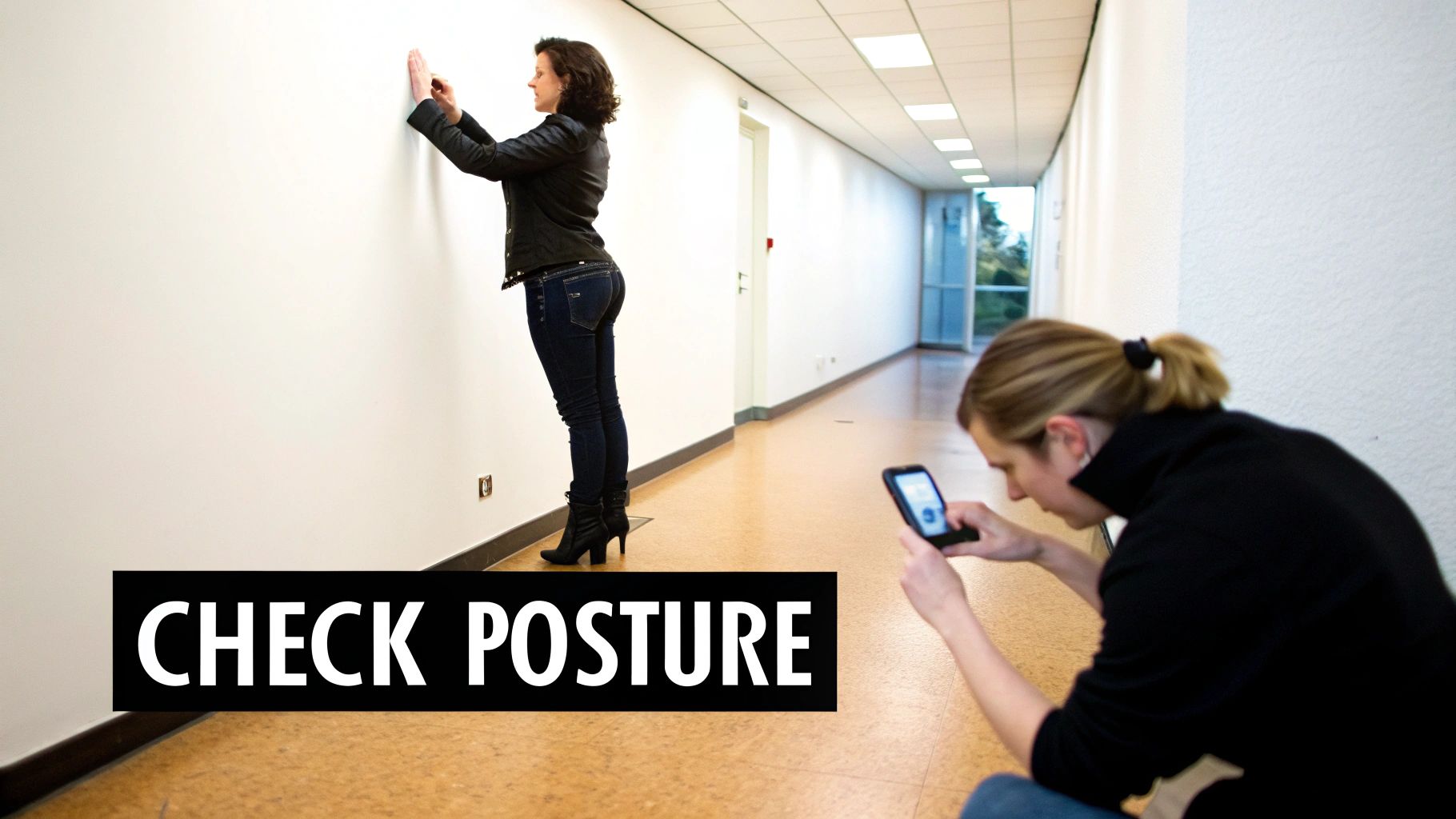
These simple self-checks don't replace a professional evaluation from a Cedar Park chiropractor, but they're incredibly empowering. You can get a surprisingly accurate picture of your posture with just a wall and your smartphone. Let's dig in.

The Simple Wall Test
This is the fastest way to check your alignment. It takes less than a minute and requires zero special equipment.
- Stand with your back against a flat wall, moving your heels about six inches away from the baseboard.
- Your glutes and shoulder blades should naturally make contact with the wall.
- Now, without forcing anything, see if the back of your head can touch the wall.
If your head touches the wall easily while your chin stays level, your posture is in pretty good shape. But if there’s a noticeable gap, or you have to tilt your head way back to make contact, that’s a telltale sign of forward head posture.
The Profile Photo Assessment
A picture doesn't lie. This method gives you undeniable visual proof and helps you estimate your craniovertebral (CV) angle—that’s the angle formed by your ear, a specific vertebra in your neck (C7), and the horizontal plane.
Grab a friend or family member and have them snap a photo of you from the side. The key is to stand in your normal, relaxed posture. Don't try to "fix" it for the camera; we need to see your everyday alignment.
When you look at the picture, your ear should be positioned directly over the center of your shoulder. Is your ear noticeably in front of your shoulder? That's forward head posture in action.
This is an incredibly common issue, especially among younger people. One study revealed that forward head posture affects a staggering 73% of university students, largely due to habits like hunching over books and laptops for hours. While it might not seem like a big deal at first, this misalignment is setting the stage for future neck pain and stiffness if it isn't corrected. You can read more about the research on student posture and its daily impact.
Key Takeaway: A home assessment is your starting point. It provides the awareness needed to take action. If you find a gap during the wall test or see your ear is forward in a photo, it's a clear signal to begin corrective measures.
What Your Home Assessment Tells You
These simple tests do more than just confirm bad posture—they highlight the specific muscular imbalances at play. When your head drifts forward, it means the muscles in the front of your neck and chest are tight and overworked, while the muscles in your upper back have become weak and stretched out.
This is a problem that won't fix itself. It demands a targeted plan that both stretches the tight muscles and strengthens the weak ones. And while a home assessment is a great first step for awareness, it can’t give you the full picture.
Here at Bell District Spine and Rehab, our Cedar Park clinic uses advanced movement analysis to get a precise diagnosis. We can measure your alignment down to the millimeter, pinpoint which spinal segments are restricted, and build a personalized treatment plan that a simple home test just can’t replicate. Your self-check is the "what," and our professional assessment provides the "why" and the "how" for your recovery.
Your At-Home Plan for Lasting Posture Correction
Realizing you have forward head posture is the first big win, but turning that awareness into lasting change takes consistent action. The most effective way to retrain your body, restore balance, and get the strain off your neck is by creating a simple, daily routine of corrective exercises.
The strategy is pretty straightforward. You need to stretch the muscles that have become tight and short (the ones pulling you forward) and strengthen the muscles that have grown weak and overstretched (the ones that are supposed to be holding you up). It's this one-two punch that actually fixes the problem at its source.
Stretching Tight Muscles to Restore Mobility
Think about it—the muscles in your chest (pectorals) and the front of your neck are the main culprits pulling your head and shoulders into that forward slump. Gently stretching them every day helps release that constant tension, giving your body a chance to settle back into a more natural alignment.
Here are two foundational stretches to get you started:
- Doorway Pectoral Stretch: Stand in an open doorway and place your forearms on the frame with your elbows bent at a 90-degree angle. Gently step forward with one foot until you feel a good, comfortable stretch across your chest. Hold it for 20-30 seconds while breathing deeply. Do this 2-3 times.
- Upper Trapezius Stretch: Sit up nice and tall, then gently tilt your right ear toward your right shoulder. If you want a deeper stretch, you can place your right hand on your head to add just a little bit of pressure. Hold for 20-30 seconds, then switch to the left side.
These simple movements are your best defense against the hours spent hunched over a desk or phone. They give those tight muscles the release they’re crying out for.
Strengthening Weak Muscles for Better Support
While stretching creates the freedom to move, strengthening provides the stability you need to hold good posture all day long. Your deep neck flexors (the small muscles at the front of your throat) and your upper back muscles (like the rhomboids and mid-traps) are your personal support system.
These next exercises are designed to wake up those dormant muscles:
- Chin Tucks: Honestly, this is the single most important exercise for fixing forward head posture. Lie on your back with your knees bent. Without lifting your head, gently tuck your chin toward your chest, like you’re trying to make a double chin. You should feel the muscles at the front of your neck engage. Hold for 5-10 seconds and repeat 10 times.
- Scapular Squeezes: You can do this sitting or standing. With your arms at your sides, just squeeze your shoulder blades together as if you’re trying to hold a pencil between them. Make sure to keep your shoulders down, not shrugged up by your ears. Hold for 5 seconds and repeat 15 times.
Remember, consistency is way more important than intensity. Doing these simple exercises every day will gradually build the endurance needed to hold your head in the right place without you even thinking about it.
Expert Insight: The goal isn't to force yourself into some rigid, military-style posture. It’s about restoring balance so your spine can rest in its natural, neutral alignment. That’s where your body functions most efficiently and without pain.
Of course, a good at-home plan also means addressing your daily habits, especially at work. For some great, actionable advice on setting up your workspace, check out these tips on improving office posture.
How Chiropractic Care in Cedar Park Corrects Posture at Its Source
While the daily exercises we've covered are fantastic for retraining your muscles, they often can't fix the core problem all by themselves: a misaligned spine. Think of it like trying to straighten a bent car frame by just painting over the dent. You need to address the underlying structure.
This is where professional chiropractic care at Bell District Spine and Rehab becomes a game-changer. We go beyond just managing the symptoms and get to the source of the issue, providing real, lasting relief for our patients here in Cedar Park, TX.
Dr. John Tuggle takes a personalized, hands-on approach to restore your body’s natural alignment. The cornerstone of this is the chiropractic adjustment, a gentle and precise technique used to correct misalignments in your neck and upper back. These adjustments restore proper joint motion, take pressure off irritated nerves, and give your body the chance to finally reset its posture.
Many patients feel an immediate sense of relief as tension melts away right after an adjustment. That's because we're physically guiding the spinal segments back into their optimal position—something stretches alone simply cannot do. You can learn more about the specific chiropractic adjustment benefits and how they support overall wellness.
Our Integrated Approach to Healing Neck Pain
Here at our Cedar Park clinic, we believe in using every effective tool at our disposal. Dr. Tuggle’s expertise is backed by advanced therapeutic technologies designed to speed up the healing process and deliver more complete, lasting results. Your care plan is never a one-size-fits-all solution; it's a specific combination of therapies chosen for your unique condition.
We often integrate services like:
- Spinal Decompression: This non-surgical therapy is a lifesaver for compressed discs, which are often aggravated by forward head posture. It gently stretches the spine, relieving pressure and reducing neck pain or radiating symptoms.
- Functional Dry Needling: Have stubborn knots that just won't release? This technique targets those tight trigger points that lock your body into poor posture. By releasing them, we can alleviate chronic muscle tension much faster than with manual therapy alone.
These therapies work in harmony with chiropractic adjustments, creating a powerful synergy that helps you heal more effectively.
The Science Behind Posture Correction
It's no secret that neck pain is a massive problem. Studies show its prevalence in the general population is an incredible 86.8%, with forward head posture being a huge contributor. Every inch your head juts forward increases its effective weight on your spine. A severe forward head posture can make your head feel like it weighs up to 60 pounds—creating an immense strain on your muscles and joints.
Our corrective approach is specifically designed to counteract these forces. We restore the spine's integrity and rebalance the surrounding muscles, directly addressing the root of this widespread issue.
By combining precise spinal adjustments with targeted muscle therapies, we don't just chase pain—we rebuild the structural foundation needed for a healthy, upright posture that lasts. This is the difference between temporary relief and true correction.
Your Partner in Long-Term Wellness
At Bell District Spine and Rehab, our goal is to empower you. We see ourselves as your trusted partners in health, providing expert care in our clinic and giving you the knowledge you need to maintain your results at home. We’re proud to serve our neighbors in Cedar Park, Leander, and the surrounding communities with solutions that are both effective and sustainable.
Your treatment plan will always include personalized guidance on ergonomics, lifestyle tweaks, and specific exercises that support your in-clinic care. We believe lasting correction happens when professional treatment and patient participation work hand-in-hand. This commitment to patient education is what sets us apart and ensures you have the tools to stay pain-free long after your treatment is complete.
Schedule Your Posture Assessment in Cedar Park, TX

You've taken a huge first step by learning how to fix forward head posture, and now it's time to put that knowledge into motion. While the at-home exercises we've covered are a critical piece of the puzzle, the safest and most direct path to lasting relief is through professional care.
It’s time to stop letting neck pain, stiffness, and headaches run your life.
Here at Bell District Spine and Rehab, we combine Dr. John Tuggle’s 24+ years of experience with a genuine commitment to our Cedar Park community. Our goal isn't just temporary relief; it's about delivering real, sustainable results that get you back to doing what you love, pain-free.
Your Path to Relief Starts at Our Cedar Park Clinic
We know that seeking care can feel intimidating, so we’ve made our process as straightforward and reassuring as possible. From your very first visit, you’ll feel supported.
- Convenient Location: Our clinic is easy to find, located right on South Bell Blvd, making it a simple trip for anyone in Cedar Park, Leander, or the surrounding neighborhoods.
- Insurance and Medicare: We believe quality care should be accessible to everyone. That's why we accept most insurance plans, including Medicare, and our team is always happy to verify your benefits for you.
- Clear Next Steps: Your journey with us begins with a comprehensive consultation. We take the time to pinpoint the exact cause of your postural issues so we can build a personalized treatment plan that actually works.
Don't let uncertainty hold you back. Taking control of your health is the most powerful decision you can make, and a professional assessment is your definitive next step toward correcting your posture and eliminating pain at its source.
We encourage you to schedule your consultation today. Give our office a call or use our convenient online booking link to find a time that works for you. Let our experienced team provide the expert care you deserve.
Your Questions About Forward Head Posture Answered
Deciding to fix your posture is a huge step toward better long-term health, and it's completely normal to have questions before you start. Here at Bell District Spine and Rehab, we want our Cedar Park patients to feel confident and informed about their care, so let's tackle some of the most common questions we hear.
How Long Does It Take to Fix Forward Head Posture?
This is easily the most common question we get, and the honest answer is: it really depends on your consistency. There’s no magic pill or overnight fix, but progress does follow a pretty predictable path.
Most of our patients start feeling initial relief from the nagging pain and stiffness within the first couple of weeks of combining chiropractic care with their daily exercises. Getting to a significant, lasting correction, however, usually takes a few months. Think about it—we’re retraining muscles that have been stuck in a bad pattern for years and giving your spine time to adapt to its proper alignment. Your commitment to both the in-clinic treatments and the at-home work is the single biggest factor in how quickly you'll see real change.
Can a Chiropractor Fix My Posture Permanently?
Our goal is always a permanent solution, not just a temporary patch. Exercises alone can't always fix the underlying spinal alignment issues, and that's where chiropractic adjustments come in. We restore the proper mechanics of the joints, which creates the foundation for lasting change.
At the same time, we arm you with the tools you need—the right exercises, ergonomic tips, and postural awareness—to maintain those results for life. It’s a partnership. We correct the structural problem, and you make sure the correction holds by actively participating in your home care plan. With this combined approach, permanent improvement is absolutely achievable.
Your active role is essential. Lasting posture correction is achieved when professional chiropractic care is supported by your daily commitment to better habits and targeted exercises.
Is Treatment for Forward Head Posture Painful?
Not at all. Our entire approach is built around gentle, effective care that prioritizes your comfort. Chiropractic adjustments for neck pain are typically very relieving. Most patients describe the feeling as a release of pressure they didn't even realize they'd been carrying around for so long.
All the therapies we offer at our Cedar Park clinic, from spinal decompression to functional dry needling, are non-invasive and very well-tolerated. We’ll always communicate with you during treatment to make sure you feel safe and comfortable every step of the way.
Will My Insurance Cover Posture Correction Treatment?
This is an important and practical question. The good news is that most health insurance plans, including Medicare, do provide coverage for chiropractic care. While "posture correction" itself might not be a line item on your benefits summary, the conditions it causes—like neck pain, back pain, and headaches—are almost always covered.
Our team at Bell District Spine and Rehab has years of experience working with all the major insurance providers. We are more than happy to verify your specific benefits for you, so you'll know exactly what to expect before you even begin care.
It's time to stop guessing and start a plan that delivers real relief. The team at Bell District Spine and Rehab is here to provide the expert diagnosis and personalized care you need to correct your posture and live pain-free. Schedule your comprehensive posture assessment with us today!