
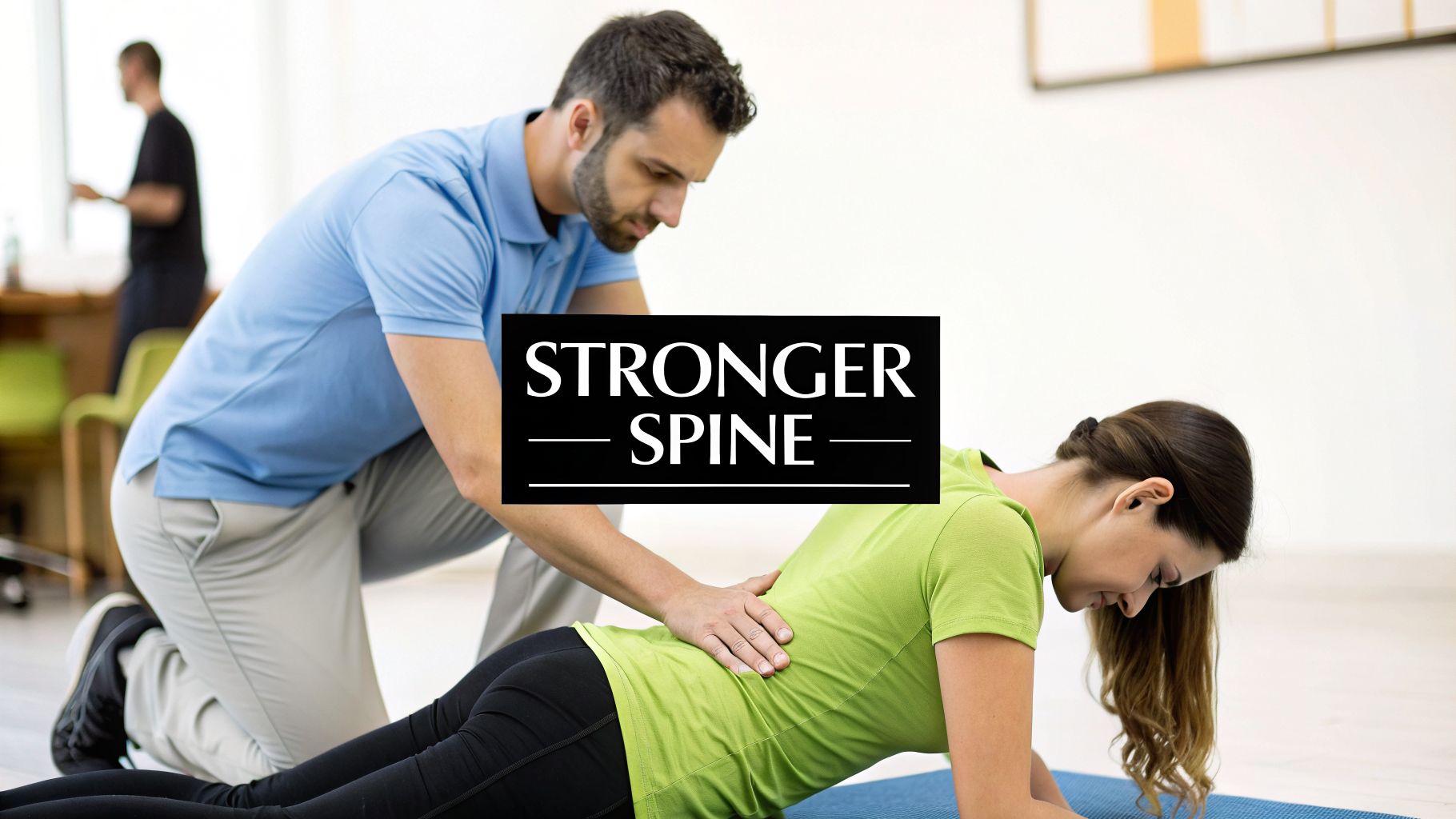
Back pain can disrupt everything, from a productive day at the office to a weekend enjoying the outdoors in Cedar Park. Whether it’s a dull, persistent ache or a sharp, limiting pain, spinal discomfort is a common concern for active individuals, desk workers, and everyone in between. If you are looking for a back pain chiropractor in Cedar Park, you understand that waiting until pain strikes is not the best approach. Building a resilient, well-supported spine through targeted movement is your best defense against future injury and chronic issues.
This guide provides an actionable plan, outlining specific exercises to prevent back pain, focusing on strengthening the core, improving mobility, and correcting muscular imbalances that often lead to strain. Before diving into these exercises, it’s helpful to understand the various forms of discomfort, such as understanding specific causes of back pain, which can help you recognize why these movements are so critical.
Inside this list, you will find clear step-by-step instructions, recommended sets and repetitions, and common mistakes to avoid. We’ll also include modifications tailored for different fitness levels. This approach is designed to empower you to integrate these powerful movements into your daily routine. If you live in Cedar Park, Leander, or North Austin and find that persistent pain is holding you back, the experts at Bell District Spine and Rehab are here to provide a professional assessment and personalized care plan from a trusted local chiropractor. Let’s begin building your foundation for a pain-free back.
1. Core Stabilization Exercises (Dead Bug & Bird Dog)
When most people think of “core work,” they picture crunches. However, true core stability comes from the deep muscles that act like a natural corset for your spine. Core stabilization exercises, particularly the Dead Bug and Bird Dog, are fundamental for building this support system and are some of the most effective exercises to prevent back pain. A weak core is a common issue our sciatica chiropractor sees in patients from Cedar Park.
These movements train your brain and body to hold the spine in a safe, neutral position while your limbs are in motion. This skill is critical for distributing loads evenly and preventing excessive stress on spinal discs and joints. This is a key principle our chiropractors use when developing treatment plans for disc injury and back pain.
How Chiropractic Care Utilizes These Exercises
At Bell District Spine and Rehab, we often prescribe the Dead Bug and Bird Dog to complement chiropractic adjustments. They target the deep transverse abdominis and multifidus muscles, which stabilize your spine. By activating these muscles, you build endurance and control, protecting your back during daily activities like lifting groceries or sitting at a desk. They are low-impact, making them exceptionally safe for nearly everyone seeking chiropractic care.
- For Desk Workers: Performing Bird Dogs during a break can counteract the spinal strain from prolonged sitting.
- For Auto Injury Patients: These exercises help rebuild core control after a whiplash or lower back injury.
- For Prenatal Chiropractic Patients: The controlled nature of the Dead Bug helps improve pelvic stability without straining the back.
How to Perform Dead Bug & Bird Dog
Actionable Tips for Proper Form:
- Frequency: Start with 2-3 sets of 8-12 repetitions per side, performing them 3-4 times per week.
- Focus on Control: Slow, deliberate movement is more important than speed. The goal is stability, not fatigue.
- Maintain a Neutral Spine: Press your lower back gently into the floor during the Dead Bug to prevent it from arching. Imagine a glass of water resting on your lower back during the Bird Dog; don’t let it spill.
- Breathe: Exhale as you extend your arm and leg, and inhale as you return to the starting position.
- Activate Before Lifting: Use these exercises as a primer before a workout to ensure your core is engaged and ready to support you.
2. Cat-Cow Stretch (Marjaryasana-Bitilasana)
The Cat-Cow stretch is a gentle, dynamic sequence that is fundamental for spinal mobility. This movement gracefully guides your spine through its full range of flexion (rounding) and extension (arching). This rhythmic motion acts like a pump for the intervertebral discs, encouraging fluid circulation to keep them healthy. It is one of the most highly recommended exercises to prevent back pain because it directly addresses stiffness, a common complaint we hear from patients looking for a chiropractor in Cedar Park, TX.
For residents in Cedar Park and the surrounding areas dealing with morning stiffness or back tension, incorporating Cat-Cow into a daily routine can be incredibly beneficial. This movement gently decompresses the spine, eases muscular tension along the back and neck, and improves your mind-body connection, teaching you to feel and control your spinal position.

How Chiropractic Care Utilizes This Exercise
The Cat-Cow stretch mobilizes each segment of your spine, from your tailbone to your neck. By alternating between poses, you increase the flexibility of the back, neck, and shoulders. This movement improves posture and balance by waking up the small stabilizer muscles along the spine. It’s a foundational exercise used in chiropractic settings to restore normal movement patterns and support spinal alignment. As your neck pain chiropractor, we often recommend this to relieve tension.
- For Desk Workers: Performing Cat-Cow during a break can relieve the strain caused by hours of sitting.
- For Post-Adjustment Care: It serves as a safe method for maintaining mobility after spinal adjustments.
- For Morning Stiffness: Starting the day with this stretch can warm up the spinal muscles and alleviate overnight stiffness.
How to Perform Cat-Cow Stretch
Actionable Tips for Proper Form:
- Frequency: Aim for 1-2 minutes (about 10-15 full cycles) in the morning and evening.
- Coordinate with Breath: Inhale as you drop your belly for Cow pose. Exhale as you round your spine for Cat pose. Let your breath guide the movement.
- Focus on the Spine: Initiate the movement from your tailbone and let it ripple up your spine to your head.
- Gentle and Slow: Avoid pushing into any range that causes pain. The goal is fluid motion.
- Modifications: If you have wrist pain, you can perform this stretch on your forearms. For those unable to kneel, a seated version can be done in a chair.
3. Glute Bridges & Single-Leg Glute Bridges
Many cases of low back pain stem not from the back itself, but from weak or inactive glute muscles. The Glute Bridge is a foundational exercise designed to strengthen the gluteus maximus. When your glutes are weak, the lower back and hamstrings are forced to compensate, leading to excessive stress on the lumbar spine and potential disc compression. This is a common pattern seen by our sciatica chiropractor in Cedar Park.

This movement re-educates your body on how to move correctly by rebalancing the relationship between your hips and spine. By activating the glutes, you create a powerful support system that offloads the lower back, making this one of the most effective exercises to prevent back pain.
How Chiropractic Care Utilizes These Exercises
Glute Bridges directly combat the negative effects of a sedentary lifestyle, especially “gluteal amnesia” where the glutes forget how to fire properly. This exercise isolates the glutes, forcing them to engage without placing strain on the back. At Bell District Spine and Rehab, we use this exercise to support spinal alignment and reduce strain. Progressing to a single-leg variation helps correct muscular imbalances between the left and right sides of your body.
- For Desk Workers: Performing glute bridges can awaken dormant glute muscles and counteract the postural strain of sitting.
- For Athletes: Single-leg variations are excellent for injury prevention and improving unilateral strength needed for sports.
- For Post-Injury Rehab: These are often prescribed to rebuild hip strength safely after a hamstring or lower back injury.
How to Perform Glute Bridges
Actionable Tips for Proper Form:
- Frequency: Aim for 3 sets of 12-15 repetitions, performing them 3-4 times per week.
- Focus on Contraction: The key is to squeeze your glutes hard at the top of the movement. Hold the squeeze for 1-2 seconds.
- Maintain a Neutral Spine: Avoid arching your lower back. Your body should form a straight line from your shoulders to your knees.
- Progress Safely: Once you master the basic bridge, progress to the single-leg version or add a resistance band.
- Prime Before a Workout: Use Glute Bridges as a warm-up to ensure your glutes are activated and ready to support you.
4. Quadruped Spinal Extensions (Superman Hold & Variations)
While many exercises focus on flexing the spine forward, quadruped spinal extensions strengthen the posterior chain—the muscles along your back. These extensions are excellent exercises to prevent back pain by building strength in the spinal erectors without placing harmful compressive loads on the discs. This is a safe and effective exercise our auto injury chiropractor might recommend.
This movement counteracts the effects of modern life, especially the forward-hunched posture common among desk workers in Cedar Park and Leander. By strengthening the muscles that hold your spine upright, you restore a more natural and resilient posture. This exercise is a staple in physical therapy and chiropractic rehabilitation for its safe activation of key stabilizer muscles.
How Chiropractic Care Utilizes These Exercises
Quadruped spinal extensions target the erector spinae and multifidus muscles along your spine. Holding the position isometrically (without movement) builds endurance, helping them support your spine against gravity. Performing this from an all-fours position reduces the load on your back, making it a safer starting point for those with existing pain.
- For Office Workers: Performing these extensions during a break can directly combat forward-leaning posture.
- For Post-Adjustment Care: After a chiropractic adjustment at our Cedar Park clinic, these holds help stabilize the spine and maintain proper alignment.
- For Disc Hernia Rehabilitation: The position offers gentle activation and can be part of a disc injury treatment plan.
How to Perform Quadruped Spinal Extensions
Actionable Tips for Proper Form:
- Frequency: Start with 3 sets of 20-30 second holds, 4-5 times per week.
- Maintain a Neutral Spine: Begin on your hands and knees. Engage your core and keep your back flat, avoiding any significant arch.
- Progress Gradually: Start by lifting one arm or one leg. Once stable, progress to lifting the opposite arm and leg simultaneously.
- Breathe Steadily: Do not hold your breath during the hold. Breathe slowly and consistently.
- Combine for Balance: Pair these with anterior core work like the Dead Bug or a plank to build balanced, 360-degree stability.
5. Hip Flexor Stretches (90/90 Stretch, Couch Stretch, Lunges)
Constant sitting, a common part of life for desk workers in Cedar Park, often leads to chronically tight hip flexors. This tightness creates a chain reaction that directly impacts your lower back. When the muscles at the front of your hips are shortened, they pull your pelvis forward. This exaggerates the curve in your lower back, compressing the spinal discs and leading to pain.
Hip flexor stretches are critical exercises to prevent back pain because they work to reverse this process. By lengthening these tight muscles, you reduce the strain on your lumbar spine and improve your overall posture. This is especially important for patients seeking headache relief, as poor posture often contributes to neck tension.
How Chiropractic Care Utilizes These Exercises
Strategic stretching of the hip flexors directly counteracts the effects of prolonged sitting. By holding stretches like the 90/90 or a lunge, you are encouraging the muscle fibers to lengthen, which allows the pelvis to return to a neutral position. This alleviates the excessive arch in your lower back, taking pressure off compressed structures. It is a fundamental component of maintaining the pelvic alignment achieved through chiropractic care.
- For Desk Workers: Performing a Couch Stretch daily can combat the negative effects of hours spent in a chair.
- For Athletes: Dynamic lunges are essential for warm-ups and cool-downs to maintain hip mobility.
- For Rehab Patients: Following a chiropractic adjustment at Bell District Spine and Rehab, gentle hip flexor stretches help maintain proper alignment and support recovery from lower back pain.
How to Perform Hip Flexor Stretches
Actionable Tips for Proper Form:
- Frequency: Aim to perform these stretches daily or at least 4-5 times per week.
- Duration: Hold each static stretch for 30-60 seconds on each side. Do not bounce.
- Engage Your Glutes: To deepen the stretch and protect your back, gently squeeze the glute of the leg being stretched.
- Mindful Breathing: Breathe deeply and slowly throughout the stretch. Exhale as you sink slightly deeper.
- Pair with Strengthening: For lasting change, combine these stretches with core and glute strengthening.
6. Planks & Modified Plank Progressions
While crunches involve movement, the plank is an isometric exercise that teaches the body to maintain stability and prevent painful spinal movements. Planks engage the entire front and side core musculature and are foundational exercises to prevent back pain because they build postural endurance. If you’re looking for a “chiropractor near me” for back pain, strengthening your core will be a key part of your recovery.
This endurance is the ability to hold proper spinal alignment during everyday tasks. Unlike exercises that involve spinal flexion, planks train your core to act as a protective brace. This is why planks are a staple in physical therapy and injury prevention programs designed by chiropractors in Cedar Park and beyond.

How Chiropractic Care Utilizes These Exercises
Planks create tension throughout the core to resist gravity, building strength without movement. This teaches the body to keep the spine neutral and stable. Modified plank progressions, such as side planks, add a rotational stability challenge, which is essential for protecting the back during twisting motions. This makes planks a safe and effective starting point for nearly everyone under chiropractic care.
- For Desk Workers: Short plank circuits can build the endurance needed to maintain good posture.
- For Athletes: Integrating planks into a warm-up “activates” the core muscles, preparing them to support the spine.
- For Seniors: Modified planks, such as on the knees or against a wall, improve postural control and balance.
How to Perform Planks & Progressions
Actionable Tips for Proper Form:
- Frequency: Begin by holding a plank for 20-30 seconds. Perform 2-3 sets, 4-5 times per week.
- Focus on Control: A solid 20-second plank with perfect form is far more beneficial than a sloppy 60-second one.
- Maintain a Neutral Spine: Keep a straight line from your head to your heels. Avoid letting your hips sag or rise too high.
- Engage Your Core: Actively draw your belly button toward your spine and squeeze your glutes.
- Breathe: Breathe steadily and deeply throughout the hold.
- Add Variations: Once you can hold a standard plank for 60 seconds, add side planks to target your obliques and improve rotational stability.
7. Thoracic Spine Mobility Drills (Quadruped T-Spine Rotation & Wall Slides)
While many focus on the lower back, a stiff middle back (thoracic spine) is often the secret culprit behind lumbar pain. A stiff thoracic spine forces the lower back to compensate by rotating and bending excessively, leading to strain. Thoracic spine mobility drills are key exercises to prevent back pain by restoring healthy movement to this critical area.
These drills specifically target the rotational and extension capabilities of your mid-back. By “unlocking” the thoracic spine, you allow for better movement mechanics from your shoulders down to your hips. This directly reduces the stress placed on your lumbar discs and joints. This is a technique our upper cervical chiropractor may use to improve overall spinal function.
How Chiropractic Care Utilizes These Exercises
Quadruped T-Spine Rotations and Wall Slides re-educate your body to move through the mid-back instead of the lower back. This helps correct postural issues like the forward hunch common in desk workers, a major factor in how poor posture can contribute to back pain. Improving thoracic mobility ensures forces are distributed properly, protecting the lumbar spine from overload.
- For Desk Workers: Performing T-spine rotations during a break can counteract stiffness and hunched posture.
- For Athletes: These drills are essential warm-ups for rotational sports like golf, tennis, or baseball.
- For Seniors: Wall Slides gently encourage better upright posture and improve shoulder range of motion.
How to Perform Thoracic Spine Mobility Drills
Actionable Tips for Proper Form:
- Frequency: Aim for 2-3 sets of 10-12 repetitions per side, performing them daily or as a warm-up.
- Move with Intention: The focus should be on slow, controlled movement through the fullest pain-free range.
- Isolate the Mid-Back: During rotations, try to keep your hips square. The rotation should come from your torso.
- Breathe into the Movement: Exhale as you rotate or extend into the stretch and inhale as you return to neutral.
- Use as a Movement Break: In Cedar Park, many of us spend time at a desk. Use these drills for a quick break to reset your posture.
8. Quadriceps & Rectus Femoris Stretching (Kneeling Quad Stretch, Standing Quad Stretch)
While many associate back pain with tight hamstrings, the powerful muscles on the front of your thighs (quadriceps) play a critical role. Tight quads can pull your pelvis forward into an anterior tilt. This tilt increases the arch in your lower back, compressing the spinal discs and forcing the back muscles to overwork.
This is why dedicated quadriceps stretching is one of the most important, yet often overlooked, exercises to prevent back pain. These stretches restore proper muscle length and help return the pelvis to a neutral, stable position. By addressing this imbalance, you directly reduce the mechanical load on your lumbar spine.
How Chiropractic Care Utilizes These Exercises
The Kneeling and Standing Quad Stretches specifically target the quadriceps muscles. Lengthening these muscles allows the pelvis to sit correctly, which alleviates the excessive curve in the lower back. This creates a more balanced system where your glutes and hamstrings can function properly, taking strain off your back. These stretches are crucial for a complete lower-body mobility routine that supports chiropractic adjustments.
- For Desk Workers: A simple standing quad stretch during a break can counteract the effects of sitting.
- For Athletes: Post-workout quad stretching is essential for recovery and preventing imbalances.
- For Seniors: Gentle, supported quad stretches improve lower body mobility, making it easier to stand up and walk.
How to Perform Quadriceps Stretches
Actionable Tips for Proper Form:
- Frequency: Perform 2-3 sets, holding each stretch for 30-60 seconds per side. Aim to do this daily.
- Maintain a Neutral Spine: During the kneeling stretch, gently tuck your tailbone and engage your core to prevent your back from arching.
- Focus on Control: The goal is to feel a gentle pull along the front of your thigh. If you feel pain, ease off the stretch.
- Breathe Deeply: Exhale as you gently deepen the stretch. Consistent breathing helps the muscle relax.
- Warm Up First: Always perform stretches when your muscles are warm, either after a brief warm-up or at the end of a workout.
Comparison of 8 Back Pain Prevention Exercises
| Exercise | Implementation complexity | Resource requirements | Expected outcomes | Ideal use cases | Key advantages |
|---|---|---|---|---|---|
| Core Stabilization Exercises (Dead Bug & Bird Dog) | Moderate — requires cueing for correct form | None (bodyweight); small space | Improved deep core stability, better neutral spine, reduced back pain over weeks | Desk workers, rehab patients, injury prevention | Targets transverse abdominis/multifidus; low injury risk; scalable |
| Cat‑Cow Stretch (Marjaryasana‑Bitilasana) | Low — simple rhythmic movement | None; mat optional | Immediate spinal mobility and reduced stiffness; gentle decompression | Disc‑related stiffness, daily mobility routine, warm‑up/cool‑down | Safe daily practice; improves proprioception and disc fluid distribution |
| Glute Bridges & Single‑Leg Glute Bridges | Moderate — needs correct glute activation | None; optional bands/weights | Increased hip extension strength, reduced lumbar compensation (noticeable in weeks) | Sedentary individuals, athletes, rehab for hip/back | Directly addresses glute weakness; rapid functional strength gains |
| Quadruped Spinal Extensions (Superman Hold & Variations) | Moderate — requires core endurance and control | None | Improved posterior chain endurance and spinal stability without disc compression | Postural rehab, post‑treatment stabilization, deconditioned patients | Strengthens spinal extensors safely; counters forward‑flexed posture |
| Hip Flexor Stretches (90/90, Couch, Lunges) | Low — simple holds and progressions | None | Restored pelvic neutral, reduced anterior pelvic tilt and back strain (with consistency) | Desk workers, athletes, post‑treatment maintenance | Immediate postural relief; easy daily implementation |
| Planks & Modified Plank Progressions | Moderate — demands body awareness to avoid compensation | None | Improved core/endurance stability and posture maintenance | General population, rehab, pre‑exercise core activation | Functional full‑core endurance; easily progressed and measurable |
| Thoracic Spine Mobility Drills (T‑Spine Rotation, Wall Slides) | Low–Moderate — technique focused | None; wall or foam roller optional | Increased thoracic rotation/extension, less lumbar compensation | Desk workers with kyphosis, rotational athletes, post‑adjustment care | Rapid mobility gains; improves breathing and upper‑body mechanics |
| Quadriceps & Rectus Femoris Stretching (Kneeling/Standing) | Low — straightforward static stretches | None | Reduced anterior pelvic tilt and improved hip/knee mobility (requires consistency) | Individuals with tight anterior chain, postural imbalance | Addresses often‑neglected muscle group; immediate pelvic positioning feedback |
What to Expect at Your Cedar Park Chiropractor
We have explored a collection of exercises designed to build a resilient and pain-free back. From foundational core stabilizers like the Dead Bug to mobility-enhancing movements like the Cat-Cow, each exercise serves a critical purpose. This guide has provided you with the “what” and the “how,” but the key message is clear: consistency is your greatest ally.
Integrating these exercises to prevent back pain into your life is where the real change happens. Think of this routine as an investment in your body’s structural integrity. Your spine is the central pillar of your musculoskeletal system, and nurturing the muscles that support it is one of the most effective wellness strategies you can adopt.
Why Choose Chiropractic Care for Back Pain?
The journey from discomfort to relief is built one consistent step at a time. While exercises are crucial, they are most effective when combined with professional care that addresses the root cause of your pain.
- Benefit 1: Accurate Diagnosis. A chiropractor can identify specific spinal misalignments, disc issues, or nerve compression that general exercises may not resolve.
- Benefit 2: Targeted Adjustments. Chiropractic care uses precise adjustments to restore proper spinal alignment, relieving pressure on nerves and reducing pain. This makes supportive exercises even more effective.
- Benefit 3: Personalized Treatment Plan. We create a plan tailored to your body, combining adjustments with specific exercises, stretching, and lifestyle advice for lasting results. Services like spinal decompression can further enhance your recovery.
To support your body’s recovery, exploring complementary therapies such as a sauna for pain relief can be beneficial. However, it is vital to recognize when professional guidance is necessary. While these exercises are safe for many, they cannot replace a personalized diagnosis from a qualified expert, especially if you are dealing with sharp, radiating pain, numbness, or a recent injury from a car accident. For residents of Cedar Park and the surrounding communities, this is where expert care becomes essential.
Don’t let back pain dictate your life. If you’re in Cedar Park, Leander, or North Austin and need a personalized plan to address your specific symptoms, the team at Bell District Spine and Rehab is here to help. As your trusted local chiropractor, we combine expert diagnostics with targeted care to get to the root of your discomfort. Schedule your consultation today and take the first real step toward lasting relief.