
When that sudden, sharp pain shoots down your arm or leg, your first thought is simple: make it stop. That radiating ache, numbness, or tingling from a pinched nerve can be alarming and disrupt your life in Cedar Park. The good news is that you can take immediate steps at home to calm the inflammation, but lasting relief requires addressing the root cause.
At Bell District Spine and Rehab, we understand how debilitating nerve pain can be. As a trusted local chiropractor serving patients in Cedar Park, Leander, and the surrounding communities, our focus is on helping you find not just temporary relief, but a true, lasting solution.
Finding Immediate Relief for Pinched Nerve Pain at Home

A pinched nerve can be incredibly frustrating, disrupting everything from your workday to your sleep. Before you can get professional help from a chiropractor, managing the symptoms at home is a crucial first step. The goal here isn’t to fix the problem, but to reduce the inflammation and avoid making it worse.
The Right Way to Use Ice and Heat
So, should you use ice or heat? It’s a question we get all the time at our Cedar Park clinic, and the answer is usually both—but the timing is key. For the first 24-48 hours after the pain flares up, stick with ice. Wrap an ice pack in a thin towel and apply it to the area for 15-20 minutes at a time. This helps numb the immediate pain and, more importantly, reduces the swelling that might be pressing on that nerve.
After that initial inflammatory window, you can bring heat into the mix. A heating pad or a warm compress, also for 15-20 minutes, works wonders to relax the tight, spasming muscles that often contribute to nerve compression. Many of our patients find that alternating between the two gives them the best of both worlds.
Strategic Rest and Activity Modification
While it’s tempting to lie perfectly still, complete inactivity can actually make you stiffer and weaken the very muscles you need for recovery. The key is strategic rest. This means you stop doing the specific things that trigger your pain, but you don’t stop moving altogether.
If sitting at your desk makes your sciatica flare, try working at a standing desk for part of the day. If your long commute from Leander to Austin is causing neck pain, double-check that your car’s headrest is properly positioned to support your head and neck.
The goal isn’t to stop moving entirely but to move smarter. Pay close attention to what your body is telling you. A gentle stretch should feel relieving; sharp pain is a signal to stop immediately.
Optimizing Your Sleep Position
A pinched nerve can make getting a decent night’s sleep feel like an impossible dream. The way you sleep plays a massive role in either taking pressure off the nerve or making it much, much worse.
-
For Sciatica (Pinched Nerve in Low Back): If you’re a back sleeper, tuck a pillow under your knees to flatten your lower spine and reduce strain. For side sleepers, a pillow between your knees is a game-changer for keeping your hips, pelvis, and spine in alignment.
-
For a Pinched Nerve in the Neck: Sleeping on your stomach is the worst position for your neck, as it forces it into an awkward twist all night long. Stick to your back or side, and use a pillow that cradles your head and keeps your neck in a straight, neutral line. Finding the right support is critical, and it might be worth investing in a quality neck pain pillow to help you heal while you sleep.
Here’s a quick-reference guide to help you safely manage your pinched nerve symptoms before seeking professional chiropractic care in Cedar Park.
Quick Guide to At-Home Pinched Nerve Care
| Action | What to Do (The Right Way) | What to Avoid (Common Mistakes) |
|---|---|---|
| Ice & Heat | Use ice for 15-20 mins in the first 24-48 hours. After that, alternate with heat. | Applying heat too early, which can increase inflammation and make the pain worse. |
| Rest | Practice “strategic rest”—avoid painful movements but keep moving gently to prevent stiffness. | Complete bed rest, which can weaken muscles and slow down your recovery. |
| Sleep | Use pillows to support your body and keep your spine aligned (under knees for back sleepers, between knees for side sleepers). | Sleeping on your stomach (for neck pain) or using a stack of pillows that bends your neck. |
| Movement | Listen to your body. Stop any stretch or activity that causes sharp, shooting, or increased pain. | Pushing through the pain or trying aggressive stretches that could further irritate the nerve. |
These at-home strategies are your best first line of defense, but remember, they are temporary fixes designed to manage symptoms. To get to the root cause of the compression and find lasting relief, a professional evaluation from a trusted Cedar Park chiropractor is the most important next step.
Understanding What Causes a Pinched Nerve
To get rid of that sharp, zinging pain for good, we have to look past the symptoms and figure out what’s actually causing the problem in the first place. The pain, numbness, or tingling you’re feeling is really just a warning light on your car’s dashboard. You could put tape over the light, but that doesn’t fix the engine. Uncovering the root cause is the only way to find a real, lasting solution.
A pinched nerve, or what we call nerve compression, is exactly what it sounds like. Too much pressure is being put on a nerve by the tissues around it—bone, cartilage, muscles, or tendons. Your nerves are the electrical wiring of your body. When something squeezes or irritates that wire, the signal gets scrambled. This is what creates that sharp, shooting pain or frustrating weakness.
Common Culprits Behind Nerve Compression
So, what’s doing the squeezing? Several things can lead to a nerve getting pinched, and many are tied to our daily lives and activities right here in the Cedar Park area.
-
Herniated Discs: Your spinal discs are the shock-absorbing cushions between your vertebrae. If you lift something the wrong way or just from years of wear and tear, the soft, gel-like center of a disc can bulge or rupture through its tougher outer layer. When this material presses on a nearby spinal nerve, it can trigger intense pain, like the sciatica that radiates all the way down your leg.
-
Bone Spurs (Osteophytes): In response to joint stress from conditions like osteoarthritis, the body sometimes grows extra little bits of bone. While it’s a natural protective mechanism, these bone spurs can end up narrowing the small openings (foramina) where nerves exit the spine, leading to compression.
-
Spinal Stenosis: This is simply a term for the narrowing of the spinal canal. Whether it’s caused by thickened ligaments, bulging discs, or bone spurs, this process leaves less room for the spinal cord and nerves. It often results in pressure and pain, especially in the neck and lower back.
How Your Lifestyle Plays a Role
It’s not always about a single major injury. More often than not, our everyday habits are the biggest contributors. Repetitive motions at work, poor posture from being stuck at a desk all day, or even the stress from a long commute can create the perfect storm for a pinched nerve.
Think of it this way: if a garden hose gets a kink in it, the water flow becomes weak or stops entirely. The same principle applies to your nerves. Chronic muscle tension, a misaligned spine, or inflammation can create a “kink” that interferes with nerve signals. These disruptions can lead to anything from a sharp, localized pain to more widespread issues. For a deeper dive, you can learn more about neuropathy and various treatment options available for these types of nerve-related conditions.
Key Takeaway: A pinched nerve is rarely the problem itself. It’s a symptom of an underlying mechanical issue. Something—a herniated disc, a bone spur, or chronic muscle tension—is physically compressing the nerve and disrupting its ability to function.
Understanding this difference is incredibly powerful. It means that by finding and fixing the root cause—the source of the pressure—we can offer much more than just a temporary fix. At Bell District Spine and Rehab, our diagnostic process is designed to do exactly that. Dr. Tuggle’s extensive experience helps him pinpoint what’s causing your pain, which allows us to create a targeted treatment plan that addresses the real problem for a permanent solution.
Gentle Stretches to Relieve Nerve Pressure
When a nerve gets pinched, your first instinct is probably to stay as still as possible. The thought of moving, let alone stretching, can seem terrifying. But in many cases, the right kind of gentle, targeted movement is exactly what your body is craving. The goal here isn’t to push through the pain, but to create space, ease muscle tension, and coax that trapped nerve into moving more freely.
This is all about decompressing the nerve, which often gets squeezed by surrounding tissues like a bulging disc or a chronically tight muscle. This diagram shows a classic example of how spinal structures can lead to nerve compression.

As you can see, a problem like a herniated disc can put direct pressure on a nerve root, which is what causes that radiating pain, numbness, or tingling. Gentle exercises are designed to carefully open up that space.
The most important rule? Listen to your body. There’s a huge difference between the feeling of a productive, gentle stretch and the sharp, shooting pain that screams, “Stop!” If any movement causes that kind of alarm bell pain, back off immediately.
Stretches For Neck And Shoulder Pain
If your pinched nerve is in your neck (what we call the cervical spine), you’ll likely feel pain, numbness, or tingling that travels down your shoulder and into your arm or hand. These specific movements are designed to relieve pressure right at the source.
-
Chin Tucks: While sitting or standing up straight, gently pull your chin backward like you’re trying to give yourself a double chin. You should feel a light stretch at the very back of your neck. Hold this for 3-5 seconds and repeat about 10 times. This is a fantastic counter-stretch for the “tech neck” posture we all get from staring at screens.
-
Head Tilts: Slowly and gently, tilt your head to bring your left ear toward your left shoulder. Go only until you feel a comfortable stretch on the right side of your neck. Hold for 15-20 seconds, then switch sides. The key here is to keep your shoulders relaxed and down—don’t let them shrug up to meet your ear.
Movements For Sciatica And Lower Back Pain
Sciatica—that searing pain that radiates down the back of the leg—is one of the most common signs of a pinched nerve in the lower back (or lumbar spine). These stretches focus on easing tension in the low back, hips, and glutes, which are often the main culprits in sciatic nerve irritation.
-
Knee-to-Chest Stretch: Lie on your back with both knees bent and your feet flat on the floor. Gently bring one knee toward your chest, using your hands to pull it in until you feel a comfortable stretch in your lower back and hip. Hold for 20-30 seconds. Release it slowly and then do the same with the other leg.
-
Seated Piriformis Stretch: Sit in a sturdy chair and cross your right ankle over your left knee. Keeping your back straight, gently lean your chest forward until you feel a deep stretch in your right glute. Hold for 20-30 seconds and then repeat on the other side. This stretch specifically targets the piriformis muscle, a small but powerful muscle that can directly compress the sciatic nerve when it gets too tight.
While these movements can provide some much-needed relief at home, they are not a replacement for a professional diagnosis. Performing the wrong exercise for your specific condition could make things much worse. An expert evaluation at our Cedar Park chiropractic clinic is essential to confirm the true cause of your pain and get you on the right recovery plan.
To improve your overall flexibility and help manage nerve-related discomfort, you might also find that incorporating gentle yoga stretches into your routine can be incredibly effective.
Ultimately, these exercises are a great tool for self-management, but their real power is unlocked when they’re paired with professional care. At Bell District Spine and Rehab, we conduct a detailed movement analysis to pinpoint exactly which exercises will benefit you the most, making them part of a complete treatment plan that gets to the root cause of your pinched nerve.
When It’s Time to See a Chiropractor for a Pinched Nerve
You’ve tried the ice packs. You’ve done the gentle stretches. While you might get a bit of temporary relief, that nagging, sharp pain from a pinched nerve just keeps coming back. That’s because home care, while helpful, often just quiets the symptoms.
A pinched nerve is a clear signal that something is mechanically wrong. Ignoring that underlying issue is a risk, and knowing when to escalate from self-care to professional help is key to preventing a minor annoyance from becoming a chronic, debilitating problem.
If you’ve been trying home remedies for a few days without any real improvement, it’s a clear signal to seek a professional diagnosis. Pain that lingers, comes back frequently, or gets worse is your body telling you that the root cause hasn’t been addressed.
Recognizing the Red Flags
Certain symptoms should never be ignored. Think of these as clear signs that your body needs an expert evaluation from a chiropractor in Cedar Park. Don’t wait to schedule a visit if you experience any of the following:
- Pain Lasting More Than a Few Days: If the discomfort doesn’t significantly improve with rest and ice, it’s time for a professional look.
- Worsening Numbness or Weakness: If the tingling in your fingers progresses to numbness, or you find it harder to grip objects, this indicates the nerve compression is becoming more serious.
- Pain That Disrupts Your Life: When the pain starts interfering with your ability to work, sleep, or enjoy your daily activities, it’s no longer something to “wait out.”
- Radiating Pain: Sharp, shooting pain that travels down your arm or leg is a classic sign of nerve root compression (radiculopathy) that requires a specific diagnosis.
At Bell District Spine and Rehab, we see patients from Cedar Park, Leander, and Austin who waited too long, hoping the pain would just go away. Seeking care sooner leads to a faster, more effective recovery and prevents long-term nerve damage.
The Bell District Spine and Rehab Difference
Choosing the right provider is crucial. Here in Cedar Park, you need a back pain chiropractor who can do more than provide a temporary fix. You need an expert who can accurately diagnose the source of the pressure and create a plan to resolve it for good. This is where Dr. John Tuggle’s 24+ years of experience makes all the difference.
Our entire approach is built on finding the root cause. We use a detailed diagnostic process to understand why your nerve is pinched—whether it’s a herniated disc, spinal misalignment, or muscle imbalance. Conservative, non-invasive treatments are remarkably effective for most pinched nerve cases, with research showing the majority of patients recover without surgery.
For those seeking drug-free solutions, spinal decompression therapy has a success rate of around 80% with minimal risk, often bringing relief in just a few weeks. You can discover more about how spinal decompression successfully treats pinched nerves on spinatomycenters.com.
Don’t let a pinched nerve control your life. If you’re tired of the pain and ready for a real solution, it’s time to see the trusted chiropractor near me for so many in our community.
Advanced Chiropractic Treatments for Pinched Nerves

You’ve tried the ice packs, you’ve done the stretches, and you’ve rested as much as you can. But that sharp, shooting pain—or that frustrating numbness and tingling—just won’t quit. When self-care at home stops moving the needle, it’s a clear signal that the problem needs a more direct, professional approach.
At Bell District Spine and Rehab in Cedar Park, we move beyond the basics. Our goal is to fix the underlying mechanical issue causing the nerve compression, not just quiet the symptoms with medication. We have a toolbox of advanced, non-invasive therapies designed to target the precise source of your pain and deliver lasting relief.
It all starts with Dr. Tuggle’s comprehensive diagnostic process, which includes a detailed movement analysis. This isn’t just about finding where it hurts; it’s about understanding why it hurts. This deep dive into your body’s mechanics ensures that every treatment is hand-picked for your specific condition, putting you on the fastest and safest road to recovery.
Chiropractic Adjustments To Restore Alignment
The foundation of our treatment for a pinched nerve is often the chiropractic adjustment. When the vertebrae in your spine get stuck or misaligned, they can put direct pressure on nerve roots or lead to problems like disc herniations. An adjustment is a specific, gentle force applied to these joints to restore their natural movement and position.
This isn’t about aggressive “cracking.” It’s a controlled technique that helps to:
- Take immediate pressure off the pinched nerve.
- Calm inflammation and ease the muscle guarding around the area.
- Improve the communication between your brain and body through the nervous system.
For anyone in the Cedar Park area looking for a neck pain chiropractor or back pain chiropractor, this precise treatment is often the key that unlocks initial relief and paves the way for deeper healing.
Spinal Decompression Therapy To Create Space
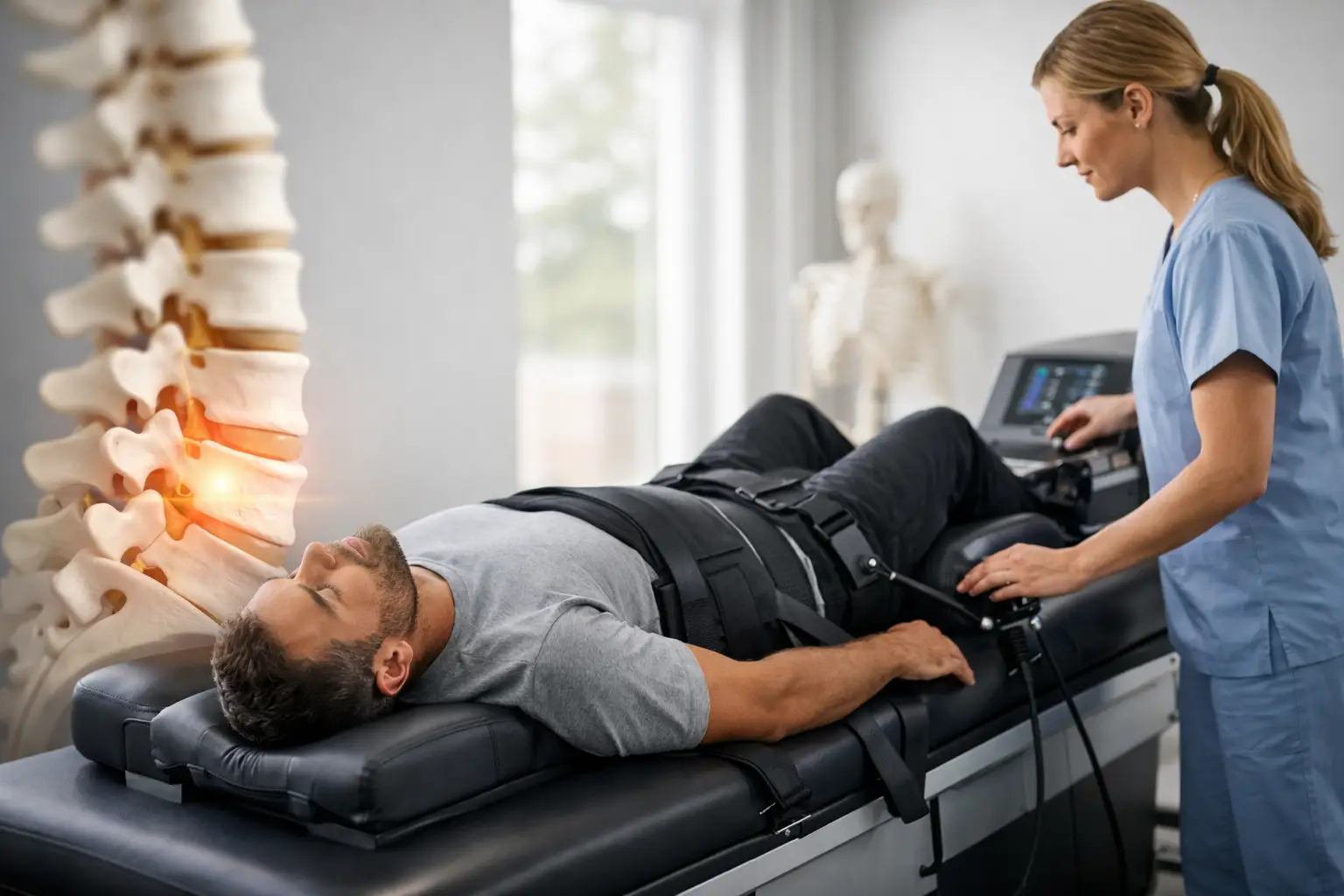
When a pinched nerve is caused by a bulging or herniated disc, spinal decompression is a true game-changer. This non-surgical therapy is incredibly gentle. You simply lie on a specialized table while a computer-controlled system methodically and comfortably tractions, or eases apart, your spine.
This gentle pull creates a vacuum effect inside the disc, which accomplishes two critical things. First, it helps suck the bulging disc material back into its proper place, away from the nerve it’s pressing on. Second, it pulls oxygen, water, and vital nutrients into the disc to kickstart its natural healing process.
This therapy is particularly powerful for stubborn conditions like sciatica, making us a trusted clinic for those seeking a sciatica chiropractor in Cedar Park.
Advanced Modalities for Faster Healing
To support the adjustments and decompression, we use some of the most advanced therapies available to speed up your recovery. These tools allow us to target the inflamed, damaged soft tissues—like muscles and ligaments—that are almost always involved in a pinched nerve issue.
-
Shockwave Therapy: This therapy uses acoustic waves to break down stubborn scar tissue and adhesions that can keep joints restricted. It also triggers new blood vessel formation and fires up the body’s own healing mechanisms. It’s fantastic for the chronic muscle tension that contributes to nerve compression.
-
Class IV Laser Therapy: This painless treatment uses specific wavelengths of light that penetrate deep into your body’s tissues. This light energy dramatically reduces inflammation, eases pain, and accelerates cellular repair, helping the irritated nerve and surrounding muscles heal far more quickly. To see how we use this for muscles and connective tissues, you can read our guide on what soft tissue therapy is.
Our philosophy is to attack the problem from every angle. By correcting alignment, creating space, and healing the damaged soft tissues, we build a comprehensive recovery plan that actually lasts.
While our focus is always on these powerful, non-invasive methods, we believe in giving our patients the complete picture. On the rare occasion that conservative care doesn’t provide the relief you need, surgery may be discussed. Modern minimally invasive procedures can have success rates of around 95% for certain conditions. Surgery is typically reserved for cases where there is clear anatomical evidence for the symptoms and when pain is severe and has not responded to non-surgical treatments over several weeks.
Here at Bell District Spine and Rehab, we are committed to helping our patients avoid the need for surgery whenever possible. If you’re searching for a trusted chiropractor near me in Cedar Park, TX, to fix your pinched nerve without drugs or invasive procedures, our advanced, personalized approach is here for you.
What to Expect at Our Cedar Park Chiropractic Clinic
When you’re stuck with that sharp, shooting, or nagging pain from a pinched nerve, your mind starts racing. What exactly is going on? How long will this last? And will the treatment actually work? These are the exact questions we hear every day at Bell District Spine and Rehab.
We believe an informed patient is an empowered one. Our goal is to cut through the confusion and give you clear, honest answers. We want you to feel confident about your recovery and comfortable taking the next step toward a life without pain. Here are some of the most common questions we get from our patients right here in the Cedar Park community.
How Long Does Chiropractic Recovery from a Pinched Nerve Take?
This is usually the first thing people want to know, and the honest answer is: it really depends. There’s no one-size-fits-all timeline. Your recovery depends on the nerve’s location, how badly it’s compressed, how long you’ve been dealing with the pain, and your overall health.
Many of our Cedar Park patients feel a real, tangible difference within their first few visits. For a simple case of nerve irritation from a tight muscle, you might find significant relief in just a couple of weeks. But for something more complex, like a herniated disc causing severe sciatica, we’re likely looking at a more structured plan that could last 4-8 weeks or longer.
After your initial exam, Dr. Tuggle will give you a clear, personalized timeline. We don’t guess. Your prognosis is based on a deep understanding of your specific condition. Our focus is always on getting you stable, lasting results—not just a temporary fix.
Will My Chiropractic Treatment for a Pinched Nerve Hurt?
Absolutely not. The entire point of what we do is to relieve pain, not add to it. In fact, most patients describe the feeling of an adjustment as an immediate sense of relief or a release of pressure. The idea that adjustments are forceful or painful is a common, but incorrect, myth.
That “popping” or “cracking” sound you might hear isn’t your bones grinding together. It’s simply the safe, natural release of gas—nitrogen, oxygen, and carbon dioxide—from the fluid inside your joints. This is called a cavitation, and it’s the same thing that happens when you crack your knuckles. It’s a good sign that movement is being restored to a joint that was stuck.
Dr. Tuggle uses gentle, specific techniques tailored to your body and comfort level. You might feel a little sore for a day or so after your first couple of treatments, much like you would after trying a new workout. Our team at Bell District Spine and Rehab will walk you through every step, ensuring you feel safe and comfortable the entire time.
Can a Pinched Nerve Just Go Away on Its Own?
While a very minor nerve irritation might occasionally get better with a few days of rest, just waiting and hoping is a big gamble. When you ignore the issue, you’re not addressing the root cause. Without correcting what’s really going on—whether it’s a spinal misalignment, a disc bulge, or a muscle imbalance—the compression is very likely to come back.
Waiting it out can allow a small, fixable issue to progress into a chronic pain cycle, or in some cases, lead to permanent nerve damage. A professional evaluation from a trusted chiropractor in Cedar Park like Dr. Tuggle is the safest and most effective path forward.
An expert diagnosis makes sure we’re treating the right problem. This not only gets rid of your current pain but also dramatically lowers the risk of future flare-ups, saving you from a frustrating cycle of recurring discomfort.
How Can I Prevent Pinched Nerves from Happening Again?
Prevention is a huge part of our philosophy. Our job isn’t done just because your pain is gone. We want to give you the tools and knowledge to stay healthy for the long haul.
Once your initial symptoms are under control, we shift our focus to proactive strategies. This often includes:
- Targeted Strengthening Exercises: We’ll give you specific exercises to stabilize your spine and support the area that was causing you trouble.
- Postural and Ergonomic Coaching: We offer practical, real-world advice for your desk setup, driving posture, and daily movements to keep strain off your spine.
- Proper Lifting Form: Learning how to lift correctly is one of the most powerful ways to protect your back and neck from future injury.
Regular maintenance visits at our Cedar Park chiropractic clinic can also play a key role. These visits allow Dr. Tuggle to catch and correct minor spinal issues before they have a chance to turn into major problems. Conditions like these are widespread; pinched nerves represent a significant global health burden, with cervical radiculopathy—a pinched nerve in the neck—affecting approximately 85 per 100,000 people each year. You can discover more insights about pinched nerve prevalence on deukspine.com. We empower our patients with the lifestyle and ergonomic advice needed to stay healthy and pain-free.
Don’t let a pinched nerve dictate the terms of your life. At Bell District Spine and Rehab, we have the experience and technology to provide a real, lasting solution. If you’re ready to move beyond temporary relief and fix the root cause of your pain, contact us today to schedule your consultation.