
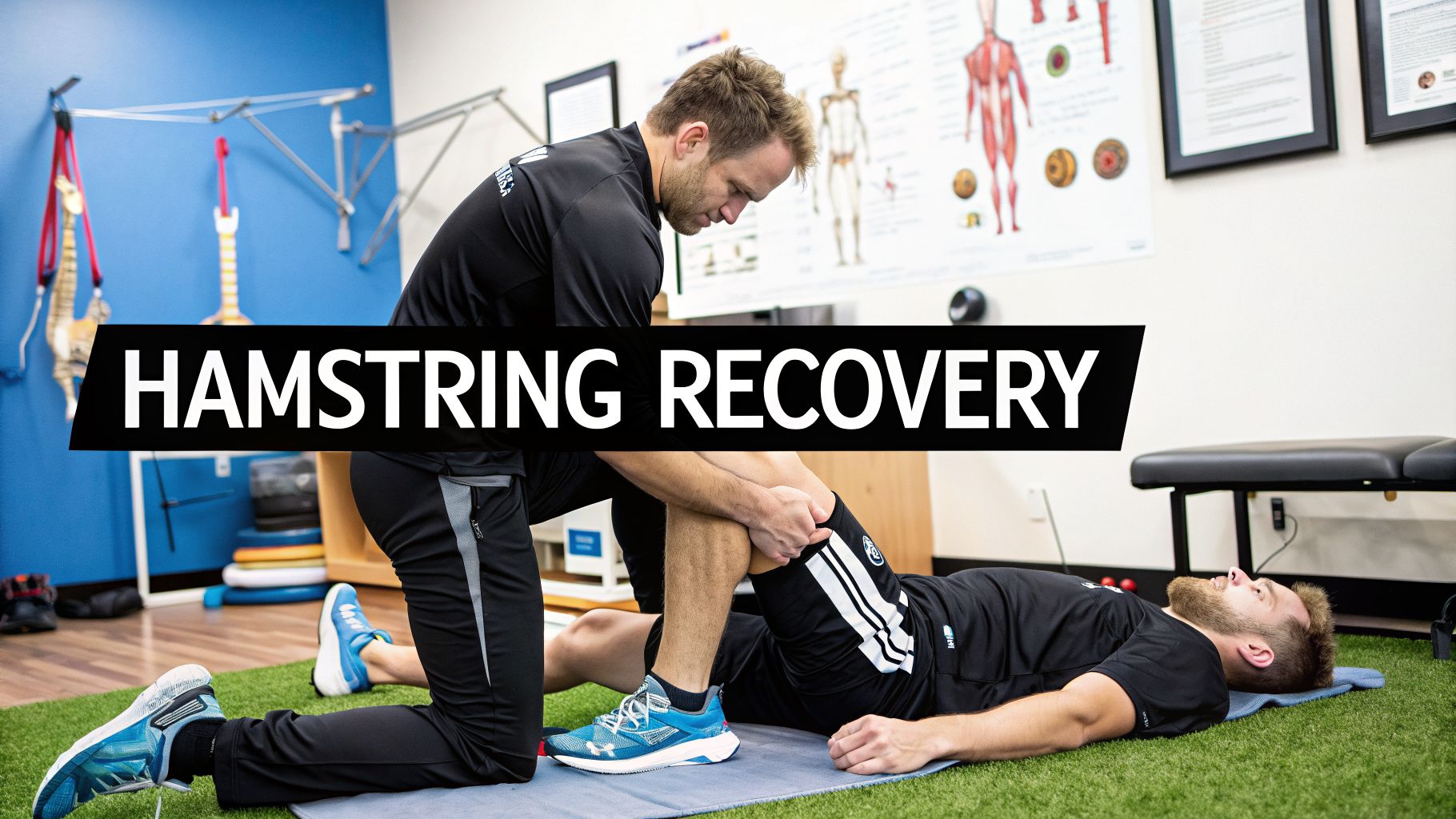
That sudden, sharp “pop” in the back of your thigh is a frustrating and all-too-common setback for active people here in Cedar Park. One moment you’re sprinting for a goal or pulling a new PR in the gym, and the next, you’re on the sideline, in pain and wondering how to recover from a hamstring injury. More importantly, you’re likely asking how long you’ll be out and if a chiropractor can help.
At Bell District Spine and Rehab, we understand your frustration. As a trusted local chiropractor in Cedar Park, TX, we have guided countless community members through this exact journey. Recovering from a hamstring tear isn’t just about resting; it’s about a smart, phased plan that rebuilds strength, restores function, and prevents it from happening again. This guide lays out that modern, evidence-based roadmap to get you back to 100%.
A Frustratingly Common Injury for Cedar Park Athletes
Hamstring strains are one of the most frequent muscle injuries we see in sports, especially in activities that demand explosive sprinting, kicking, or sudden changes of direction. The impact is huge, causing immediate pain and sidelining you from the activities you love.
Think about a dedicated soccer player in Cedar Park, pushing through a tough season. A sudden sprint for the ball ends with a pulled hamstring, keeping them off the field for crucial weeks. This scenario is incredibly common. Hamstring injuries plague athletes at all levels, with rates hitting 3 to 4.1 per 1000 competition hours and 0.4 to 0.5 per 1000 training hours among professional male European soccer players. Chiropractic care offers a path to not just relieve the pain but to address underlying mechanical issues contributing to the injury.
The Journey Back to Full Strength
Getting back on the field isn’t about just waiting for the pain to disappear. It’s a strategic process guided by your chiropractor. Rushing back too soon is the number one reason for re-injury, which happens in up to one-third of all cases. A proper recovery builds resilience to make sure this doesn’t become a nagging, recurring problem like chronic back pain or sciatica.
This is why we break the recovery process down into distinct phases, moving from initial pain management to regaining mobility and, finally, rebuilding strength with targeted chiropractic and rehabilitative care.

The key takeaway here is that recovery is an active process, not a passive one. You have to move from controlled rest into structured activity. This is your roadmap to not just healing, but coming back stronger than before.
Your recovery is a marathon, not a sprint. Each phase builds on the last, creating a strong foundation that reduces your risk of re-injury and helps you return to your sport with confidence.
For a deeper dive into the data-driven approach we use, check out this Modern Evidence-Based Guide to Hamstring Recovery. At Bell District Spine and Rehab, Dr. John Tuggle creates personalized plans based on these exact principles, ensuring our Cedar Park patients get the most effective chiropractic care for their specific injury.
The First 72 Hours: What to Do Immediately After a Hamstring Injury
You feel it instantly—that sharp, sudden “pop” or pull in the back of your thigh. Whether you’re a local athlete or just reaching for something at home, the immediate aftermath of a hamstring strain is a critical window. What you do in the first three days can make a huge difference in how quickly and how well you recover.
For years, everyone chanted the “RICE” mantra (Rest, Ice, Compression, Elevation). But we’ve learned a lot since then. Modern sports medicine has moved on, and so should your recovery plan. The new, evidence-based approach is all about PEACE & LOVE. This isn’t just a catchy phrase; it’s a smarter way to manage the injury from day one, shifting the focus from total rest to active, intelligent healing.

First, Give It Some PEACE
For the first 1-3 days, your goal is simple: calm things down and create the ideal environment for your body’s natural repair crew to get to work. This is the PEACE phase.
-
P for Protect: Take the load off the injured leg for a few days. If it hurts to walk, use crutches. The key is to avoid any activity that causes that sharp, pulling pain. You have to prevent the injury from getting worse before you can start making it better.
-
E for Elevate: Whenever you’re sitting or lying down, prop your leg up so it’s higher than your heart. Gravity is your friend here, helping to naturally reduce the swelling that builds up around the injury site.
-
A for Avoid Anti-inflammatories: This is a major change from the old RICE method. While popping an ibuprofen might seem like a good idea, it can actually slow down long-term healing. That initial inflammation is your body’s construction crew arriving on site; you don’t want to send them home. Avoid these medications for the first 48-72 hours.
-
C for Compress: Wrap your thigh with a compression bandage or sleeve. This helps limit excessive swelling and internal bleeding without completely shutting down the vital healing processes.
-
E for Educate: Understanding your injury is one of the most powerful tools you have. Knowing what’s happening in your body and what to realistically expect helps you become an active partner in your recovery, not just a bystander. Our role as your Cedar Park chiropractor is to provide this education.
The Do’s and Don’ts of Early Hamstring Care
Navigating this initial phase can be tricky. Here’s a quick-reference table to help you make the right moves in those crucial first 72 hours.
Hamstring Injury Do’s and Don’ts in the First 72 Hours
| Action (Do) | Rationale | Action to Avoid (Don’t) | Rationale |
|---|---|---|---|
| Protect the leg from pain-causing loads (use crutches if needed). | Prevents worsening the tear and allows the initial healing phase to begin. | Push through the pain or try to “walk it off.” | This can increase the severity of the muscle tear and prolong recovery. |
| Elevate the injured leg above your heart as often as possible. | Uses gravity to help drain excess fluid and reduce swelling. | Apply heat (heating pads, hot tubs). | Heat increases blood flow, which can worsen swelling and inflammation in the acute phase. |
| Use a compression wrap around the thigh. | Provides gentle pressure to limit excessive swelling and bleeding. | Aggressively stretch the hamstring. | Stretching a freshly torn muscle fiber can cause more damage and scarring. |
| Focus on gentle, pain-free movement of the ankle and knee. | Encourages blood flow and prevents stiffness without stressing the hamstring. | Take anti-inflammatory drugs like ibuprofen or naproxen. | These can interfere with the essential, short-term inflammation needed for tissue repair. |
Making smart choices early on sets the stage for a smoother, faster return to the activities you love.
Then, Show It Some LOVE
After about three days, the game plan shifts. Your hamstring is ready to move from protection to repair. Now it needs LOVE to heal correctly and rebuild its strength.
-
L for Load: Your hamstring needs a little bit of stress to heal strong. As soon as your pain allows, you can begin gentle, pain-free loading. Think isometric contractions—tensing the muscle without moving the leg. This is the first signal to your body to start laying down new, healthy tissue.
-
O for Optimism: Don’t underestimate the power of your mindset. Staying positive and confident in your body’s ability to recover is a massive asset. Fear and pessimism can genuinely become barriers to getting better.
-
V for Vascularisation: Get that blood flowing! Pain-free cardio, like using a stationary bike or swimming, increases circulation. This delivers a fresh supply of oxygen and nutrients to the injured area, accelerating the repair process.
-
E for Exercise: This is where a specific, targeted plan from your chiropractor becomes non-negotiable. Moving from simple mobility drills to progressive strengthening is the key to a full recovery and, just as importantly, to preventing another injury down the road. You can learn more about how different injuries heal by exploring our local guide to healing a muscle strain.
The immediate aftermath of a hamstring strain is a delicate balance. The goal isn’t to stop inflammation entirely, but to manage it. Your body’s inflammatory response is the construction crew arriving on-site to begin repairs; our job is to manage the site, not shut it down.
Here in Cedar Park, our approach at Bell District Spine and Rehab aligns perfectly with this modern protocol. We can provide targeted soft tissue therapy to manage acute symptoms and guide you on the appropriate level of loading from day one. Getting expert chiropractic guidance early lays the groundwork for a smoother, faster recovery and is the most important first step on your journey back to full function.
Reclaiming Your Pain-Free Range of Motion

Once the initial, intense phase of swelling and sharp pain starts to fade, it’s tempting to think you’re in the clear. This is where the real work begins. We’re not just resting anymore; we’re shifting our focus to intelligently reintroducing movement to get your hamstring’s flexibility back without derailing your recovery.
A huge mistake we see patients make is jumping straight into aggressive static stretching. They think yanking on that tight muscle is the fastest way back. But an injured muscle that’s just starting to heal doesn’t like being pulled into a deep, sustained stretch. It can actually irritate the new tissue and set you back. Instead, as your local chiropractor, we focus on active, controlled movements to remind the muscle how to work through its range of motion, gently and without pain.
Listen to Your Body—It Knows Best
This entire phase is a conversation with your body, and pain is its way of talking to you. It’s the signal to back off. You’re aiming for movement that feels like a gentle “hello” to the muscle, not a painful scream. Pushing into sharp pain is completely counterproductive.
The trick is to find that sweet spot between a productive movement and a harmful strain. This is precisely what we identify during our movement assessments at our Cedar Park chiropractic clinic. We can pinpoint which exercises will promote healing and which ones you need to avoid for now, creating a plan that matches your injury’s exact stage of recovery.
Gentle Movements to Kickstart Healing
Instead of forcing a stretch, your chiropractic care program should be built around gentle, active exercises. These movements are critical because they help the new muscle fibers heal in a more organized, parallel fashion, leading to stronger, more flexible tissue. This process also supports proper spinal alignment, which can be affected by limping or compensating for a leg injury.
Here are a few examples of early-stage mobility exercises we often give our patients in Cedar Park:
-
Pain-Free Isometrics: This is the very first step to waking the muscle up. You’ll tense the muscle without actually moving your leg. Lie on your back with your knee slightly bent, heel on the floor. Gently press your heel down to activate your hamstring, holding for 5-10 seconds without pain. This re-establishes that brain-muscle connection.
-
Gentle Nerve Glides: After an injury, the sciatic nerve, which runs right alongside the hamstrings, can get “stuck” or irritated. If you’re looking for a sciatica chiropractor, you know how painful this can be. Nerve glides are slow, controlled movements to gently free it up. A simple one is to sit on a chair and slowly straighten your leg until you feel light tension, then point and flex your foot.
-
Active Knee Extensions: While seated, slowly and deliberately extend your injured leg out in front of you. Stop just before you feel any real pain or a significant stretch, then slowly bring it back. This active movement is far more therapeutic than just passively pulling on the muscle.
The goal isn’t to force flexibility; it’s to encourage it. Active, pain-free movements restore blood flow, reduce stiffness, and help the new muscle tissue align correctly, building a foundation for future strength.
These techniques are a cornerstone of modern chiropractic rehabilitation. If you want a deeper look at the hands-on methods we use to support this process, you can learn more about how we use soft tissue therapy at our Cedar Park clinic. By combining expert guidance with these specific movements, we help patients safely get back their full, pain-free mobility, setting the stage for rebuilding resilient strength.
Building Resilient Strength to Prevent Re-Injury

This is where we build a lasting fix for your hamstring. Getting your mobility back is a huge win, but without building real, robust strength, you’re leaving the door wide open for another injury. It’s a frustrating cycle we see all too often in our Cedar Park chiropractic clinic.
The goal now is to forge a hamstring that’s not just healed, but bulletproof—resilient enough to handle whatever your sport and life throw at it. This involves progressive strengthening, with a special focus on a type of training called eccentric loading, all while ensuring your spine and pelvis are properly aligned to support the movement.
The Gold Standard: Eccentric Loading
Imagine you’re slowly lowering a heavy box to the floor. Your muscles are lengthening under tension, acting like brakes. That’s an eccentric contraction. For your hamstring, this exact braking action happens explosively when you’re sprinting, right before your foot hits the ground.
This is the precise moment most hamstring injuries happen. It stands to reason, then, that to prevent another one, we have to train the muscle to be incredibly strong in that lengthened, “braking” state. This is exactly why eccentric training is the gold standard in hamstring rehab. It actually helps remodel the muscle fibers, making them longer and far more durable.
Eccentric strengthening isn’t just about building muscle size; it’s about fundamentally changing the muscle’s architecture to make it more resistant to the specific forces that cause injury in the first place.
At Bell District Spine and Rehab, your trusted chiropractor in Cedar Park, TX, we don’t just hand you a list of exercises. We make sure you’re performing them with perfect form to maximize these architectural changes and build true strength that protects you down the road.
A Progressive Approach to Strength
You can’t just jump straight into advanced, heavy-duty exercises. A successful chiropractic program builds strength layer by layer, starting with foundational moves and gradually cranking up the difficulty. This ensures the healing tissue adapts and gets stronger without being overloaded and re-injured.
Phase 1: Foundational Strength
This initial stage is all about safely re-engaging the hamstring and its key support team—the glutes and core. A strong core is a key benefit of consistent chiropractic care for everything from neck pain to sports performance.
- Glute Bridges: This move is critical for firing up your glutes. When your glutes are working properly, they take a massive amount of strain off your hamstrings during hip extension.
- Hamstring Curls (Bodyweight or Band): These isolate the hamstring’s job of bending the knee, building basic strength without needing complex coordination.
- Core Work (Planks, Bird-Dog): A stable core provides a solid platform for your legs to generate force from, preventing excess strain from being dumped onto the hamstrings.
Phase 2: Advanced Strengthening
Once your foundation is solid, we start introducing more challenging, hamstring-focused exercises that really emphasize that crucial eccentric load.
- Single-Leg Romanian Deadlifts (RDLs): This is a powerhouse exercise. The slow, controlled lowering phase directly trains the hamstring’s eccentric strength while also challenging your balance and core stability. It’s one of the single most effective movements for building resilient hamstrings.
- Nordic Hamstring Curls: While intense, research shows Nordic curls can reduce hamstring injury incidence by up to 51%. They are incredibly effective at improving muscle structure and eccentric strength.
To rebuild strength safely, you can incorporate targeted moves like the ones described in these 8 powerful hamstring exercises. This resource offers a great visual guide for several of these key movements.
Advanced Therapies to Accelerate Tissue Remodeling
While you’re putting in the hard work in the gym, we can support your recovery with advanced therapies right here in our Cedar Park office. For stubborn injuries or tissue that’s slow to heal, Shockwave Therapy can be a complete game-changer.
This non-invasive treatment uses acoustic waves to stimulate a healing response deep within the muscle tissue. It helps break down old scar tissue and encourages the body to build new, healthy blood vessels and muscle fibers. Think of it as a way to kickstart and accelerate the very tissue remodeling your strengthening program is trying to achieve.
When combined with a smart strengthening plan and chiropractic adjustments, it can significantly speed up your journey back to full function. Dr. Tuggle, our trusted chiropractor in Cedar Park, TX, will assess if you are a good candidate for this therapy to ensure a faster, more complete recovery.
Making a Confident Return to Your Sport
Getting back on the field, court, or track is the ultimate goal. But this is where so many athletes make a critical mistake. They get the green light simply because the pain is gone, only to find themselves right back on the sidelines with a re-injury just weeks or even days later.
A confident return isn’t just about being pain-free; it’s about being truly prepared for the chaotic, high-speed demands of your sport. This final phase of recovery is all about bridging the gap between controlled gym exercises and live competition. Your hamstring needs to be ready not just to contract, but to react—to absorb force, change direction instantly, and generate explosive power without a hint of hesitation.
It’s about rebuilding trust in the muscle. At Bell District Spine and Rehab, this is a stage we meticulously manage for athletes from Cedar Park, Leander, and the surrounding communities. We know that a true return to sport is defined by functional milestones, not just checking boxes on a calendar.
From Straight Lines to Full Speed
The first step toward sport-specific movement is re-learning how to run properly. We don’t just tell you to go for a jog; we start by rebuilding the mechanics from the ground up. This involves a careful, gradual progression designed to reintroduce the forces of running without overwhelming the newly healed tissue.
Your progression might look something like this:
- A-Skips and B-Skips: We start here because these drills break down the running motion into its core components. They’re fantastic for reinforcing proper knee drive and hamstring action in a controlled way.
- Gradual Speed Increases: From there, you’ll start with jogging at just 50% effort. We slowly ramp that up to 70-80%, paying extremely close attention to your form and any signs of fatigue or discomfort.
- Strides and Accelerations: Once you’re comfortable at submaximal speeds, we can introduce short bursts of acceleration. This is how we teach the hamstring to handle rapid changes in force again.
Throughout this process, a key focus is on lumbopelvic control. Your core and pelvis have to remain rock-solid during high-speed movements. Research has shown a direct link between an unstable pelvis—like an excessive anterior pelvic tilt—and increased strain on the hamstrings during sprinting. As your back pain chiropractor, this is a detail we never overlook.
A successful return to sport is measured by your ability to perform sport-specific movements at full intensity, without pain, and—just as importantly—without subconscious hesitation. Until you can cut, jump, and sprint with complete confidence, the job isn’t done.
Rebuilding Agility and Reactive Strength
Most sports aren’t played in a straight line. Your hamstring needs to be ready for multidirectional sprints, sudden stops, and explosive changes of direction. This is where we bring in agility and plyometric drills.
This is a critical step because these movements replicate the intense eccentric loading demands of competition—the exact mechanism that often causes the initial injury in the first place. We have to bulletproof the muscle for those scenarios.
Drills to Restore Sport-Specific Function
- Cutting and Crossover Drills: We start these slowly and build intensity. These drills are essential for retraining the hamstring to decelerate your body and then re-accelerate in a new direction.
- Box Jumps and Bounding: These plyometric exercises rebuild the explosive power, or the “stretch-shortening cycle,” that’s absolutely necessary for jumping and sprinting.
- Sport-Specific Scenarios: This is where it all comes together. A soccer player will practice kicking motions, while a basketball player will work on defensive shuffles and jumping for rebounds. The drills must match the demands of your game.
Passing these functional tests is your true ticket back to playing. When you can perform these drills at full speed, with perfect form, and with zero apprehension, you know your hamstring is not just healed—it’s resilient.
This milestone-driven approach is how we ensure athletes from our Cedar Park community don’t just return to their sport, but return to dominate it with a significantly lower risk of ever dealing with this frustrating injury again. Our comprehensive approach, whether for a sports injury or a different issue like those from an auto accident, ensures all aspects of your physical health are addressed for a full recovery.
Your Hamstring Injury Questions Answered by a Cedar Park Chiropractor
A pulled hamstring can leave you with more than just pain—it often brings a wave of confusion and uncertainty. At Bell District Spine and Rehab, Dr. John Tuggle has guided countless patients in Cedar Park and the greater Austin area through this exact process, helping them move past the frustration and get back to their lives.
Let’s tackle some of the most common questions we hear every day at our chiropractic clinic. Our goal is to give you the clear, patient-focused answers you need to take an active role in your own recovery.
How Long Will It Really Take to Heal My Hamstring?
This is almost always the first question people ask, and the honest answer is: it all comes down to the grade of the strain. Recovery isn’t a race against the clock; it’s a journey through specific functional milestones.
A minor (Grade 1) strain might feel better in just 1-3 weeks, letting you get back to light activity fairly quickly. But a more significant (Grade 2) tear is a different story, often needing a solid 4-8 weeks of focused rehab. For those severe (Grade 3) ruptures, a full recovery can take several months as the muscle tissue needs significant time to heal and rebuild.
The most important thing to remember is that a personalized rehab plan from your chiropractor, which moves at your body’s pace, is the only way to go. One of the biggest reasons we see re-injuries is people pushing too hard, too soon. That’s why we focus on hitting strength and mobility goals, not just watching the calendar. It’s the fastest and safest way back to your game.
Should I Use Heat or Ice on My Hamstring?
The classic heat vs. ice debate. We see a lot of confusion around this one. For the first 48-72 hours right after the injury, the modern thinking actually leans away from aggressive icing. We now prioritize compression and elevation. While ice definitely helps numb the pain, it can also slow down the body’s natural inflammatory response, which is the crucial first step in the healing process.
Once you’re past that acute phase, heat becomes your best friend. Applying a warm pack for 15-20 minutes before you do your mobility or strengthening exercises is a great strategy. It increases blood flow to the hamstring, making the muscle tissue more pliable and ready to work. This simple step can make your rehab sessions much more effective. Here at our Cedar Park clinic, we walk patients through exactly when and how to use each one based on their specific stage of healing.
Your recovery is a dynamic process. The tools and techniques that help in week one are often different from what’s needed in week six. Expert guidance from your local chiropractor ensures you’re always using the right strategy at the right time.
Can I Still Work Out with a Hamstring Injury?
Absolutely—and you should! The old-school idea of complete rest is outdated and can actually set you back. The key is what we call “relative rest.” It means modifying your activity to avoid stressing the injured hamstring while still training the rest of your body.
Staying active is a huge win. It helps you maintain your cardiovascular fitness and overall strength, which prevents that frustrating feeling of deconditioning. Just as important, it promotes a systemic healing environment throughout your body.
Here are a few ways our patients keep moving safely:
- Upper Body Workouts: There’s no reason to stop your normal routine for your arms, chest, back, and shoulders.
- Core Exercises: A strong, stable core is critical for taking the load off your hamstrings. Think planks, bird-dogs, and dead bugs.
- Contralateral Training: It sounds complex, but it’s simple: working the uninjured leg. Studies show this has a crossover effect, helping to maintain neurological pathways and strength on the injured side.
Why Does My Hamstring Keep Getting Injured?
The re-injury rate for hamstring strains is frustratingly high—some reports put it at 30% or more. This almost always comes down to one thing: an incomplete or rushed rehab process.
The most common culprits we see for a recurring injury are:
- Returning to sport too soon, before the muscle has regained its full strength and resilience.
- Inadequate eccentric strength, which leaves the muscle vulnerable during the high-force movements of sprinting and decelerating.
- Poor running mechanics or other biomechanical issues (like poor spinal alignment) that were never fixed in the first place.
- Weak glutes and core muscles, which forces the hamstrings to do more work than they should.
A truly comprehensive chiropractic rehab program, like the ones we design for our patients in Cedar Park, addresses all of these factors head-on. Our goal isn’t just to patch you up; it’s to build a more resilient athlete from the ground up, drastically cutting the risk of this becoming a nagging, chronic problem.
Your recovery journey is unique, and you don’t have to navigate it alone. The team at Bell District Spine and Rehab is here to provide the expert guidance and personalized chiropractic care you need to heal correctly and return to your life with confidence. If you’re looking for a “chiropractor near me” because you’re struggling with a hamstring injury, back pain, or neck pain, we invite you to schedule a consultation and discover how our patient-focused, evidence-based approach can help you.