
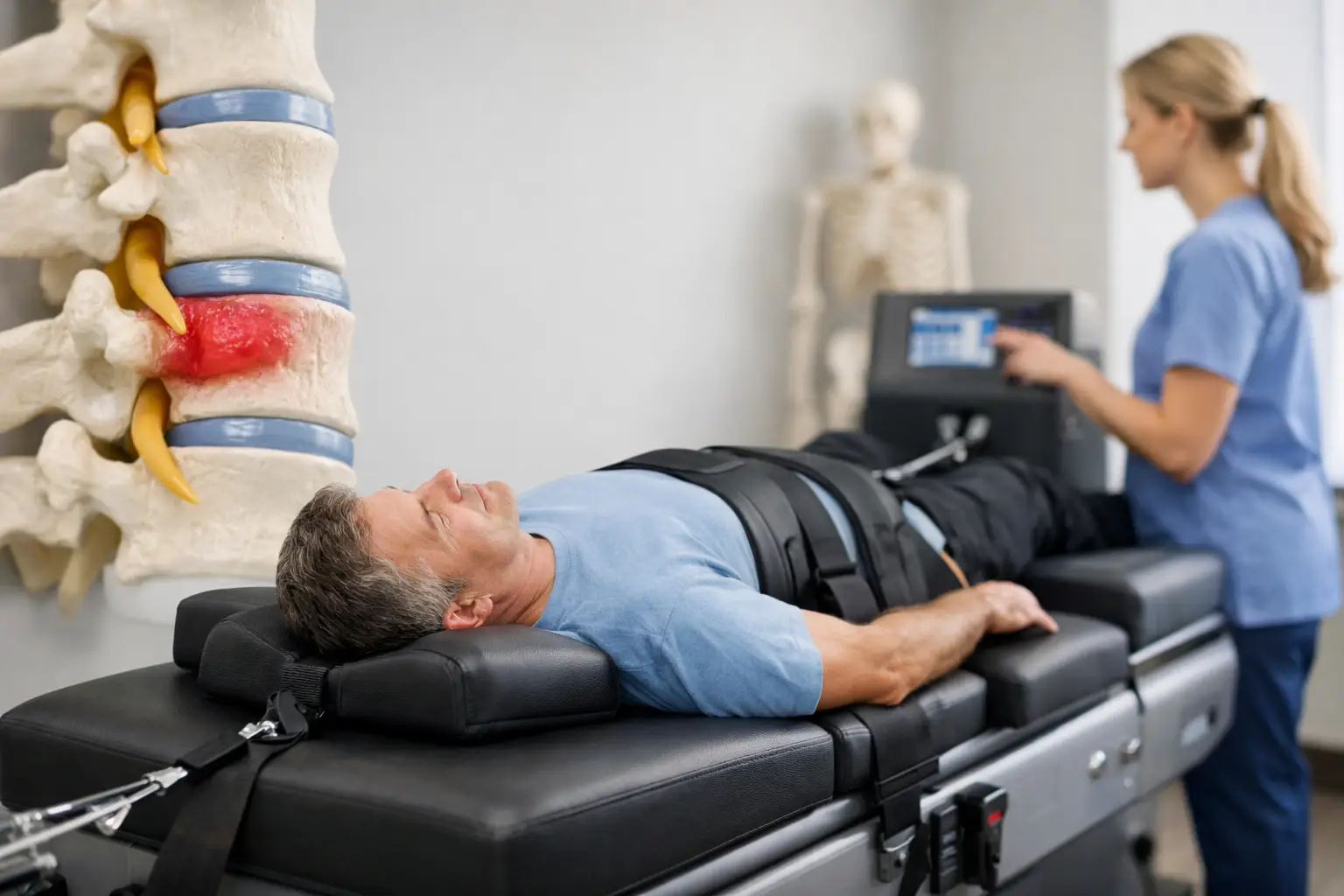
That sharp, radiating pain down the leg often starts with a very small problem in a very important place. When a disc in the spine bulges or herniates, it can irritate nearby nerves and make normal movements like sitting, bending, driving, or even sleeping feel difficult. For many patients, spinal decompression for herniated disc pain offers a non-surgical option to reduce pressure, calm irritated tissues, and help the body move toward recovery.
A herniated disc does not always mean surgery is the next step. In fact, many cases respond well to conservative care when treatment is built around the actual cause of the pain, not just the symptom. That distinction matters, especially for people who want real relief without depending on medication to get through the day.
What happens when a disc herniates
Spinal discs act like cushions between the vertebrae. They help absorb force, support movement, and keep the spine functioning smoothly. A herniated disc happens when the inner material of the disc pushes outward through a weakened area. Sometimes that bulge is mild. Sometimes it is large enough to irritate or compress a nearby nerve.
This is why symptoms can vary so much. One person may feel local low back pain and stiffness. Another may have burning, tingling, numbness, or weakness traveling into the hip, buttock, or leg. In the neck, a herniated disc may send pain or numbness into the shoulder, arm, or hand.
The size of the herniation is only part of the story. The location matters, and so does inflammation. A relatively small disc issue in the wrong spot can create significant symptoms, while a larger bulge elsewhere may be less noticeable. That is one reason a careful evaluation is so important before choosing treatment.
How spinal decompression for herniated disc works
Spinal decompression is a non-invasive treatment designed to gently stretch the spine in a controlled way. The goal is to reduce pressure within the affected spinal segment. When the pressure on the disc and nearby nerve decreases, patients may experience less pain, less radiating discomfort, and improved mobility.
For a herniated disc, the treatment is not about forcefully pushing anything back into place. It is more precise than that. The decompression table applies targeted traction based on the patient’s condition, symptoms, and tolerance. By creating cycles of distraction and relaxation, the treatment can help improve disc mechanics, reduce nerve irritation, and support the movement of fluids and nutrients into the disc.
That matters because discs have limited blood supply. They rely on movement and pressure changes to help exchange nutrients. A disc under constant compression may stay irritated. Controlled decompression can create a better healing environment, especially when paired with therapies that improve stability and movement.
Who may benefit from spinal decompression for herniated disc pain
This treatment is often considered for people dealing with disc-related back or neck pain, sciatica, nerve symptoms, and movement restrictions that have not resolved with rest alone. It can be a good fit for patients who want to avoid injections, minimize medication use, or explore conservative care before considering surgery.
It may be especially helpful when pain worsens with sitting, bending, lifting, or prolonged standing. These patterns can suggest that disc pressure is playing a role. Patients with numbness, tingling, or pain traveling into an arm or leg may also be candidates if the exam supports disc involvement.
That said, spinal decompression is not the right choice for every patient. Some people need a different starting point, especially if symptoms are severe, progressive, or linked to other structural issues. A treatment plan should always be based on the individual, not on a one-size-fits-all protocol.
What treatment usually feels like
Most patients are surprised by how gentle spinal decompression feels. During a session, you are positioned on a specialized table while the spine is guided through controlled traction cycles. Treatment should feel measured and specific, not aggressive.
Some patients notice relief early, particularly if nerve pressure is a major driver of symptoms. Others improve more gradually over several visits as inflammation settles and mobility improves. It depends on how long the problem has been present, the severity of disc involvement, overall conditioning, and how well the spine is supported by surrounding muscles.
Mild soreness can happen at the beginning, especially if the area has been guarded and inflamed for a while. That does not always mean the treatment is a bad fit, but it should be monitored. A well-run plan adjusts based on response rather than pushing through discomfort without reason.
Why decompression works better with rehab
A herniated disc is rarely just a disc problem. In many cases, there are movement faults, muscular imbalances, poor lifting mechanics, postural stress, or instability patterns that keep overloading the same area. If those factors are ignored, pain often returns even when symptoms improve temporarily.
That is why spinal decompression tends to work best as part of a broader treatment strategy. Chiropractic care, soft tissue work, corrective exercise, and functional rehabilitation can all play a role in reducing stress on the injured segment and helping the body move better.
For example, a patient with low back disc pain may need decompression to reduce nerve irritation, but they may also need hip mobility work, core stabilization, and changes in how they sit, bend, or train. Someone with a cervical disc issue may need posture correction, shoulder blade control, and support for chronic tension through the neck and upper back.
At Bell District Spine and Rehab, this combined approach is central to care. The goal is not just to reduce pain during treatment. It is to improve how the spine functions after treatment so patients can keep moving with more confidence.
When results vary
Spinal decompression can be very effective, but it is not magic, and results are not identical for everyone. Some herniated discs respond quickly. Others improve only partially because the condition is more advanced or has been present for a long time.
There are also cases where decompression is helpful for pain relief but not enough on its own to restore full function. If a patient has significant weakness, severe neurological changes, or worsening symptoms despite conservative care, co-management or referral may be appropriate. Good care means knowing when a treatment is the right choice and when it is not.
Patient habits also matter. If someone continues the exact movements and loads that triggered the problem, healing may stall. Sitting for long hours without support, lifting with poor mechanics, skipping rehab, or returning to high-demand activity too quickly can all interfere with progress.
Signs you should get evaluated sooner
Not every episode of back pain needs urgent attention, but some symptoms should not be ignored. Pain that shoots down the leg or arm, numbness that is getting worse, new weakness, or symptoms that persist beyond a brief flare-up deserve a proper evaluation.
Severe pain after lifting, twisting, or an accident can also point to disc involvement. The same is true when back pain is paired with difficulty standing upright, walking comfortably, or finding any position that relieves symptoms. The earlier the condition is identified, the easier it is to build a treatment plan around the actual source of the problem.
What to expect from a personalized plan
A good care plan starts with questions, not assumptions. Your provider should look at where the pain is, whether symptoms travel, which movements increase pressure, and whether the issue appears disc-related, joint-related, muscular, or mixed. That clinical picture helps determine whether spinal decompression makes sense and how it should be used.
If it is recommended, treatment is usually scheduled as a series rather than a one-time visit. That is because disc injuries typically respond to consistent, progressive care. Along the way, the plan may also include hands-on treatment, mobility work, strength-based rehab, and guidance on how to move at work and at home.
This kind of structure matters for busy adults in Cedar Park, Leander, Round Rock, and nearby communities who are trying to stay active, keep working, and avoid a cycle of flare-ups. Relief is important, but so is building a body that can tolerate normal life again.
A herniated disc can make simple tasks feel bigger than they should. The right conservative treatment plan can change that. If spinal decompression is a fit for your condition, it may help create the space your spine needs to calm down, heal, and move forward with less pain.