
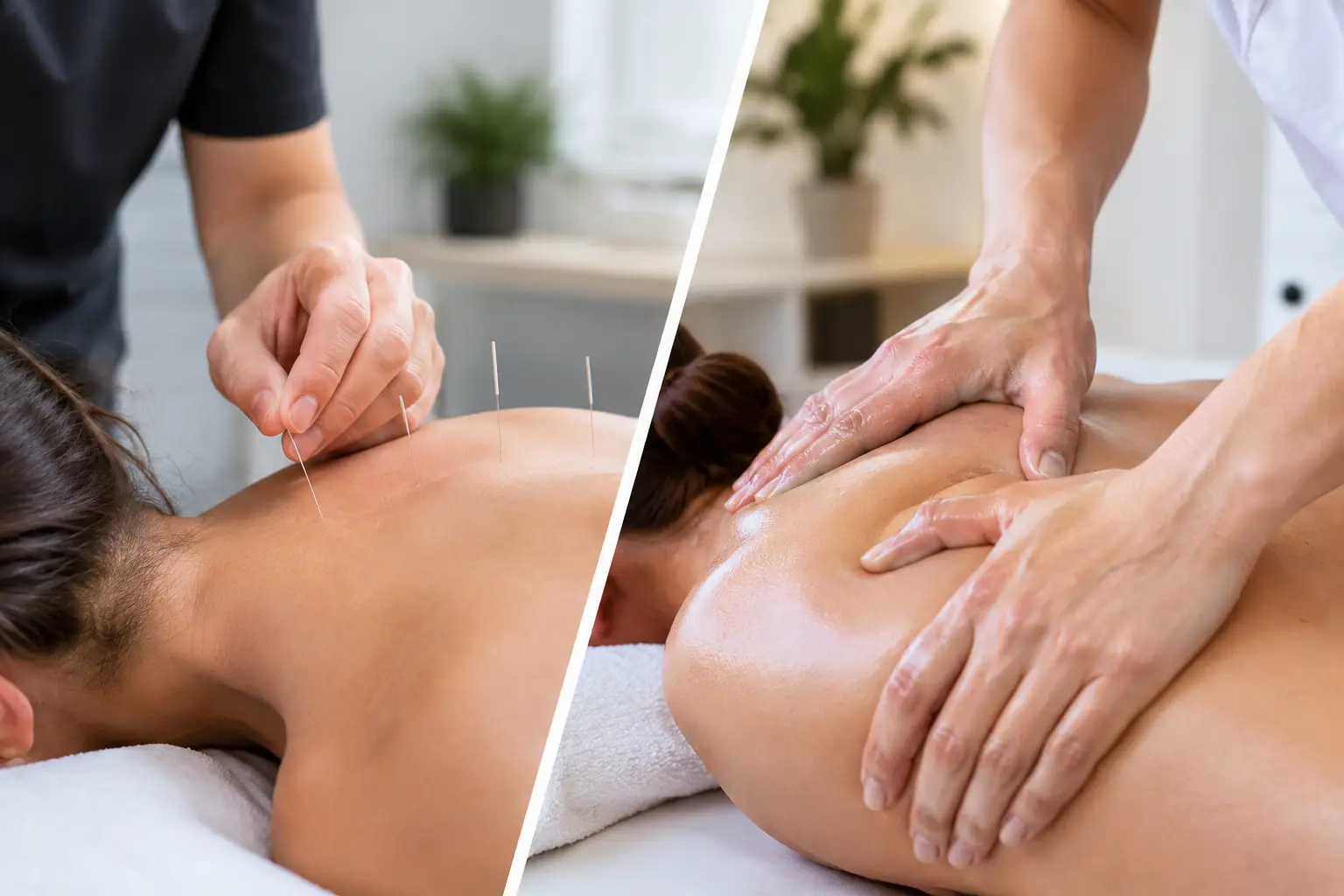
A tight calf that will not loosen, a knot between the shoulder blades, or low back pain that returns after every long workday can make one question feel urgent: what will actually help? When comparing dry needling vs massage therapy, the best choice depends on what is driving your pain, how your body is moving, and what you need to get back to doing.
Both treatments can support pain relief and better mobility without medication or surgery. They work differently, though. Massage therapy uses hands-on pressure to address soft-tissue tension. Functional dry needling uses a very thin needle to target irritated muscle tissue and trigger points. In many cases, these approaches can complement each other rather than compete.
Dry Needling vs Massage Therapy: The Core Difference
Massage therapy works from the outside in. A trained provider uses hands, forearms, or tools to apply pressure and movement to muscles and other soft tissues. The goal may be to improve circulation, reduce general tension, ease soreness, and help tissue move more freely.
Dry needling is more targeted. A clinician inserts a sterile, single-use filament needle into specific tight bands of muscle, often called trigger points. These areas can be sensitive, restrict motion, and sometimes refer pain elsewhere. For example, a trigger point in the gluteal muscles may contribute to pain that travels down the leg, while tension in the neck and upper back may contribute to certain headache patterns.
The word “dry” simply means that no medication is injected. Dry needling is not the same as acupuncture, even though both use thin needles. Functional dry needling is based on a musculoskeletal assessment and is used to address movement-related muscle dysfunction.
When Massage Therapy May Be the Better Fit
Massage can be especially helpful when pain is tied to widespread muscle tension, general stiffness, stress-related guarding, or soreness after physical activity. It is often a comfortable option for people who feel tight across a broad area rather than in one sharply defined spot.
A person who spends hours at a desk, for example, may develop tension across the neck, shoulders, chest, and upper back. Hands-on soft-tissue work can help calm that overall feeling of tightness while making it easier to move comfortably. Athletes may also benefit from massage when they are dealing with post-training soreness or need recovery support between demanding sessions.
Massage is not always enough when a deeper trigger point or a specific movement restriction is maintaining the problem. If relief feels good but lasts only a short time, the underlying issue may involve more than surface-level tension. Poor movement patterns, joint restrictions, weakness, or an irritated muscle can continue to overload the same area.
When Dry Needling May Be the Better Fit
Dry needling may be appropriate when a clinician identifies a specific muscle trigger point that is contributing to pain or restricted movement. It is commonly considered for persistent neck or back tightness, shoulder pain, hip discomfort, muscle strains, certain headache patterns, and sports-related muscle dysfunction.
The treatment is often useful when a muscle seems stuck in a protective, shortened state. During needling, some patients feel a brief twitch response or cramping sensation in the muscle. This can be followed by temporary soreness, much like the soreness after exercise. Many people notice that the treated area feels less guarded and moves more freely afterward, especially when dry needling is paired with corrective exercise and hands-on care.
Dry needling is not a shortcut around rehabilitation. A needle can help reduce a pain-producing muscle response, but it does not automatically correct the reason that muscle became overloaded. If weak hip muscles, limited ankle motion, poor lifting mechanics, or a spinal issue is part of the picture, those factors need attention as well.
Comfort, Sensation, and Recovery Expectations
Massage therapy usually feels relaxing, though deep pressure can be intense over tender tissue. Some people feel immediate ease after a session, while others experience mild tenderness for a day or two. The response varies with the amount of pressure used, the condition being treated, and the person’s sensitivity.
Dry needling is typically a shorter, more focused procedure. The needle itself is very thin, but the muscle response can feel unusual. Patients may notice a quick pinch, a twitch, a dull ache, or a short-lived cramp. Soreness for 24 to 48 hours is common, particularly when treating an area that has been tight or painful for a long time.
Neither treatment should leave you feeling worse for days without explanation. A qualified provider should explain what to expect, check how you respond, and adjust the plan when needed. Drinking water, staying gently active, and following any recommended mobility work can help after either treatment.
Why the Best Plan Often Includes More Than One Therapy
Pain rarely has a single cause. A runner with recurring calf tightness may also have limited ankle mobility. A professional with low back pain may have hip weakness, poor workstation habits, and reduced spinal movement. Treating only the sore muscle can bring temporary relief without creating lasting change.
That is why a complete evaluation matters. At Bell District Spine and Rehab, care can be built around the source of the problem, not just the most painful spot. Depending on your needs, a plan may include chiropractic adjustments, soft-tissue techniques, functional dry needling, movement analysis, therapeutic exercise, spinal decompression, or other non-invasive options.
Massage-like soft-tissue work may be used to reduce broad tension and improve comfort before mobility work. Dry needling may be used to address a stubborn trigger point that limits progress. Rehabilitation then helps the body use that improved movement in daily life, whether that means sitting through work without pain, returning to the gym, or getting back on the field.
Who Should Use Caution With Dry Needling?
Dry needling is not right for everyone. Your provider should review your health history, medications, and symptoms before recommending it. People who take certain blood-thinning medications, have bleeding disorders, are pregnant, have active infections, have significant needle anxiety, or have particular medical conditions may need a different approach or additional clearance.
Massage therapy also requires individualized judgment. Deep pressure may not be appropriate over an acute injury, an area of inflammation, a blood clot risk, a fracture, certain skin conditions, or unexplained swelling. Pain that follows a serious accident, comes with numbness or progressive weakness, or affects bowel or bladder control requires prompt medical attention rather than routine soft-tissue care.
A good treatment recommendation never begins with a one-size-fits-all answer. It begins with a careful assessment of your symptoms, movement, health history, and goals.
How to Decide What You Need
If you want general relaxation or relief from broad muscle tightness, massage therapy may be a sensible starting point. If you have a focused, persistent knot that limits movement or keeps returning despite stretching and massage, dry needling may offer a more precise option.
Still, the question is not simply which treatment feels better. The more useful question is what is keeping the problem active. A thorough musculoskeletal exam can identify whether your pain is primarily muscular or whether joint mechanics, nerve irritation, posture, training load, or weakness are contributing.
The goal is not to chase temporary relief from one tight area. It is to help you move with less pain, build confidence in your body, and return to the activities that matter to you with a plan that fits your condition.